


I remember my first civilian Monday like a scene from a bad dream: traffic instead of formation, timesheets instead of mission briefs, and a nagging chest ache I couldn't name. I thought leaving the military would mean freedom. Instead, I woke up plugged into a new system that felt eerily familiar. Over coffee and canceled meetings I realized: I wasn’t lazy or broken — I was still wired for a different game. This post is my candid, practical attempt to explain why that happens and how I used AI and systems to build a life that finally felt aligned.
1) The Hook — That Feeling Isn’t Your Fault
You’re not lazy.
You’re not broken.
You’re not behind.
I kept telling myself that during my Military Transition, because everything in Civilian Life was trying to prove the opposite. This is anchored to my own timeline from 2026-03-02, but the feeling started way earlier—right when the uniform came off and the “freedom” was supposed to kick in.
My First Monday Out (and the First Punch in the Gut)
First Monday as a civilian: I’m in traffic, staring at brake lights like it’s a new kind of formation. Coffee in one hand, steering wheel in the other, and this weird thought hits me—this is the mission now?
I finally get to the office and I’m answering to a boss who never carried a ruck, never stood a watch, never had to make a call with real weight behind it. But he’s got the title, so I’ve got to nod. I’m “free,” but I’m still asking permission to live my own day.
That’s when the Transition Challenges got real. Not the paperwork. Not the benefits. The quiet pressure in my chest that said: something is off.
The Civilian Matrix: Same Rules, Different Uniform
Here’s the metaphor that finally made it make sense: I wasn’t stuck. I was still plugged into the Civilian Matrix. Same rules, different uniform. In the military, the system is obvious—rank, orders, structure. In civilian work, it’s just re-skinned: meetings, managers, “culture,” and performance reviews.
And if you’re frustrated, that doesn’t mean you’re failing. It usually means you’re misaligned.
“Frustration during transition often signals misalignment, not personal failure.” — Dr. Laura Bennett
What This Is (and What It Isn’t)
This isn’t therapy. It’s not cheerleading. I’m not here to tell you to “be grateful” or “just adjust.” I’m here for a practical reframe: if the system is the problem, then the answer isn’t more willpower—it’s better systems and better tools.

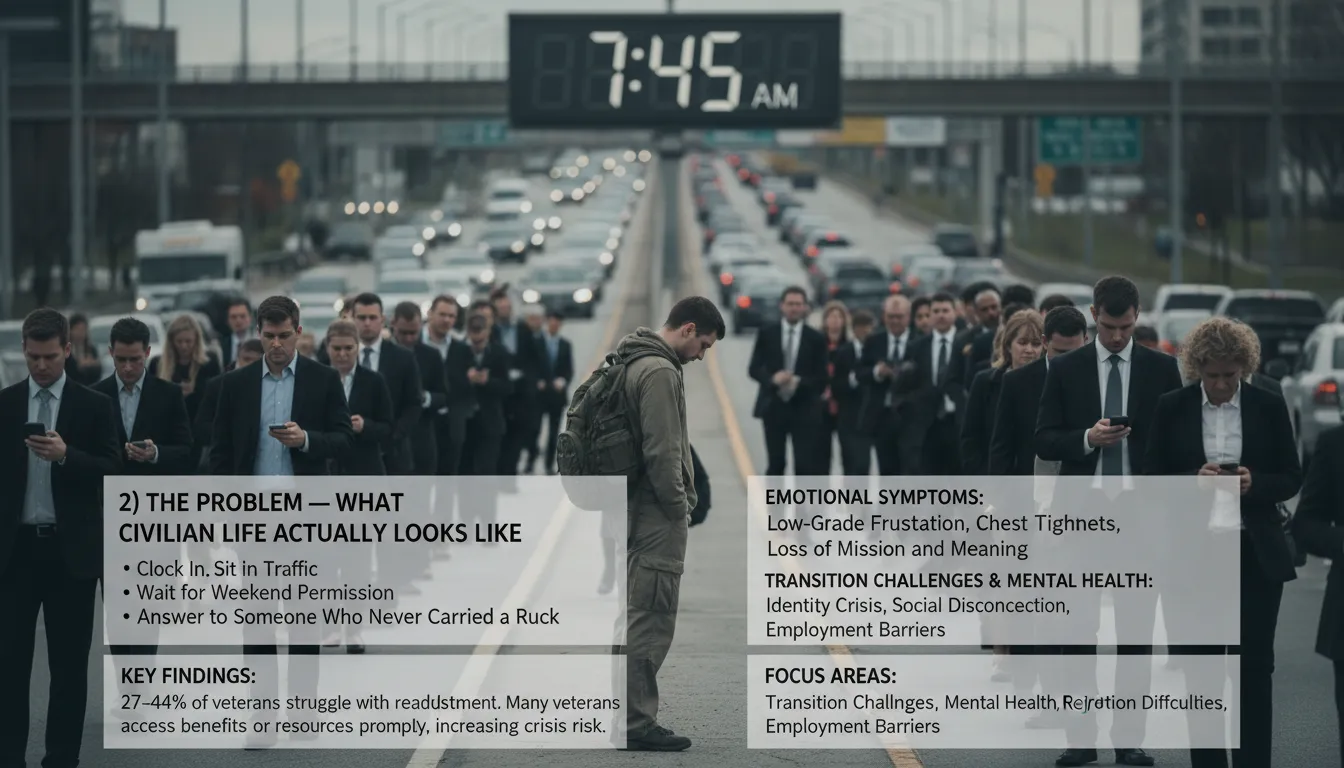
2) The Problem — What Civilian Life Actually Looks Like
Transition Challenges: the “freedom” that feels like a new cage
You leave the military thinking life will finally open up. For me, it didn’t. It just changed uniforms. Instead of a mission brief, it was a calendar invite. Instead of a team that knew my limits, it was coworkers who didn’t get why I move fast and talk straight.
- Clock in.
- Sit in traffic.
- Answer to someone who never carried a ruck.
- Wait two weeks for permission to live on a weekend.
That’s the part nobody puts on the “thank you for your service” poster.
Mental Health: the low-grade pressure you can’t name
The symptoms weren’t dramatic at first. It was low-grade frustration. Chest tightness. A short fuse. A weird emptiness after work because nothing I did felt like it mattered. I went from mission-driven to meeting-driven—impact to inbox.
And if you’re dealing with PTSD Symptoms, this grind can hit harder. The noise, the crowds, the lack of structure—it can turn a normal day into a fight you don’t talk about.
Reintegration Difficulties: losing identity and losing people
Reintegration Difficulties aren’t just paperwork. It’s identity. In service, I knew who I was and where I fit. As a civilian, I felt like a stranger in my own life. Friends moved on. The tribe was gone. I started thinking the problem was me.
Col. James Parker (Ret.): "You don't stop being trained the day you take your uniform off — you just need a new mission framework."
Employment Barriers and VA Benefits: when it feels like begging
Job applications felt like begging for permission to exist. Translate your MOS. Explain gaps. Smile through interviews with people who didn’t understand Service Members at all. I internalized every “no” as proof I failed.
But the data says this struggle is common: 27% to 44% of veterans report difficulty readjusting (Pew Research Center). And about 50% of recently separated veterans don’t connect with resources and VA Benefits for years—often only when they’re in crisis. That delay links to higher risk of homelessness, suicide risk, unemployment, and health issues.
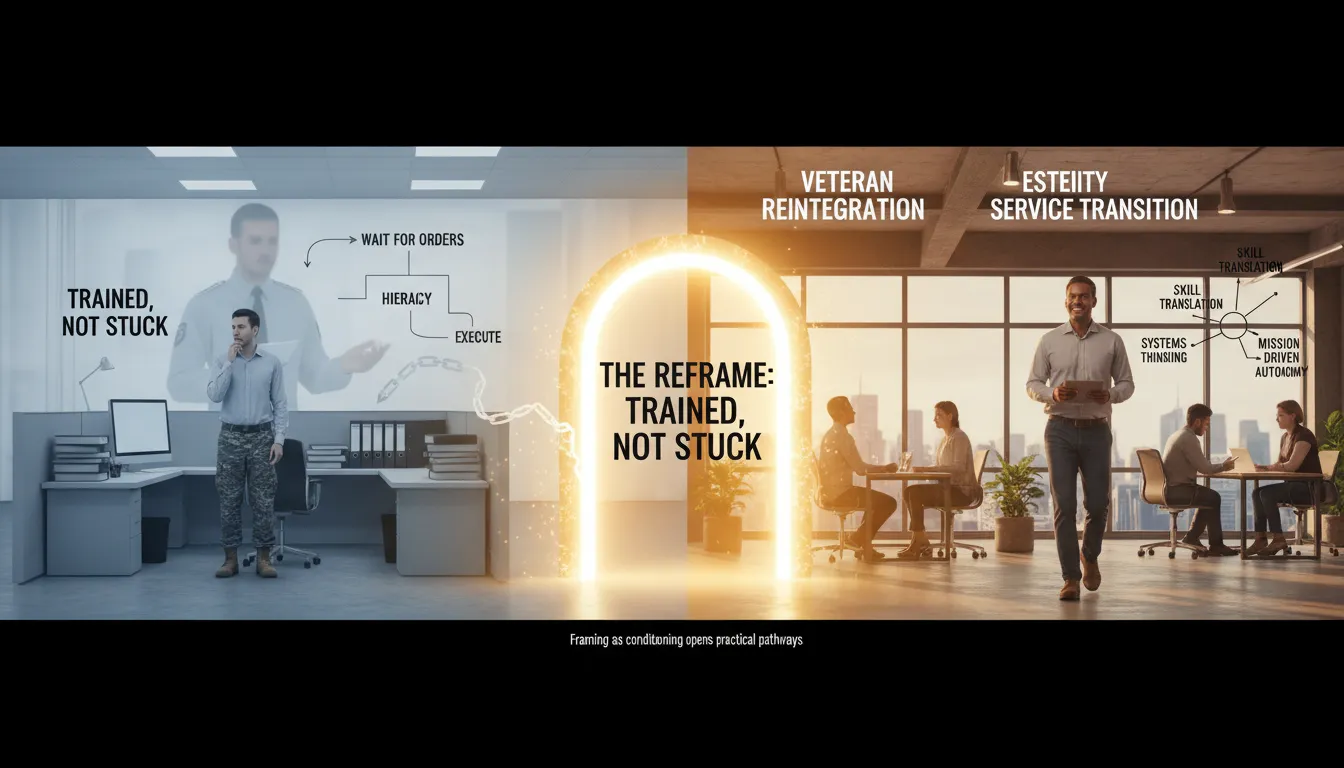
3) The Reframe — You’re Trained, Not Stuck
Veteran Reintegration starts with naming the conditioning
Here’s the truth: You’re not stuck. You’re trained. That hit me hard during my own Service Transition, because I kept calling it an Identity Crisis like something was wrong with me. But it wasn’t “me.” It was the programming.
I was conditioned to:
- Wait for instructions.
- Operate inside hierarchy.
- Execute someone else’s mission.
That training kept me alive and effective. Then I stepped into civilian life and realized the same structure was still there—just with different labels. Mission briefs became meetings. Chain of command became org charts. Accountability became “performance reviews.” The Matrix didn’t disappear. It just upgraded.
Same structure, different uniform: meeting-driven vs mission-driven
This is where a lot of Reintegration Barriers show up. You’re surrounded by people who never lived your pace, your standards, your dark humor. That Cultural Disconnection makes you feel isolated, and isolation makes you think you’re failing. You’re not. You’re just trying to run a mission mindset inside a meeting world.
My micro-habits were sabotaging my freedom
When I started freelancing, I thought I wanted independence. But I kept “waiting for orders” without realizing it. I’d finish a task and then pause—like I was waiting for the next brief. I’d hesitate to pitch clients because nobody “approved” the plan. I’d overbuild outlines and under-send proposals. That’s conditioning, not laziness.
Research backs this up in a simple way: when you frame the problem as conditioning, you can build practical fixes—skill translation and systems work because they match military habits.
Marcus Reed (Veteran Founder): "The discipline that felt like a cage became the scaffolding for my first business — once I reclaimed the mission."
Quick checklist: 3 military habits that translate
- After-action reviews → weekly business review and system tweaks.
- Standard operating procedures → checklists, templates, automation.
- Commander’s intent → clear outcomes so you can execute without permission.
The pivot is simple: your training becomes an asset the moment you choose the mission.
4) The Pivot Moment — Why AI Feels Like the Red Pill
AI for Veterans: The day I noticed it doesn’t care
The pivot hit me on a normal weekday, staring at another “required” process that felt like it was built to slow me down. Then I opened an AI tool and typed a simple request. No rank. No résumé. No gatekeeper.
AI doesn’t care about rank.
AI doesn’t care about credentials.
AI doesn’t care about permission.
It responds to input. You give it direction. It executes.
Skill Translation: Mission command without the bureaucracy
That’s when it clicked: this is military structure without the waiting. I don’t need a committee to approve my next move. I can run a “mission” in plain language and get an output in seconds.
And the research is catching up to what I felt in my gut: AI and digital tools can shorten the time it takes to access resources and help with Skill Translation—turning “squad leader” into “team lead,” “logistics NCO” into “operations coordinator,” and “SOP enforcement” into “process improvement.”
My first real use: outreach in minutes, not hours
The first time I used AI for outreach, I was trying to connect with hiring managers and local business owners. Normally, I’d overthink every line, rewrite it ten times, and still feel behind.
I asked AI to draft three versions: one formal, one direct, one friendly. Then I told it my background and the role I wanted. It gave me clean drafts, subject lines, and follow-up messages. What used to take me an entire evening became a 20-minute block. That wasn’t “magic.” That was leverage.
Transition Navigation: Tools that speed up the path
Now I see Transition Navigation differently. Digital tools and personalized guidance are emerging for employment, VA claims, and healthcare navigation. The win isn’t just information—it’s time. Less searching. Less guessing. Faster next steps.
Dr. Laura Bennett: "When veterans apply trained structure to AI systems, they're effectively outsourcing bureaucracy and reclaiming agency."
Practical lens: a force-multiplier, not a replacement
- My content team (drafts, outlines, edits)
- My research analyst (summaries, comparisons)
- My funnel builder (pages, emails, offers)
- My assistant (checklists, schedules, follow-ups)
But I keep it honest: AI is a force-multiplier. It needs clear orders and ethics. I verify facts, protect personal data, and don’t outsource my judgment.
5) The Process — From Applying to Deploying Systems
My Transition Planning used to look like this: update resume, apply, wait, repeat. It felt like I was doing work, but nothing moved. The “time to benefit” was brutal—weeks of effort before any payoff. Then I flipped it: instead of applying for jobs endlessly, I started deploying systems that produced proof, leads, and momentum while I slept.
Skill Translation That Beats a Resume
One of the biggest Employment Barriers is that civilian hiring managers don’t “see” what we did. So I built systems that show it. AI helped me turn my experience into case studies, short posts, and simple portfolios—real outputs, not just bullet points. That’s Skill Translation with receipts.
My Simple Systems Stack (No Fancy Tools)
- Content automation: AI drafts posts from my notes; I edit and schedule.
- Lead funnel: one page, one offer, one email sequence.
- AI-driven templates: outreach messages, follow-ups, and proposal outlines.
- Scheduling + follow-up flows: reminders so I don’t drop the ball.
- Benefits reminders: calendar nudges for VA claims steps and healthcare paperwork.
The Playbook I Followed
- Identify one repeatable task (posting, outreach, claims tracking).
- Script prompts so the input is consistent.
- Automate with AI + cheap tools (email, calendar, forms).
- Monitor and iterate weekly—small fixes, not big rebuilds.
My first automation backfired. I told AI, “Write outreach messages,” and it produced generic fluff. No replies. The fix was prompt design: I defined the target role, my proof, and the exact ask.
Write 5 outreach emails to [role] at [industry].

Use my proof: [case study]. Ask: 15-min call. Tone: direct, respectful.
Aisha Khan (Transition Coach): "Systems turn mission-attitude into predictable outcomes — that's the moment confidence returns."
Finding Support Faster (Less Friction)
Half of recently separated veterans fail to connect with resources. Systems reduce that friction: one tracker, one reminder flow, one place to store links. Start here: VA.gov and veteran tech programs like VET TEC (when available) to speed up support and training.
6) The Reality Check & Payoff — What Ownership Looks Like
Reality Check: You’re Not Failing, You’re Miscast
I had to admit something that stung: most of my Transition Stress wasn’t because I couldn’t handle civilian life. It was because I was trying to win a game I didn’t design. The rules were hidden, the ladder was crowded, and “do more, wait longer” was the default plan.
When reintegration goes sideways, the cost isn’t just a bad job. It can spiral into unemployment, homelessness, health issues, and for some, suicide risk. Reducing friction matters. That’s why I stopped chasing more credentials and started building systems. Research-backed insight lines up with what I lived: systems-focused approaches reduce transition stress and improve long-term outcomes.
Colonel Andrea Morales (Veteran Advocate): “Freedom is less about leaving a uniform and more about designing systems that let you live on your terms.”
Ownership: Leverage That Scales Beyond Your Time
Ownership isn’t a title. It’s having something that produces value without asking permission. Certifications can help, sure—but they don’t automatically create leverage. A system does.
For me, that meant using AI like a small team: content, research, follow-up, scheduling. Not to “get rich quick,” but to create Economic Impact I could actually control—and a job fit that didn’t drain me.
The Payoff: No Formation, No Approvals
Here’s what “outside the Matrix” started to look like:
- I wake up. No formation. No supervisor mood to manage.
- My content posted overnight.
- Leads came in while I slept.
- Automation handled the follow-up and booked calls.
That’s not hype. It’s architecture. And it creates space for Community Integration and Family Reconnection—because I’m not always “on,” always commuting, always waiting for Friday to breathe.
Small Next Step (This Week)
- Audit one repetitive task you do weekly (emails, scheduling, follow-ups).
- Write the steps in plain language.
- Ask AI to turn it into a checklist and a template.
Prompt: “Turn this task into a repeatable SOP and draft the email templates I need.”
7) Wild Cards — Odd Analogies and Thought Experiments
Civilian Life: Same Matrix, New Firmware
When I hit Civilian Life, I thought I’d escaped the system. But it felt like the same Matrix with new firmware. Different logos. Same rules: wait your turn, ask permission, stay “realistic.” My Transition Challenges weren’t about work ethic—they were about running old code in a new environment. So I started doing one thing that felt almost illegal: I questioned the rules like they were optional.
Thought Experiment: Write Your Life Like a Mission Brief
If your life was a mission brief, what would it say?
- Objective: What are you trying to win this quarter?
- Constraints: Time, money, family, health—what’s real?
- ROE: What will you not do anymore (overtime, toxic bosses, debt)?
This is where Finding Support gets practical: you can hand this “brief” to a mentor, spouse, or buddy and finally talk in a language that makes sense.
Dr. Laura Bennett: "Playful experiments often reveal the fastest path to serious change."
Mini-Quote Swap + Micro-Anecdote
Unexpected stat I keep coming back to: most “good plans” die in the first 72 hours—not from failure, but from overthinking. I watched a vet I’ll call Ramirez prove the opposite. He set up simple text reminders, a booking link, and an auto-reply for lawn care. Nothing fancy. Just enough system to keep moving. That little automation helped him clear a fictional-but-realistic $200/month, and he used it to buy books for school instead of swiping a credit card.
Small Failure (That Taught Me Something)
I tried to automate coffee orders like it was formation: 0600, same drink, no questions. It failed on day two. The app updated, my order vanished, and I stood there like a lost private. Lesson: systems break—so build them simple, and expect friction.
Two Wild Prompts
- Write a 60-second mission statement (read it out loud).
- Map three military skills to freelance gigs: planning → project setup, training → coaching, logistics → ops support.
8) Conclusion & Call to Action — Build the Legion
Veteran Reintegration Starts When You Stop Calling It “Failure”
Let me bring it back to the beginning: you’re not lazy, you’re not broken, you’re not behind. If you feel trapped after service, it’s not because you can’t hack civilian life. It’s because you’re still plugged into a system that rewards waiting, asking, and staying small. The reframe that changed everything for me is simple: you’re not stuck—you’re trained. And the job now is to repurpose that training into systems and ownership, not another chain of approvals.
Transition Navigation: One Week, One System
If you want a clean starting line, do this this week. Pick one task that drains you—job searching, budgeting, emails, workouts, appointments, content, anything. Audit it like you would on deployment: what’s the objective, what’s the friction, what’s the repeatable step? Then sketch a simple mission brief: purpose, steps, tools, and a “done” standard. Finally, run one AI prompt to remove friction. Try this:
Act as my assistant. My goal is [X]. I have [time/resources]. Turn this into a 7-day plan with daily steps, a checklist, and one automation idea.
Then report back. Not with perfection—just with what worked and what didn’t.
Community Integration: Don’t White-Knuckle This Alone
Research keeps pointing to the same thing: community-led, systems-focused approaches reduce friction and improve long-term outcomes. That’s why I’m building this as a Legion, not a lone-wolf brand. Subscribe and follow, and if you’re using VA Benefits, Transition Planning programs, digital tools, or veteran tech initiatives, bring that intel with you. Share the small wins and the faceplants—both count as progress.
“We build freedom together; small systems add up to real independence.” — Colonel Andrea Morales (Veteran Advocate)
This work is messy. It’s imperfect. Some days you’ll feel like you’re back at zero. But you don’t have to do it alone. If this hit home, subscribe and follow. We’re not escaping alone. We’re building a Legion.
