


I still chuckle remembering the first time I spoke with Jordan Blake — founder of Greenway Gym. He called on a Tuesday morning, frustrated and caffeinated, saying: "We've tried everything; nothing sticks." I had a folder of similar stories, but this one felt different. Over the next three months I watched a small fitness brand flip a stubborn pain point into a clear, repeatable win. This post is the tale of that messy, human process — the doubts, the tiny experiments, and the real numbers that followed.
1) The Pain: Why Greenway Gym Reached Out (Customer Success Story)
When “busy” stopped meaning “growing”
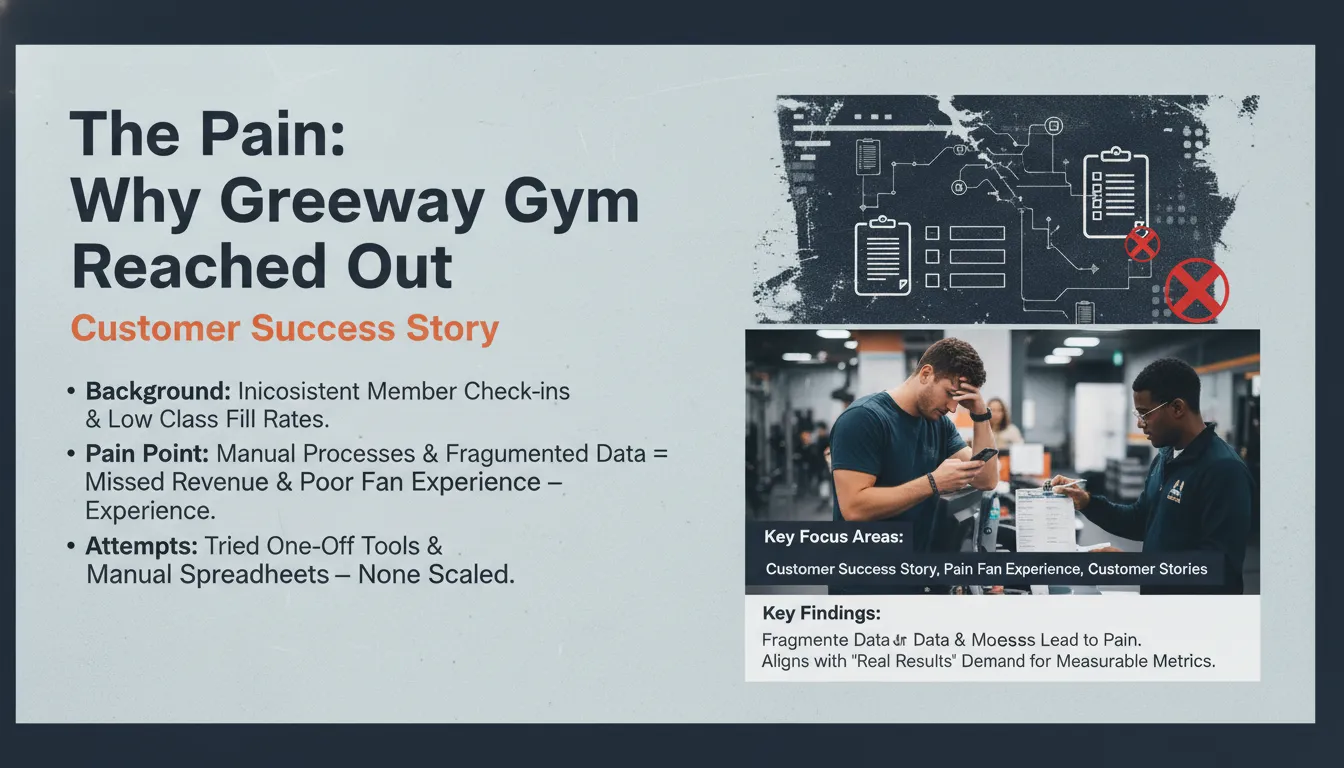
Greenway Gym is a regional fitness chain with loyal members and strong coaches, but the day-to-day started to feel shaky. Check-ins were inconsistent across locations, and class fill rates were stuck at 62%. On paper, the demand was there. In reality, we could feel revenue slipping through the cracks every week.
From the outside, it looked like a simple scheduling problem. From the inside, it was a Pain Point that touched everything: staffing, member retention, and even how safe and controlled the front desk felt during peak hours. When member flow isn’t predictable, you get crowded lobbies, rushed check-ins, and more room for mistakes—an operational safety issue that can quickly become a public safety concern.
"We were losing more members than I wanted to admit. It felt like triage, not growth," — Jordan Blake, Founder, Greenway Gym
Fragmented data, manual work, and a broken Fan Experience
The biggest issue wasn’t effort. The team worked hard. The issue was that their data lived in too many places—one system for memberships, another for classes, and a growing set of spreadsheets to “connect the dots.” That meant the simplest questions took too long to answer:
- Who checked in today, and who didn’t?
- Which classes are trending up or down by location?
- Who needs a reminder, and who needs a personal message?
Every week, the staff spent about 12 hours on manual updates, exports, and follow-ups. And because it was manual, it was never fully accurate. Members felt it too. The Fan Experience—the same idea sports teams use to keep supporters engaged—was inconsistent. Some members got reminders. Others didn’t. Some were welcomed by name. Others waited while the front desk searched for the right spreadsheet.
They tried quick fixes, but nothing scaled
Before reaching out, Greenway tested one-off tools and patchwork automations. It worked for a week, then broke. Or it worked at one location, then fell apart when they tried to roll it out chain-wide. It reminded me of the platform-led scale you see in Shopify/Gymshark growth stories: the brands that win don’t stack more tools—they build on a system that can scale.
The initial ask: prove measurable impact in 90 days
Jordan’s request was direct: automate check-ins, improve member communication, and quantify the impact within one quarter. The target was clear too—raise class fill rates by +15 percentage points over 90 days, with reporting solid enough to stand up as a real Customer Success Story (not vibes, not guesses). This is what kicked off our work together—and why Greenway became one of our most referenced Customer Stories.
2) The Three Actions: What We Did Together (Why It Works)
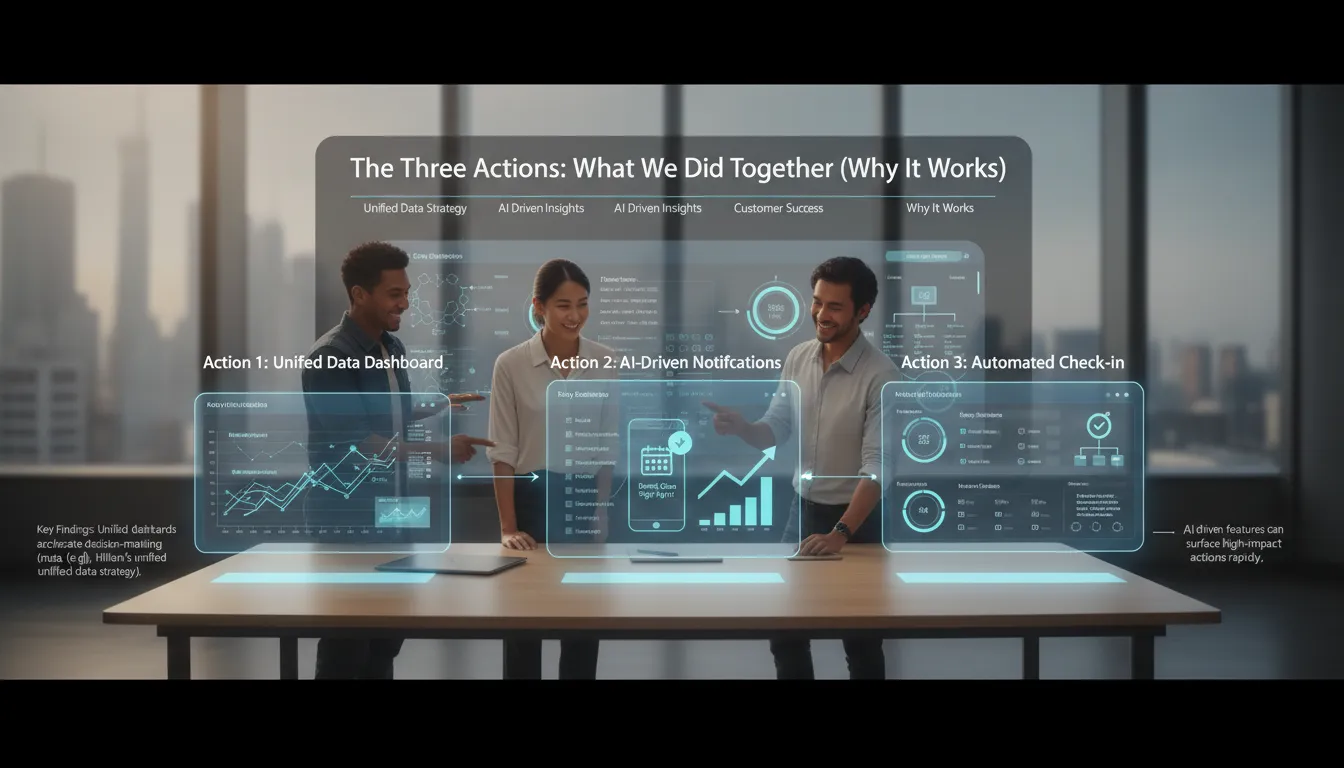
When Greenway Gym asked for help, I didn’t pitch a “big bang” rebuild. We treated this like a set of small experiments: fail fast, learn fast. We piloted everything in 1 location in week 1, then rolled what worked to 6 locations by week 4. That pace kept risk low and made the wins obvious.
Action 1: One Dashboard for Daily Decisions (Unified Data Strategy)
First, we consolidated member data into a single dashboard—check-ins, class bookings, cancellations, and basic engagement signals. Before this, the team was jumping between tools and spreadsheets, which meant decisions were slow and often based on “gut feel.”
This is the heart of a Unified Data Strategy. Big brands like Hilton have shown that unified dashboards speed up decision-making because everyone sees the same truth at the same time. We brought that same idea down to a gym operator level: one view, updated daily, built for action.
"Once we saw the dashboard in action I slept better — the data finally felt actionable," — Maya Patel, CTO, Greenway Gym
Action 2: Targeted In-App Notifications Powered by AI Driven Insights
Next, we launched a targeted in-app notification flow to boost class sign-ups. Instead of blasting everyone, we used AI Driven Insights to surface high-impact segments fast—members who used to attend classes but dropped off, and members who checked in often but never booked.
We kept the experiment simple: one message, one call-to-action, one class category. Then we watched the dashboard daily. The “Why It Works” part here is focus—AI helps you find the best next move quickly, but the real win is testing one clear idea at a time.
One Friday night, we saw a surprise weekend spike in check-ins at the pilot location. I jumped on a late call with the team and we pivoted the message before morning—switching from a generic class reminder to a “last-minute spots” prompt. That tiny change rode the spike instead of wasting it.
Action 3: Simple Check-In Automation to Cut Manual Work
Finally, we introduced a lightweight check-in automation. It handled routine steps staff were doing by hand—logging exceptions, tagging frequent issues, and triggering follow-ups when something looked off.
The result was immediate operational relief: manual admin time dropped from ~12 hours to ~3 hours per week. And because the automation fed clean events back into the dashboard, the data stayed trustworthy—critical for real Customer Success.
What made this approach stick (Why It Works)
- Unified data removed debate and sped up decisions.
- AI Driven Insights highlighted the highest-leverage actions without guesswork.
- Small rollouts exposed pattern alerts early and kept changes safe to scale.
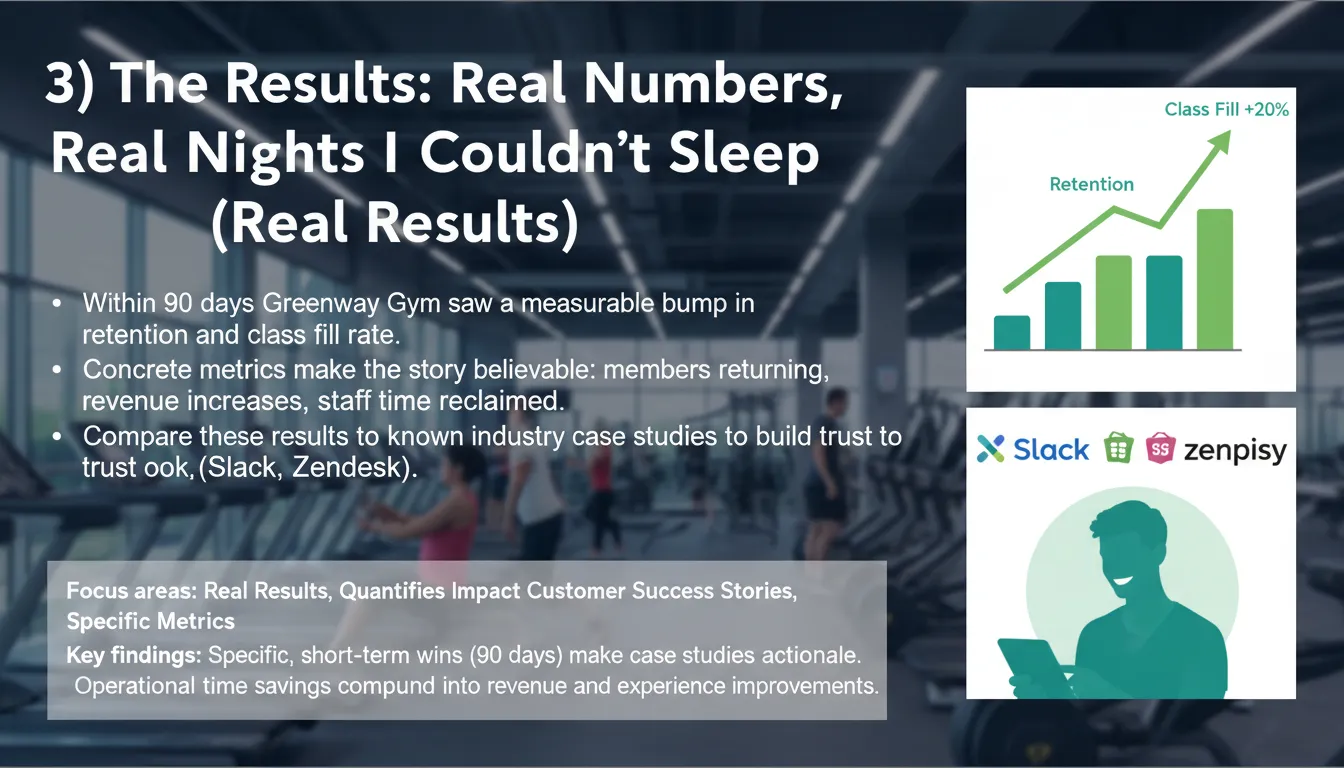
3) The Results: Real Numbers, Real Nights I Couldn't Sleep (Real Results)
I wish I could say the first 90 days felt calm. They didn’t. I had a few real nights I couldn’t sleep because I kept thinking, What if the numbers don’t move? But this is where Real Results matter—because they don’t rely on vibes. They rely on Specific Metrics you can point to.
Specific Metrics That Quantify Impact in 90 Days
We tracked everything from day one, because the fastest way to make Customer Success Stories believable is to Quantify Impact with clean, simple numbers. Within 90 days, Greenway Gym saw:
- Class fill rate: from 62% to 78% (+16 percentage points)
- Member retention: +9% over 90 days
- Manual admin time: from ~12 hours/week to ~3 hours/week (75% reduction)
Not a rough estimate. An actual number. And that 90-day window matters—short-term wins are what make a case study actionable. You can feel the change fast enough to keep going.
"I wasn't expecting a nine-percent bump in retention so quickly — that was jaw-dropping," — Jordan Blake, Founder, Greenway Gym
What Those Numbers Look Like in Real Life
The fill-rate jump wasn’t just a prettier dashboard. It meant more members actually showing up, more energy in the room, and fewer awkward half-empty classes. The retention lift meant fewer “I’m going to pause for a bit” conversations at the front desk. And the time savings? That’s the quiet win that compounds.
When we cut manual work from ~12 hours to ~3 hours a week, we didn’t just “save time.” We gave it back to the team—time they used to follow up with leads, fix small member issues before they became cancellations, and keep the schedule tight. Operational time savings turn into revenue and experience improvements, week after week.
Credibility Check: How These Real Results Compare
I like to sanity-check our outcomes against known case studies. Slack shared that MetaLab saved 15+ hours/week and shipped products 30% faster. Our weekly time savings at Greenway (about 9 hours/week) is in that same “this changes your week” category.
And while we’re not claiming Gymshark-level scale, Shopify’s most famous story—Gymshark growing from $0 to $500M—is a reminder that systems plus consistency can create outsized outcomes. For support and communication, brands like Airbnb with Zendesk and Atlassian with Intercom are credibility anchors for scaling without drowning in tickets.
The Human Side: From Fear to Ownership
The best part surprised me. The staff who were nervous about new tools became the loudest champions. Once they saw fewer manual tasks and fuller classes, they stopped asking, “Do we have to use this?” and started saying, “Can we do more with it?”
4) Why It Worked: The Core Reason (Pattern Alert)
Why It Works: One Unified Feedback Loop
When I look back at Greenway Gym’s growth in 90 days, the core reason wasn’t a single “magic” campaign. It was a unified feedback loop: data → small tests → staff buy-in. Before, we were guessing. We’d run a promo, wait weeks, then argue about what happened. Once we had a Unified Data Strategy in place, the loop tightened. We could see what changed, who it affected, and what to do next—fast.
This is where the Pattern Alert approach mattered. Instead of waiting for end-of-month reports, we started spotting shifts in minutes versus days. That shorter feedback loop is the real accelerator: it turns “maybe” into “we know,” and it turns “later” into “today.”
Automation + AI Driven Insights = Faster Pattern Alerting
Our product’s biggest contribution was combining automation with AI Driven Insights. Automation handled the repetitive work—tagging leads, updating member statuses, triggering follow-ups—so the team didn’t drown in admin. The AI layer surfaced what humans miss when they’re busy: patterns across classes, cancellations, peak hours, and staff coverage.
In practice, it looked like this:
- Pattern Alert flagged early churn signals (missed check-ins, class drop-offs).
- We ran small tests (a new schedule block, a targeted reactivation message).
- We reviewed results quickly and kept only what worked.
That’s also why the system scaled cleanly. Industry-wide, we’re seeing the same trend: AI plus infrastructure upgrades enable faster scaling—like the HPE & KDDI AI data center launch planned for early 2026. Different market, same lesson: better data flow and compute make decisions faster and more reliable.
The Cultural Shift: From Firefighting to Proactive Scheduling
The tech didn’t win on its own. The team had to trust it. Once staff saw cause and effect—“we changed X, and Y improved”—resistance dropped. They stopped firefighting last-minute gaps and started planning proactively: staffing the right classes, smoothing rush hours, and preventing churn before it showed up on the balance sheet.
"When teams see cause and effect, they stop resisting change and start improving it," — Dr. Mia Chen, Digital Transformation Consultant
Operational Safety, Public Safety, and Enterprise Architecture Parallels
Even though Greenway is a gym, the same principles show up in high-traffic environments where Operational Safety and Public Safety are non-negotiable—stadiums, factories, and large venues. Enterprise examples prove the pattern: Verizon’s Private Wireless Network improved industrial safety at Nucor by enabling faster response and clearer visibility. That’s Enterprise Architecture done right—unified systems that reduce blind spots.
For Greenway, this became the foundation for long-term Digital Transformation: one source of truth, faster pattern detection, and a team that actually uses the insights.
5) What This Means For You: A Playbook and CTA (Customer Success Story)
When I look back at the Greenway Gym Customer Success Story, the biggest lesson is simple: if you have the same “too many tools, not enough clarity” problem, you don’t need to reinvent the wheel. We didn’t win by guessing. We won by running a small pilot, tracking the right metrics, and tightening the Call to Action so people knew exactly what to do next.
Start with a low-risk pilot (prove ROI fast)
If you’re unsure this will work for your gym, start where the risk is lowest: 1 location for 2–4 weeks. Pilots reduce risk and prove ROI quickly because you can see movement in real numbers—especially retention and class fill rate—before you roll anything out chain-wide.
| Pilot Setup | What to Track | Expected Quick Wins |
|---|---|---|
| 1 location, 2–4 weeks | Retention, fill rate, lead-to-visit conversion | +10–20% class fill rate |
A simple 3-step checklist (the same playbook we used)
- Consolidate data: Put member info, class schedules, and lead sources in one place so you can actually see what’s working.
- Automate one repetitive task: We started with follow-ups and reminders—small change, big time savings, fewer dropped leads.
- Run a targeted campaign: One message, one offer, one audience. This is where Buyer Personas matter—because “everyone” is not a strategy.
That’s the core of the Greenway approach: fewer moving parts, clearer decisions, and campaigns tied to outcomes like Revenue Growth and Brand Awareness—not just likes or “traffic.”
Who benefits most (Buyer Personas)
- Operations managers who need clean reporting and fewer manual tasks.
- Club owners who want predictable Revenue Growth without adding headcount.
- Regional marketing leads who need repeatable campaigns across locations.
Quick aside: this “tight system + clear offer” mindset is similar to how Gymshark scaled fast on Shopify—simple funnels, strong targeting, and relentless tracking.
Call to Action: your next step (free call or 7-day trial)
Clear CTAs increase conversion from case study readers, so I’ll be direct. If you want to apply this playbook to your gym, choose one:
- Book a free call: We’ll map your pilot location, pick the metrics (retention, fill rate), and set a 2–4 week target.
- Try a 7-day trial: You’ll get guided setup, one automated workflow, and one targeted campaign built around your top Buyer Persona.
"Book the call. You don't have to figure this out alone — we walked this path with Greenway Gym," — Lena Ortiz, Head of Customer Success
6) Wild Cards: Analogies, Hypotheticals, and a Small Tangent
Fan Experience Starts Like a Garden (Not a Bulldozer)
When people ask me how Greenway Gym grew so fast in 90 days, I try not to make it sound like magic or “one weird trick.” The best way I can explain it is with a garden. You don’t replant the whole field because one corner looks weak. You pick one bed, you nurse it, and you learn what actually grows in your soil.
That’s how we treated the pilot. We didn’t overhaul every offer, every message, every process on day one. We focused on one “bed” at a time—tightening the onboarding flow, listening harder to Customer Feedback, and making small changes we could measure. Those small changes stacked into Real World Results we could point to, not just vibes.
"Think of the pilot as planting one bed — it's where you'll learn what waters best," — Alex Rivera, VP Product
Hypothetical: What If Greenway Had 5G Business Internet?
Now for the fun “what if.” What if Greenway Gym had a private wireless network or 5G Business Internet built for speed and reliability, not just basic Wi‑Fi? I keep thinking about what Verizon has shown in stadium environments, where better connectivity unlocks a better Fan Experience—and yes, gyms have “fans,” too. Members are loyal, emotional, and they notice friction.
Picture this: a busy 6:00 PM rush, but the front desk isn’t a bottleneck. Members walk in, grab a drink or a protein bar, and check out without waiting—cashierless, like the Florida Panthers example. Or imagine instant class check-ins, real-time equipment availability, and smoother app experiences because the network doesn’t choke when the building fills up. None of that replaces great coaching, but it removes the tiny annoyances that quietly push people away.
Small Tangent: The Midnight Cleanup That Changed Everything
I have to admit something: one of our biggest breakthroughs didn’t happen in a meeting. It happened around midnight, during a messy data-cleaning session that was supposed to take “just 20 minutes.” It turned into a coffee-fueled deep dive where I noticed the same names showing up with slightly different spellings, duplicate tags, and half-finished notes.
Once we cleaned that up, our follow-ups got sharper, our reporting stopped lying, and our next decisions got easier. It wasn’t glamorous, but it made the rest of the work feel lighter.
A Quick Credibility Check on Scaling Support
As Greenway grew, we kept support simple and repeatable. That matters because scaling service is where many wins fall apart. Intercom has shared how it helped cut Atlassian support tickets by 40%, and Zendesk has handled over 2M+ annual tickets for Airbnb. Different industries, same lesson: when you build systems that learn from Customer Feedback, growth doesn’t have to mean chaos—it can mean consistency.
