


I used to believe online business looked like sunset laptop shots and overnight wins. After years of spinning up funnels and changing niches, I burned out. One rainy Tuesday I ditched the hype and focused on what compounds. This post is how I actually run my business — dashboards, checklists, quiet wins — and why systems beat trends.
1) The Myth — Beach Laptops vs. Real Work (Hook + Problem)
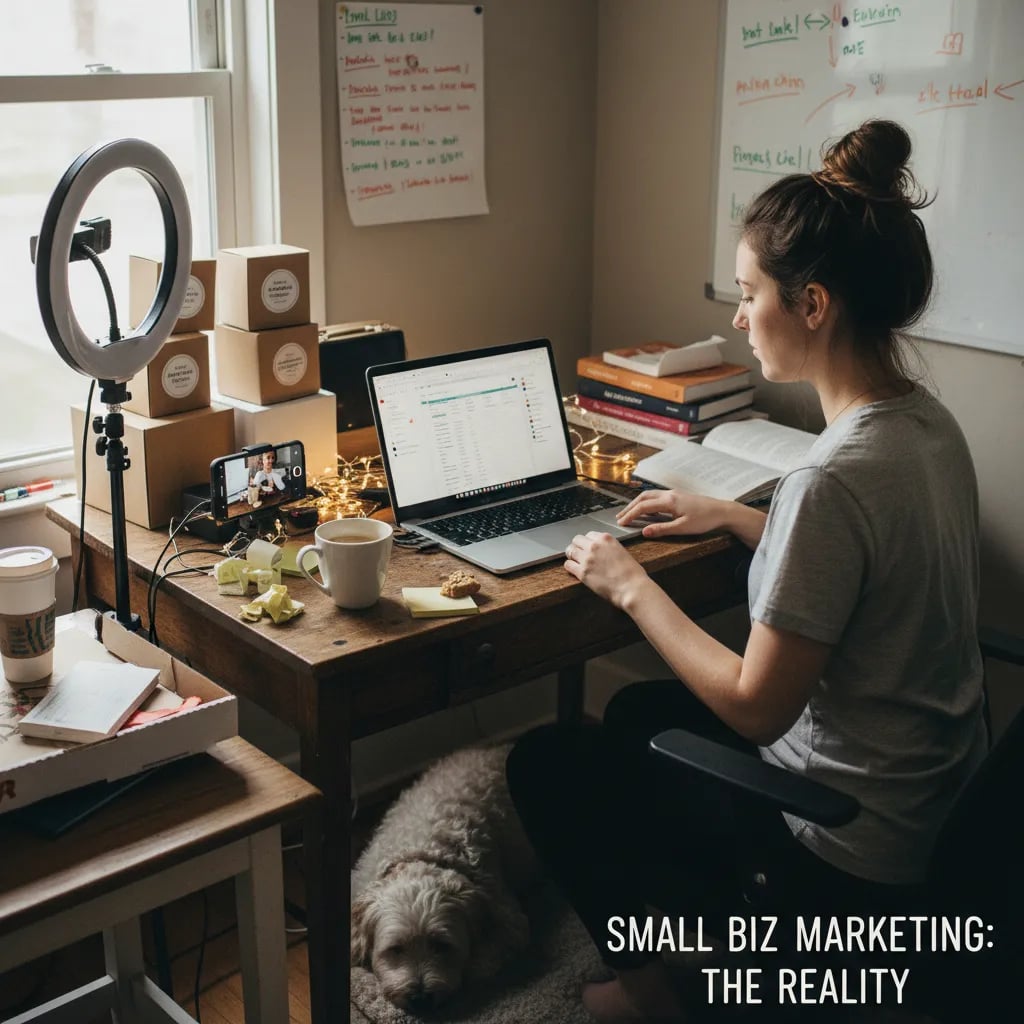
The “Digital Marketing Industry” fantasy vs. my real screen
Most people think online income looks like beach laptops and Lambos. Mine looks like dashboards, checklists, and a calendar that tells me what to do when I don’t feel like doing it. It’s quiet. It’s not sexy. And it’s the only reason my Small Business Marketing doesn’t fall apart every time life gets busy.
I learned that the hard way during my first course launch. I had the screenshots. The “coming soon” posts. The hype captions. I even made a little countdown graphic like I was a real internet person. Then launch day came… and nothing happened. Zero customers. Not “low sales.” Not “a few refunds.” Just silence.
Lots of activity, no traction (and why it keeps happening)
That moment showed me something I didn’t want to admit: I wasn’t building an offer people could find and trust. I was performing. And in the real world, performance doesn’t pay bills—process does.
Here’s the pattern I see with beginners (and yes, I did it too): every 30–60 days, they restart.
- New niche
- New funnel
- New tool
- New “content strategy”
Same results. Zero traction. Not because they’re lazy, but because nothing has time to compound.
Online Presence Importance: people research before they buy
This is where the internet gets real. In my world, prospects don’t wake up and “feel inspired” to purchase. They research. 96% of prospects research online before contacting sales. That means your content, reviews, and pages are doing the selling long before you ever get a DM.
And it’s not just online businesses. 97% of users check a business’s online presence before visiting. Local SEO and basic visibility can decide whether someone walks into your shop—or drives past it. That’s why I care so much about Online Presence Importance, even when it feels boring.
Intent Driven Searches beat viral posts
Trends used to feel exciting. I’d chase whatever was popping off, hoping it would “unlock” growth. All it unlocked was chaos… and a messy Trello board with 48 half-finished ideas.
Now I build around Intent Driven Searches—the kind of searches people make when they already want help and are comparing options. Those are the visitors who read, click, and book calls without needing to be convinced.
"I used to post wildly and panic—until the numbers showed me otherwise." — Alex Monroe
Motivation wasn’t my problem. Process was.
I didn’t need more hype. I needed a repeatable checklist I could follow on good days and bad days. Mine is simple:
- Check traffic + leads (10 minutes)
- Publish one piece of helpful content
- Follow up with warm leads
- Update one page that supports search visibility
That’s the work. Not beach vibes—just systems that stack wins.

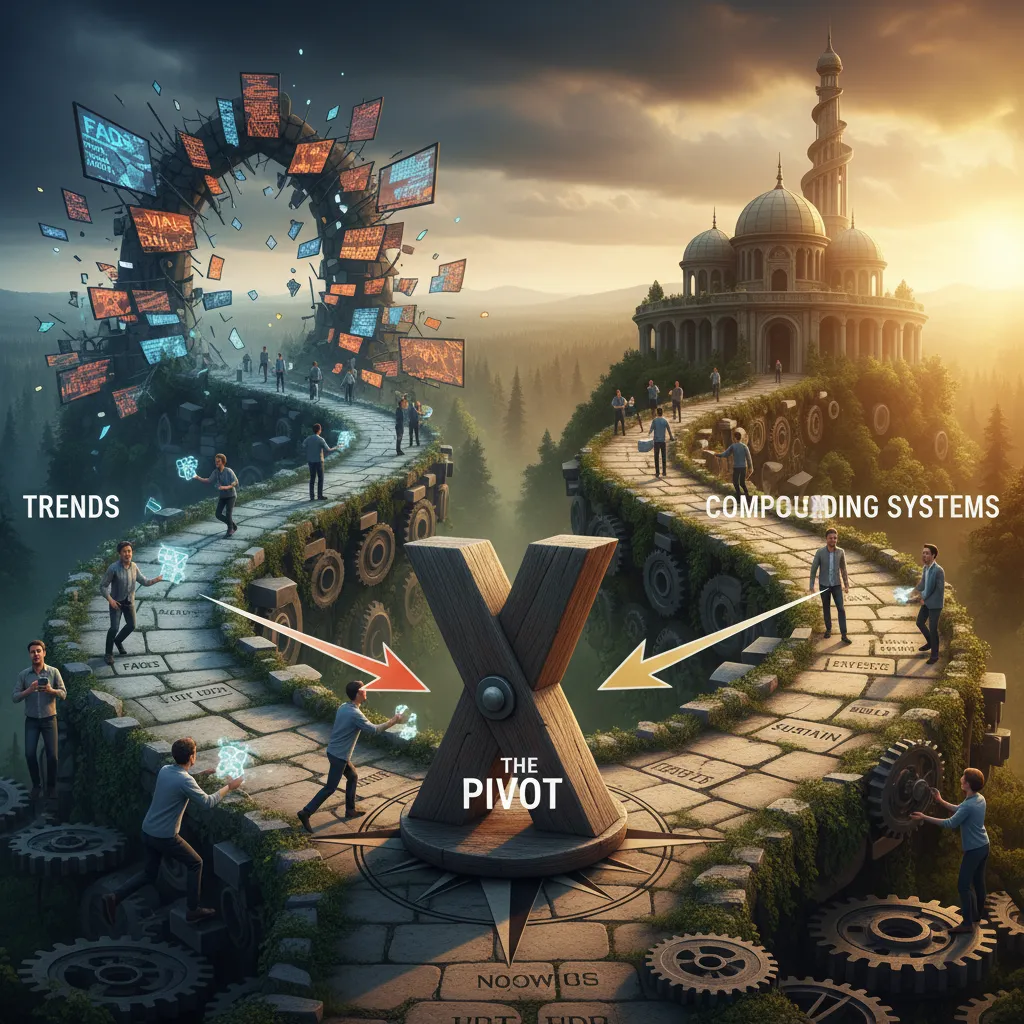
2) The Pivot — From Trends to Compounding Systems
Digital Marketing Trends vs. What Actually Builds Momentum
For a long time, my marketing plan was basically a mood. I’d wake up, check Digital Marketing Trends, and ask the same question every day: “What’s trending?” If a platform update dropped, I reacted. If a new content format popped off, I copied it. If someone posted fresh Marketing Statistics 2026, I treated it like a prophecy.
But my results were always the same: a spike, then silence. A “good week,” then a reset. I wasn’t building anything. I was just chasing noise.
The Coffee Moment (and the Three Schedulers I Deleted)
The pivot happened on a random morning over coffee. I had three different schedulers open—three. One for short videos, one for threads, one for “repurposing.” My calendar looked full, but my pipeline looked empty.
I stared at the tabs and realized I was managing tools, not building a system. So I did something that felt reckless: I deleted them. Not because scheduling is bad, but because I was using it to hide from the real work—consistency and follow-up.
That’s when the question changed:
Instead of “What’s trending?” I started asking “What compounds?”
SEO Effectiveness Tactics: Boring, Repeatable, Profitable
Once I made that shift, my priorities got simple. I stopped planning constant launches and started iterating one offer and one message. I leaned into SEO Effectiveness Tactics that don’t care about the algorithm’s mood—like writing for Long Tail Keywords that match real buyer intent.
Trends can bring attention, but compounding brings predictability. And the market is rewarding predictability right now. Global digital advertising spend is projected to pass roughly $740–800B by 2026, which tells me one thing: brands are investing more, not gambling less. The winners won’t be the loudest. They’ll be the most consistent.
Fewer Launches, More Iteration
My calendar used to be packed with “big pushes.” Now it’s mostly small improvements:
- Update one landing page headline
- Rewrite one email sequence subject line
- Publish one search-focused post targeting a specific problem
- Improve one CTA based on real replies
And yes, I still test trends—but only as experiments, not strategies. If it works, I fold it into the system. If it doesn’t, I move on without burning the whole plan down.
Systems Stack Like Compound Interest (Even When They’re Boring)
Here’s the wild part: systems are not exciting. They’re checklists. They’re dashboards. They’re doing the same thing when nobody claps. But they stack.
"Small, consistent bets beat big, sporadic swings." — Alex Monroe
Even social platforms are signaling this. U.S. social commerce sales are expected to pass $100B in 2026, and that kind of growth doesn’t come from one-off virality. It comes from steady attention, steady trust, and steady follow-through.
3) The System — One Offer, One Traffic System, One Content Rhythm
My marketing doesn’t look like “big launches.” It looks like me opening a dashboard, checking what moved, and running the same simple playbook again. I used to restart every time things got quiet. New idea. New funnel. New tool. Same stress. Now I keep one system running until it compounds.
One Core Offer (Less Choice, More Sales)
I sell one core offer. Not because I’m boring—because it removes friction. When someone asks, “What do you do?” I don’t give them a menu. I give them one clear outcome and one clear next step. Sales conversations get shorter, and follow-up gets easier because everything points to the same thing.
"A single focused offer is a compass in a crowded market." — Alex Monroe
When I narrowed down, my content got sharper too. Every post became a small proof point for the same promise.
One Traffic System: Organic Search Traffic + Short Form Videos + One Ad Set
I don’t chase every platform. I run a simple funnel that mixes three inputs:
- Organic Search Traffic from long-tail keywords (the “how do I…” searches). Organic search drives a meaningful share of eCommerce orders—around 23.6%—so I treat SEO like an asset, not a trend.
- Short Form Videos that turn one idea into quick demos. These don’t need to go viral. They just need to reach the right people and push them to my link.
- One small paid ad set that retargets visitors. I don’t scale ads until the organic side is steady.
My SEO posts are built around one question each, with a simple structure: problem, steps, example, and a call to action. I keep a tiny checklist in my notes app:
Keyword → Intent → Outline → Publish → Internal link → Update in 30 days
One Content Rhythm: Educate, Demonstrate, Invite
Every day, I run a three-part loop:
- Educate: teach one small concept in plain language.
- Demonstrate: show proof (a screenshot, a result, a behind-the-scenes step).
- Invite: one clear action—reply, click, or join the list.
Follow-Up Flow: Email Marketing Conversions + Human Nudges
When someone opts in, they enter an automated email sequence. Email still converts when it’s consistent—campaigns can lift eCommerce conversions by about 20%—so I treat it like my main relationship channel. My goal is simple: steady Email Marketing Conversions, not flashy open rates.
Then I add one personal touch: if someone replies or watches multiple pages, I send a short DM: “Saw you checking this out—want the quick version?” Consistent, not creepy.
Mobile Site Traffic: I Build for the Phone First
Most of my visitors are on a phone. Globally, smartphones generate about 78% of retail Mobile Site Traffic, so I track mobile scroll depth, button taps, and drop-off points. If the page is slow or the CTA is buried, nothing else matters.
4) The Proof — Metrics That Turned 'Random' Into Predictable
I didn’t “feel” my way into consistency. I watched it happen in my dashboards. For months, my results looked like a slot machine: one good week, then silence. Then I built one offer, one traffic system, one daily content framework, and one follow-up flow. Slowly, the line stopped bouncing and started climbing.
"Traffic became predictable; sales stopped feeling random." — Alex Monroe
Why the market tailwinds matter (Global Ad Spend + Ecommerce Sales Projections)
I’m not building in a small pond. Ecommerce Sales Projections put global retail eCommerce at $7.95 trillion by 2027. And Global Ad Spend (digital) is projected around $740–$800 billion by 2026. That tells me two things: attention is expensive, and the businesses that win are the ones with systems that can measure and improve.
The three numbers that changed everything (SEO Effectiveness Tactics + email)
I stopped tracking vanity metrics and focused on the few that actually move revenue. My “proof” stack was simple:
- Search referrals: Organic search drives about 23.6% of eCommerce orders. So I doubled down on SEO Effectiveness Tactics like updating old posts, tightening product page titles, and building internal links to my core offer.
- Email conversion uplift: Email campaigns can increase eCommerce conversions by about 20%. My goal wasn’t more subscribers—it was more buyers per send.
- Repeat purchase rate: This is where “random” finally dies. When repeat purchases rise, you’re not starting from zero every week.
Small case study: from sporadic $500 weeks to consistent $2k+ weeks
Here’s what it looked like in real life. Before systems, I’d hit a $500 week, get excited, then disappear because I didn’t know what caused it. After I ran the same process daily for four months, I started seeing consistent $2k+ weeks. Not because I found a magic post—because the inputs became repeatable.
| Timeframe | What I did | What changed |
|---|---|---|
| Month 1–2 | Publish + optimize, capture emails, follow-up flow | Search traffic steadied; more replies |
| Month 3–4 | Same system, tighter offers, clearer CTAs | Sales became regular; $2k+ weeks appeared |
Social Commerce Growth made multi-channel non-negotiable
Social Commerce Growth is real: U.S. social commerce sales are expected to pass $100B in 2026. Plus, 78% of retail site traffic comes from smartphones globally. So I treated short-form video as a traffic assist, not a personality contest. It helped that 91% of businesses use video, and 59.4% plan to increase influencer budgets—meaning the platforms are only getting louder.
Why it wasn’t overnight (the slope beats the spike)
Compounding is boring at first. Week one looks the same as week two. But the slope matters more than the spike. Once search referrals, email conversion uplift, and repeat purchases all tick up together, the business stops feeling like luck and starts feeling like math.
5) The Payoff — How Systems Win (CTA + Wild Cards)
I used to think Small Business Marketing was about big moments: a viral post, a lucky referral, a “perfect” launch. But the real payoff came when I stopped chasing moments and started building systems I could repeat on tired days.
"If you want hype, scroll. If you want proof, build systems." — Alex Monroe
If You Want Hype, Scroll TikTok. If You Want Proof, Build Systems.
Here’s my direct pitch, the same one I tell myself when I feel distracted: if you want hype, scroll TikTok. If you want proof, build systems. My results don’t come from genius. They come from checklists, dashboards, and follow-up that runs even when I’m busy.
This is what Human First Media looks like in practice: I show up like a person, talk to real people, and let the system do the heavy lifting after the first touch.
Follow Along: I Share Dashboards, Templates, and Failures
I’m not hiding the messy parts. I document everything: what I track, what I change, what flops, and what quietly works. If you’re building Network Effects Marketing (where each customer, review, and share makes the next one easier), you need proof you can copy—not motivation you can’t measure.
- Dashboards (traffic, leads, replies, sales)
- Templates (content, outreach, email follow-up)
- Failures (because they’re data, not drama)
Wild Card #1: The 5% Weekly Compound Thought Experiment
What if you improved one part of your system by 5% per week for six months? That’s not a rebrand. That’s one better headline, one tighter offer, one extra review, one clearer email.
| Time | Simple Projection |
|---|---|
| Week 0 | 1.00x |
| Week 12 | ~1.80x |
| Week 24 (~6 months) | ~3.23x |
That’s the compounding effect beginners miss. And it pairs perfectly with Local SEO Impact: local search behavior rewards consistency. When people repeatedly find accurate info, reviews, and helpful pages, you become the obvious choice. (For stats, see sources like Google/Think with Google and BrightLocal; local searches are tied to ~1.5 billion physical visits monthly.)
Wild Card #2: Orchard vs. Market
Building marketing systems is like planting an orchard, not buying fruit at a market. Buying fruit is fast (ads, trends, hacks). Planting takes time (content, email, reviews, local pages). But once the trees mature, you don’t “launch” fruit—you harvest.
Try This Small Experiment (Imperfect Is Fine)
- Create one offer you can explain in one sentence.
- Write a 7-day email nurture sequence that helps, not hypes.
Keep it simple. Systems are iterative. Launch ugly, measure honestly, and improve weekly.

6) Appendix — Sources, Quick Templates, and Honest Confessions
Sources I Actually Used (Digital Marketing Industry + Global Digital Advertising)
I don’t want this to read like vibes. I want it to read like proof. If you want to dig into the same numbers I use when I plan content and offers in the Digital Marketing Industry, here are the sources I keep bookmarked for stats, trend checks, and sanity checks around Global Digital Advertising and buyer behavior.
- EntrepreneurHQ — Digital marketing industry statistics
- Cool Nerds Marketing — Digital marketing trends 2026
- SEO.com — Digital marketing statistics
- SEOProfy — Ecommerce marketing statistics
- Wix — Small business marketing statistics
- Google Think — Consumer insights and trends
- PwC — AI and analytics predictions
For your own experiments, here are the data points I track most: Instagram sits around 2B monthly active users (use platform growth for discovery), SEO is used by 69% of marketers and is often rated highly effective (hello, SEO Blogging Comeback), local searches drive about 1.5B physical visits monthly, and global digital ad spend is projected at $740–$800B by 2026. Those numbers don’t guarantee results, but they do tell me where attention already is.
Quick Templates (Creator Economy Market, One Page Only)
Clear templates cut decision fatigue. That’s the whole point. Here are the exact “single page” starters I reuse in the Creator Economy Market when I don’t want to think.
| Template | Copy/Paste Version |
|---|---|
| Offer One-Liner | I help [WHO] get [RESULT] in [TIME] without [PAIN], using [METHOD]. |
| 7-Day Email Sequence | Day 1: The Problem • Day 2: My Story • Day 3: Quick Win • Day 4: Mistakes • Day 5: Proof • Day 6: Objections • Day 7: Invite |
| 3 Daily Content Prompts | 1) What I did today (process) 2) One lesson (simple) 3) One proof point (number/screenshot) |
Honest Confessions (What Still Trips Me Up)
I still struggle with telling stories consistently. I can teach systems all day, but some days my brain wants to write like a robot. I also still get tempted by shiny tools, especially when I’m tired and want a shortcut.
“I still miss a day of posting sometimes — and that's okay. Systems tolerate messes.” — Alex Monroe
Next Steps (90 Days, Not 9 Minutes)
Try the templates as-is. Pick one platform that already has discovery built in, and let existing growth do some of the heavy lifting. Track three things for 90 days: mobile traffic share, email conversion uplift, and organic search share. Then send me a screenshot of your simple dashboard. Imperfect systems beat perfect inaction, every time.
