
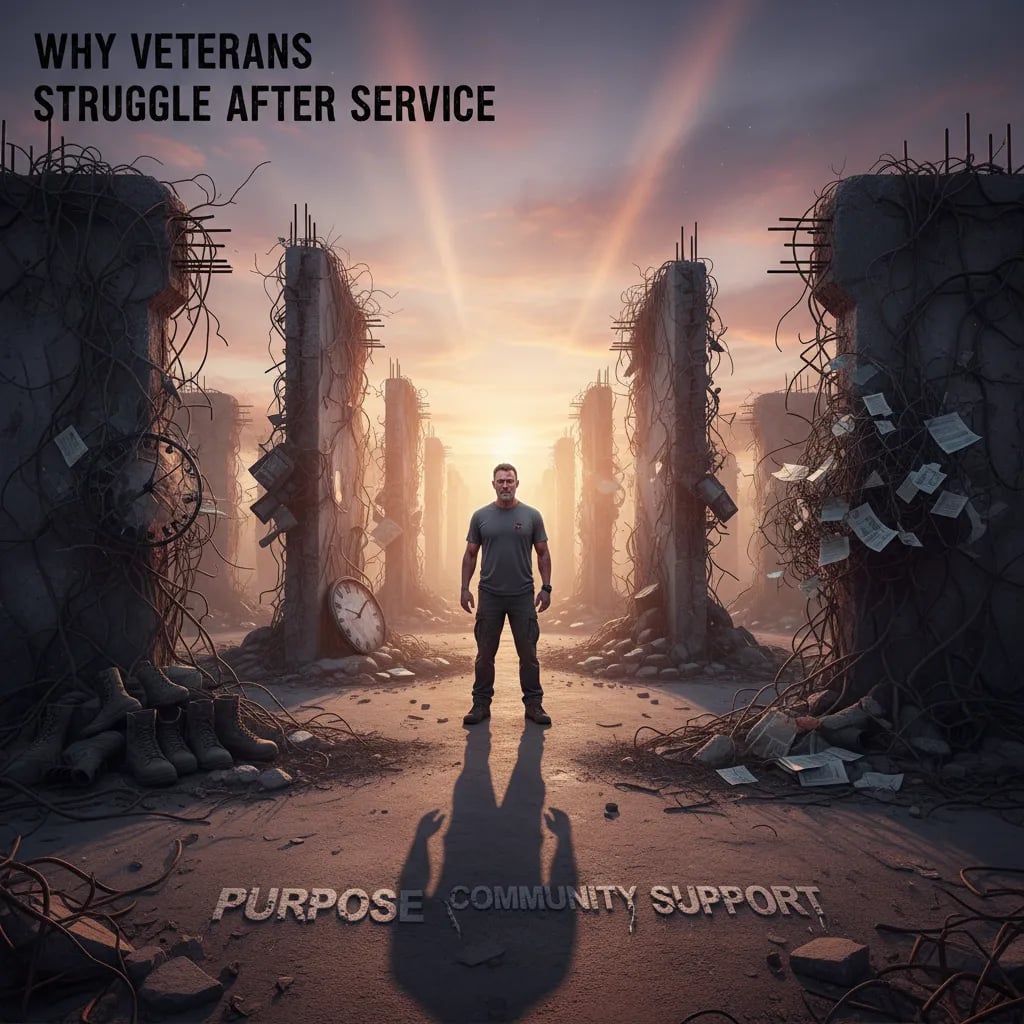


I still remember the first weekend I had off after separating: no formation, no six‑hour brief, no mission. For the first time in a decade I had to plan my own day. Discipline hadn’t left me — I made my bed, kept my journal — but the invisible scaffolding that turned those small acts into momentum was gone. In this post I walk through that gap: the identity vacuum veterans fall into, why 'motivation' is a red herring, and how rebuilding structure — systems, not hype — becomes the new mission.
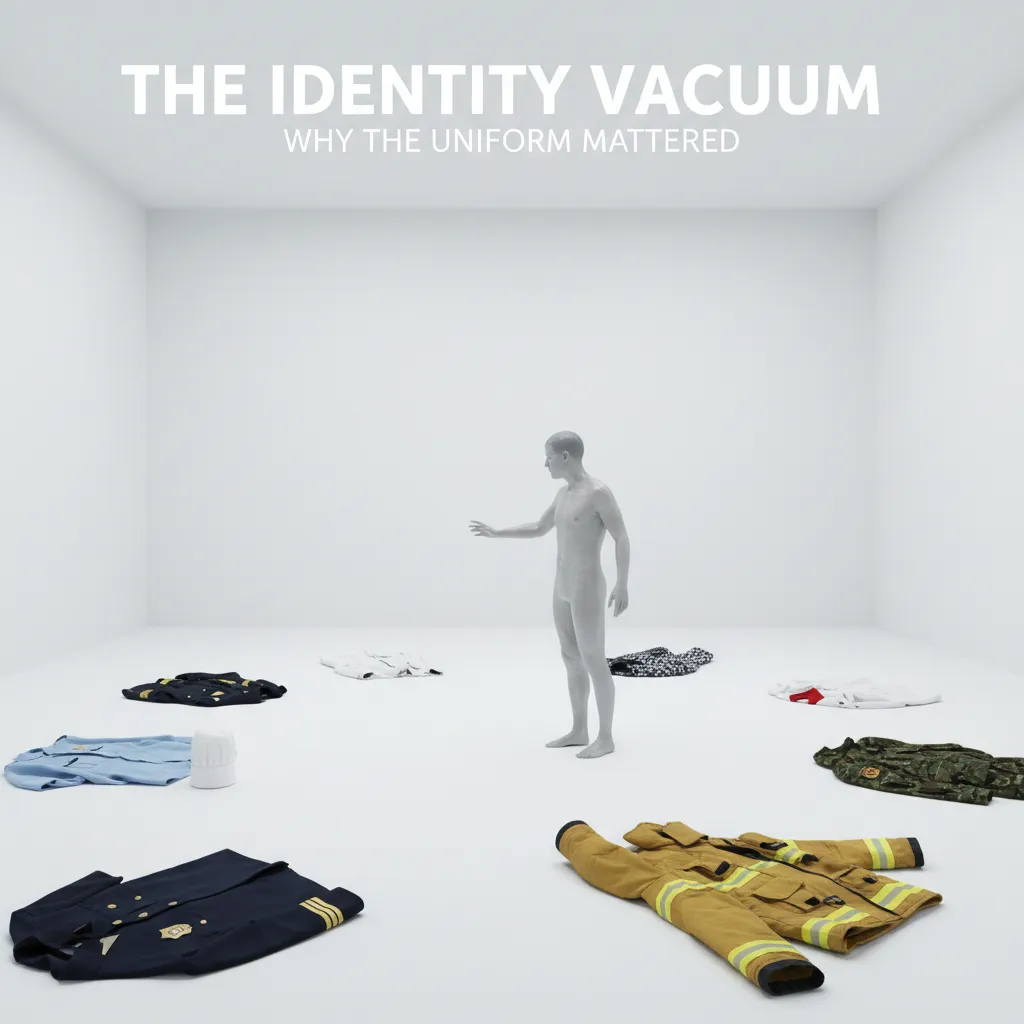
The Identity Vacuum (Why the Uniform Mattered)
The day after I turned in my uniform, I woke up at the same time out of habit. My body was ready for formation. But my phone didn’t buzz. No schedule. No “be here at 0900.” Just a quiet that felt too big for the room. I was proud of my service, but I also felt hollow—like someone removed the frame and expected the picture to stay straight.
Colonel Mark Rivera: "Uniforms aren’t just clothes — they’re an architecture for identity."
That’s what hit me: the uniform wasn’t only what I wore. It was a shortcut to who I was. Soldier. Specialist. Team leader. Those titles answered questions before anyone asked them. In the middle of a Veterans Transition, losing that label creates an Identity Shift that’s hard to explain to civilians. You still have discipline. You still want to perform. But the structure that told you what “good” looks like is gone.
And the brain doesn’t like blanks. When your role disappears overnight, you get cognitive friction—small decisions feel heavy. What time do I wake up? What matters today? Who do I call when I’m stuck? That’s where a lot of Transition Challenges live: not in laziness, but in missing identity cues.
Jessica Monroe (Army vet): "I traded salutes for silence. The hardest part was naming who I was without a rank."
Research backs up what many of us feel. About 48% of post-9/11 veterans report difficulty adjusting to civilian life. And 28% struggle with parting from military friends and finding purposeful careers. That loss of the tribe hits hard—especially for junior enlisted, and for women and minorities who may face a steeper identity shift when their service experience isn’t understood or respected in the same way outside.
Finding Purpose Starts Small
I didn’t “find purpose” in one big moment. I rebuilt it with small wins that felt huge:
- Keeping a morning ritual (same wake-up, same workout, same first task)
- Naming a new role out loud: dad, student, founder
- Choosing long-term goals—like a purposeful job (56%) or homeownership (52%)—because direction calms the noise
Why Motivation Isn’t the Problem (The Invisible Structure Did the Work)
When I got out, people kept asking why I “lost motivation.” I didn’t. I still woke up early. I still wanted to do well. But there were no external timers anymore—no formation, no morning brief, no shared mission. My drive felt like a car engine revving in neutral. That’s what Structure Loss looked like for me: not laziness, just no track to run on.
Sgt. Aaron Kline: “I still woke up early, but I didn’t know what for — structure gave me the ‘why.’”
Motivation vs. Structure: The Missing Scaffolding
Motivation is the internal spark. Structure is the external scaffolding that tells that spark where to go. In service, structure was everywhere: shift schedules, command calendars, checklists, and deadlines that didn’t care how I felt that day. That’s why the source line hits so hard: “Leaving the military doesn’t remove discipline. It removes structure.”
Dr. Lisa Hayes, psychologist: “Structure converts discipline into progress; motivation alone rarely sustains change.”
Daily Routine as a Protective Factor (and a Mental Health Anchor)
I didn’t realize how much my Daily Routine protected my Mental Health until it was gone. Research backs this up: loss of structure contributes directly to anxiety and adjustment difficulties, and keeping a daily routine is often cited as a key tip for a successful transition. One finding that stuck with me: 35% experience anxiety from career uncertainty or loss of structure.
How Military Structure Can Be Borrowed in Civilian Life
What helped wasn’t “more hustle.” It was rebuilding simple systems that looked familiar:
- Morning brief → a written task list with 3 priorities
- Squad accountability → peer check-ins (a weekly call or gym meet-up)
- Command calendar → a shared family/work calendar with fixed blocks
- Shift schedule → set start/stop times, even when self-employed
During Transition Challenges, motivation gets blamed because it’s easy to see. Structure is invisible. Therapists, employers, and even family sometimes misread the drift as laziness—when it’s really a missing framework that used to do the heavy lifting.
Reality Check: Transition Snapshot & Stats
When I left active duty, I wanted a clean checklist. Instead, I got a messy life. So I started looking at what veterans actually report—not to scare myself, but to see where the cracks usually form. Dr. Michael Trent put it best: "The numbers are blunt tools, but they show where systems must plug the gaps."
Finding Job, Housing Insecurity, Financial Stability & GI Bill Benefits: The Quick Snapshot
| What shows up | What veterans report | Why it matters |
|---|---|---|
| Finding Job | 33% say it’s the top transition challenge[1] | Work isn’t just income—it’s structure |
| Career + purpose | 28% struggle with leaving military friends and finding purposeful careers[1] | Identity loss hits before the paycheck does |
| Adjustment time | Average 7 months to adapt, with 3 major challenges[1] | It’s not a “two-week reset” |
| Resume basics | 20% never created a resume when leaving[1] | Good people lose jobs on paperwork |
| Mental health strain | 35% feel anxiety from career uncertainty/loss of structure[3] | Stress spikes when routines disappear |
| Financial Stability | 1 in 3 face financial stress in the first year[3] | Money pressure speeds up bad decisions |
| Housing Insecurity | Disproportionately affects veterans due to thin credit history[2] | One denial can start a spiral |
| GI Bill Benefits | 40%+ use GI Bill within 2 years to pivot careers[3] | Education becomes a bridge, not a detour |
These numbers show patterns—not destiny. They also hit harder in certain places: rural areas with fewer employers, and junior enlisted folks who leave younger with less savings and fewer networks. Colonel Mark Rivera nailed it:
"A statistic without context is just noise — give me the person behind the percentage."
And yes, stats make people comfortable. Feelings do the real work. But here’s the move: pick one metric to influence this month.
- Finding Job: write one civilian resume bullet per day.
- Financial Stability: track every dollar for 14 days.
- Housing Insecurity: pull your credit report and dispute one item.
- GI Bill Benefits: book one call with a school VA rep and confirm your timeline.

How Structure Creates Momentum (Systems > Motivation)
In the military, I didn’t wake up and “find motivation.” I followed a plan. Mission brief. Timeline. Checklists. Someone always knew where I was supposed to be. After separation, that scaffolding vanished, and I felt the drift fast—even with the same discipline.
That’s when I learned the difference: motivation is a feeling, but systems are a path. Dr. Lisa Hayes said it best:
“Designing simple, repeatable systems reduces decision fatigue and anchors change.”
Daily Routine: From Mission Planning to Weekly Sprints
I started treating civilian life like a series of weekly sprints. Instead of morning PT and formations, I built a 30-minute mission plan every day. Same time. Same notebook. I tracked wins, even small ones. Research backs this up: keeping a Daily Routine is a key tip for a successful transition, partly because systems cut anxiety by reducing decision points.
- 5 minutes: review calendar + top 3 tasks
- 15 minutes: one job task (networking, Resume Creation, application)
- 10 minutes: money check (balances, bills, budget)
Post-Separation Financial: Systems That Protect Financial Stability
About 1 in 3 veterans face financial stress in the first year post-service. I did too—especially watching credit card balances creep up while income was uncertain. So I automated what I could: bills on autopay, a simple budget rule, and a weekly “money admin” block. Automating finances and job-search tasks removed the daily mental load and helped rebuild Financial Stability.
- Accountability buddy: one weekly check-in
- Calendar blocks: job search, training, admin
- Automations: bills, savings transfers, application reminders
- Micro-goals: 1 resume bullet, 1 outreach message, 1 application
One stat hit me hard: 20% of veterans had never created a resume when leaving service. That’s not laziness—it’s lack of a system. As Sgt. Aaron Kline put it:
“My spreadsheet became my battle plan — boring, but effective.”
In the full post, I include a sample weekly mission plan and a habit tracker template.
Systems as the New Mission (Turn Routines into Roles)
When I got out, I kept waiting for motivation to show up like it used to. It didn’t. What I missed was the mission frame: clear objectives, a timeline, and someone checking the standard. So I built my own system and treated civilian life like an operation—small, repeatable, and measurable.
Make a Purposeful Career Plan Like a Deployment
I started assigning objectives to normal goals: job search, training, health, money. Then I ran a weekly after-action review. Jessica Monroe, an Army vet who became a trades apprentice, said it best:
“Treat your transition like a deployment plan with milestones.”
Her system was simple: three weekly objectives, tracked every Sunday. She used GI Bill Benefits to take trade courses (over 40% of vets use the GI Bill within two years for training), and she treated each class like a mission task—show up, pass, log progress, repeat.
Objectives, Metrics, and After-Action Reviews
- Objective: Apply to 5 roles per week
- Metric: 5 applications + 2 follow-ups logged
- AAR: What worked? What didn’t? What changes next week?
Resume Creation: Translate Military Skills Into Outcomes
A big reason vets get underemployed is skills mismatches—not because we lack skill, but because we describe it in a way civilians don’t recognize. Dr. Michael Trent put language to what I learned the hard way:
“Translating military skills is an act of storytelling — frame tasks as outcomes employers understand.”
- Replace rank/job codes with civilian titles (team lead, operations coordinator).
- Turn tasks into results (reduced downtime, improved safety, trained new hires).
- Match keywords to the posting before you hit submit.
Adjustment Indicators (So You Don’t Drift)
| Indicator | What I Track Weekly |
|---|---|
| Sleep | Average hours + consistency |
| Mood | 1–10 rating + triggers |
| Income flow | Applications, interviews, invoices |
I also stopped chasing shiny ideas. Consistency beat every “big plan” I tried and abandoned. Use VA offices, local workforce centers, and online veteran entrepreneurship groups for networking—one conversation a week is a system too. And if homeownership is your target (it is for 52% of veterans), make it a metric, not a wish.

Rebuilding Income Without Hype (Small Wins, Real Money)
My first paycheck after separation wasn’t big, but it felt like oxygen. I remember staring at the deposit and realizing the quiet relief wasn’t about pride—it was about Financial Stability. When money starts moving again, your brain stops running worst-case drills at 2 a.m. Research backs this up: immediate income stability reduces downstream mental health and housing risks. That’s why I stopped chasing “freedom” pitches and started chasing cash flow.
Employment Transition: Cash Flow Beats “Big Plans”
In the first year, practical income steps outperform speculative ventures. I learned that the hard way after watching other vets get pulled into “get rich quick” funnels. Meanwhile, 1 in 3 veterans face financial stress in the first year post-service[3]. That stress shows up fast in Credit Card Balances, late fees, and the kind of Housing Instability that starts with “I’ll catch up next month.” Housing insecurity can hit veterans harder when credit history gets bruised[2].
Emily Santos, career coach: "Focus on cash flow first. Skills are important, but rent waits for no one."
Job Prospects Without Hype: Low-Drama Income Paths
I rebuilt my Job Prospects with boring options that paid:
- Temp or contract work to restart income quickly
- VA benefits you’ve earned (treat them like a paycheck line item)
- Apprenticeships and union tracks with clear wage steps
- Veteran-specific hiring programs that translate MOS skills
Colonel Mark Rivera: "A steady paycheck rebuilds confidence faster than seminars and hype."
Checklist: Small Wins That Create Financial Stability
- Resume updated for one target role
- LinkedIn profile cleaned up (headline + skills + one story)
- 3 employer contacts (recruiter, hiring manager, vet rep)
- Simple budget plan (fixed costs + minimum debt payments)
- Short-term income targets:
2 weeks,30 days,90 days
Prioritize Like a Mission: Housing First, Then Upskilling
I covered fixed costs first—housing, food, bills—because stability protects everything else. After that, I invested in skills using the GI Bill or local programs. Homeownership mattered too; 52% of veterans cite homeownership goals[1]. But I couldn’t chase that until the basics were locked in.
Practical First Steps & Soft CTA (Start Small, Build Systems)
When my Transition Challenges hit, it wasn’t because I got lazy. It was because my Daily Routine stopped being automatic. I had freedom, but no rails. Most vets take about 7 months to adapt, and many face three big challenges along the way. Systems don’t erase the hard parts—but they speed up the adjustment.
My 7-day starter plan (imperfect, but real)
I learned the hard way that “someday” doesn’t show up on the calendar. Research backs this up: concrete 7-day actions turn strategy into habits. Here’s what I’d do again:
- Morning mission (15 min): write today’s one win on paper. Then do it before noon.
- Resume Creation: build a basic one-page resume. (About 20% of us never made one when we got out.)
- Contact 3 peers: text or call three people you trust. Ask, “Can I send you one weekly update?”
- Automate one bill: pick rent, phone, or savings. Remove one decision from your week.
Quick aside: I once forgot my plan by Wednesday and spent the rest of the week “catching up” in my head. Nothing moved. The lesson wasn’t shame—it was schedule it or it disappears.
Tiny worksheet (steal this)
- Name your role: “Student,” “Apprentice,” “Job seeker,” or “Provider.”
- List 3 weekly objectives: one identity, one income, one health.
- Schedule a 30-minute planning block: same day, same time.
Accountability + one metric
Peer accountability increases follow-through. Jessica Monroe said,
"Reporting one small win to my buddy every Friday saved me from giving up."
Pick one metric—applications/week or savings rate—and report it in the comments or a veteran group.
Use the tools already earned
Check GI Bill Benefits (over 40% use them within two years), VA benefits, local apprenticeship programs, and veteran job fairs. Emily Santos put it best:
"Small, scheduled wins compound into livelihoods."
If you’re rebuilding your post-service identity, start with systems that reward consistency—not noise.
Wild Cards: Quotes, Analogies & A Tiny Thought Experiment
I keep coming back to a line I used earlier: uniforms are architecture. They don’t just cover you—they hold you up. In Civilian Life, that support vanishes, and the Identity Struggle can feel weirdly physical, like you’re walking around without a frame.
Here’s the quirky part: imagine building a “civilian uniform.” Not a costume—an anchor. Mine started small: the same plain shirt, the same notebook, and one phrase I say before work: “Today has a plan.” I didn’t expect to miss the coffee formation more than anything, but I did. Not the caffeine—the moment where everyone’s day clicked into place together. So I recreated it: coffee at the same time, phone off, five minutes to map the morning.
Colonel Mark Rivera: “Rules are sometimes kindness — they spare you the burden of deciding everything.”
That quote helped me forgive myself for wanting structure. During Transition Challenges, I thought freedom meant I should “figure it out” on the fly. But too much choice is heavy. Sometimes bureaucracy is a strange comfort. A form, a process, a checklist—annoying, yes, but also a handrail.
Another reframe that stuck: the transition isn’t like leaving a job. It’s like switching from a railroad schedule to piloting a small plane. On rails, the route is set and the signals tell you what to do. In the air, you get freedom—but now you own navigation, weather, fuel, and landing. That’s not weakness. That’s a new skill.
Dr. Lisa Hayes: “Metaphors help the brain translate experience into action.”
So here’s a tiny thought experiment to close this out. Picture your life as a mission plan. If the next 90 days were a deployment of your own design, what are three explicit objectives? Not vibes—objectives. When I finally wrote mine down, my drift slowed. My days stopped asking, “Who am I now?” and started answering, “What’s the next step?”
