
I used to think posting more would fix everything. I’d grind out daily posts, celebrate a viral day, then wonder why my bank balance didn’t follow. Then I flipped the script: instead of more content, I built a tiny system. Within weeks my messages found buyers instead of just likes. This post is that short, practical map for anyone tired of chaotic posting.
1) The Content-First Trap (Why Content Alone Fails)
When I first started chasing Online Success, I did what most beginners do: I went all-in on Content Marketing and Social Media Marketing. I posted every day. I tried every trend. I measured my progress in likes, views, and comments. It felt productive… but it was backwards.
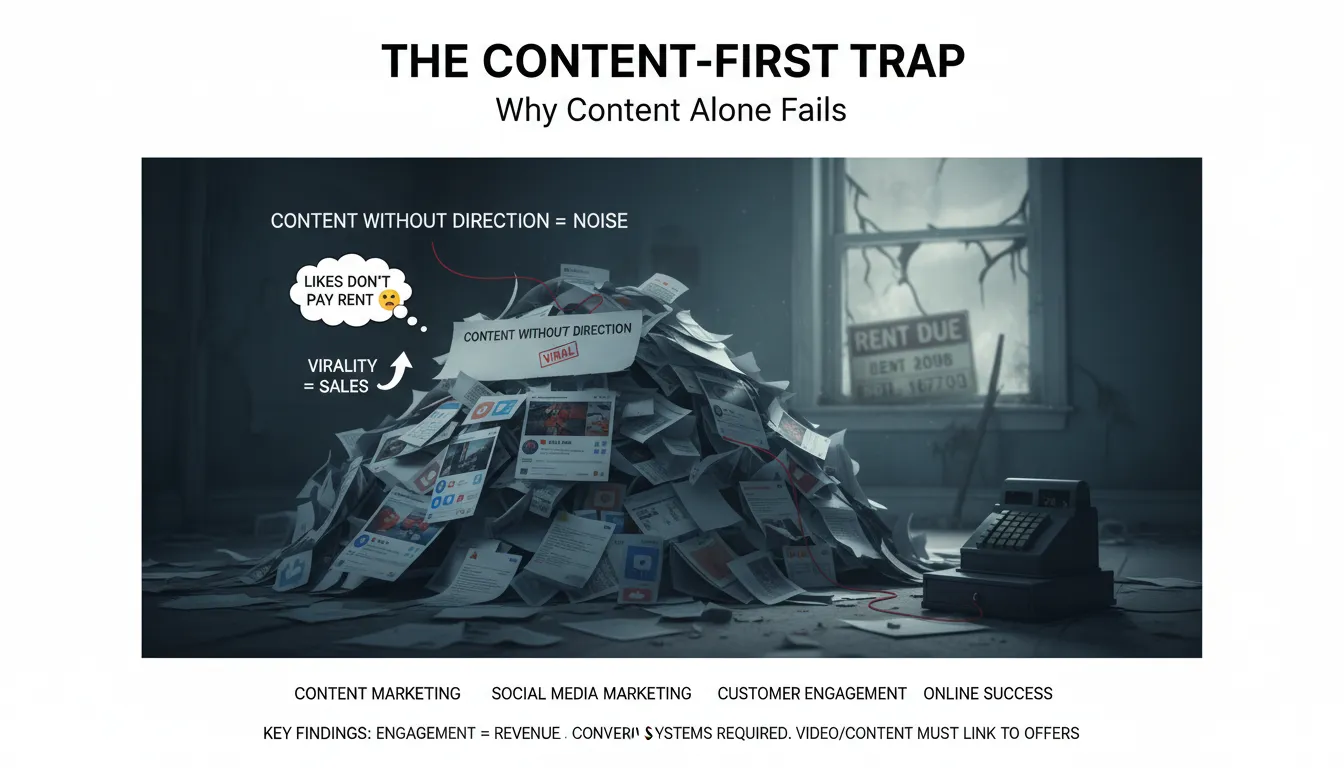
Content Marketing Without Direction Becomes Noise
Content is powerful, but only when it has a job. Without a clear direction, your posts become noise—more words, more videos, more effort, and still no real result. Likes don’t pay rent.
I learned that “more content” is not a strategy. It’s often a way to avoid the harder work: deciding who you help, what problem you solve, and what you want your content to lead to.
Customer Engagement vs. Revenue: The Metric Trap
Here’s the painful truth: Customer Engagement does not guarantee revenue. You can have a growing audience and still have an empty bank account. Engagement metrics can hide a bigger issue—your content may be attracting people who like watching, but not people who are ready to buy.
Research-backed insights say it clearly: engagement does not guarantee revenue; conversion systems are required. And yes, video helps. Video and content strategies can increase attention—some studies show video content can boost engagement by up to 30%. But attention without a next step is just entertainment.
Views can come from curiosity.
Likes can come from agreement.
Comments can come from emotion.
Sales come from trust + a clear offer + an easy path to say yes.
Virality Without Conversion Is a Trap (My Viral Video Lesson)
I once had a video go viral on social—one of those moments you dream about. It popped off across platforms like TikTok, Instagram, and even got shared in a few places I didn’t expect. My notifications were nonstop. My follower count jumped fast.
And then I checked my sales.
Zero.
That’s when it hit me: virality can be a trap if there’s no conversion layer. No offer. No funnel. No clear “here’s what to do next.” I had momentum, but nowhere to send it. The worst part wasn’t just the lost income—it was the morale crash after all that excitement.
Why Beginners Get Stuck in the Content-First Loop
Most beginners keep posting because it feels like progress. But content alone can’t carry your business. You need a simple system that connects attention to action. Even basic MVP testing can reduce failure risk by up to 60%—because you’re validating what people will actually pay for, not just what they’ll applaud.
Don't find customers for your products, find products for your customers. — Seth Godin
That quote explains the real fix: content should serve the customer first, and it should lead somewhere specific. Otherwise, you’re building an audience you can’t help—and a business that can’t grow.
2) The Systems-First Framework I Use (Clear, Simple, Repeatable)
When I started online, I thought the goal was to post more. More tips. More reels. More “value.” But my results were random because my effort was random. Once I stopped chasing content and started building a system, everything got simpler—and more profitable.
“Clarity creates leverage; systems turn effort into results.” — Marie Forleo
Start With Clarity: Find Your Niche (Without Overthinking)
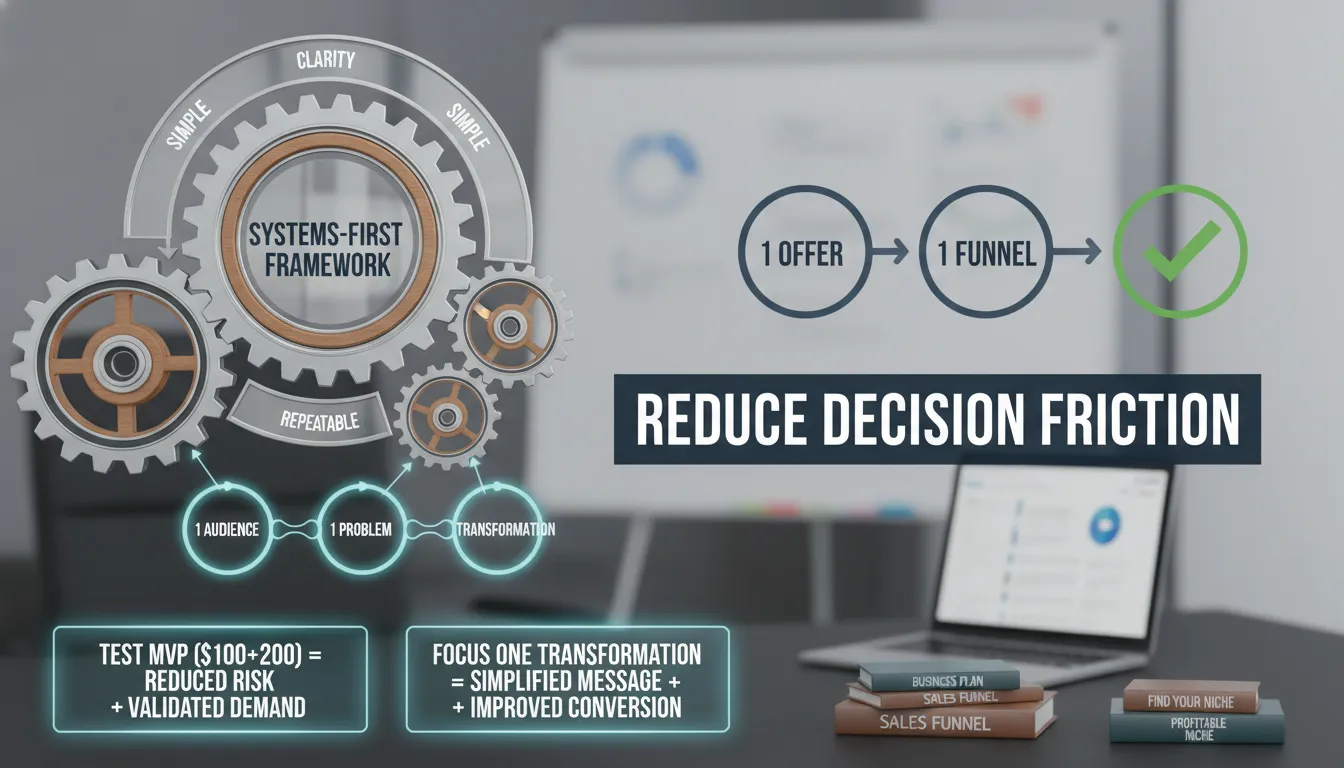
My framework has five parts. It’s not fancy, but it works because it forces focus. If you want to Find Your Niche and turn it into a Profitable Niche, you don’t need 10 ideas. You need one clear path people can say “yes” to.
Clear audience
Specific problem
One transformation
One offer
One Sales Funnel
The 5 Elements (My Simple Business Plan)
I treat these five elements like a one-page Business Plan. If one is missing, content becomes noise again.
Element | What it means |
|---|---|
Audience | One group you understand and can speak to clearly. |
Problem | One painful, specific issue they want solved now. |
Transformation | One outcome you help them get (start → finish). |
Offer | One clear way to buy that outcome (not a menu of options). |
Sales Funnel | One simple path from content → trust → purchase. |
Why “One Transformation” Makes Everything Easier
Beginners often try to help with everything. I did too. But focusing on one transformation simplifies your message, makes your content easier to create, and improves conversion because people instantly understand what you do.
Instead of “I help with marketing,” it becomes: I help X solve Y so they can achieve Z. That sentence alone can guide your posts, your offer, and your funnel.
One Offer + One Sales Funnel = Less Friction, More Sales
When you have multiple offers, people hesitate. When you have one clear offer, buyers move faster. I learned this the hard way.
Personal example: I used to sell a “starter call,” a “content package,” and a “monthly coaching plan.” Lots of interest, very few sales. I pivoted to one offer: a simple 2-week setup where I helped someone pick a niche, shape one transformation, and build a basic funnel. Conversions went up because the decision got easier.
Validate Demand With a Minimum Viable Product ($100–$200)
I also test before I build big. A minimum viable product in the $100–$200 range reduces risk and validates demand. It’s small enough for a beginner buyer to say yes, and real enough to prove you can deliver results.
Here’s the system in one line:
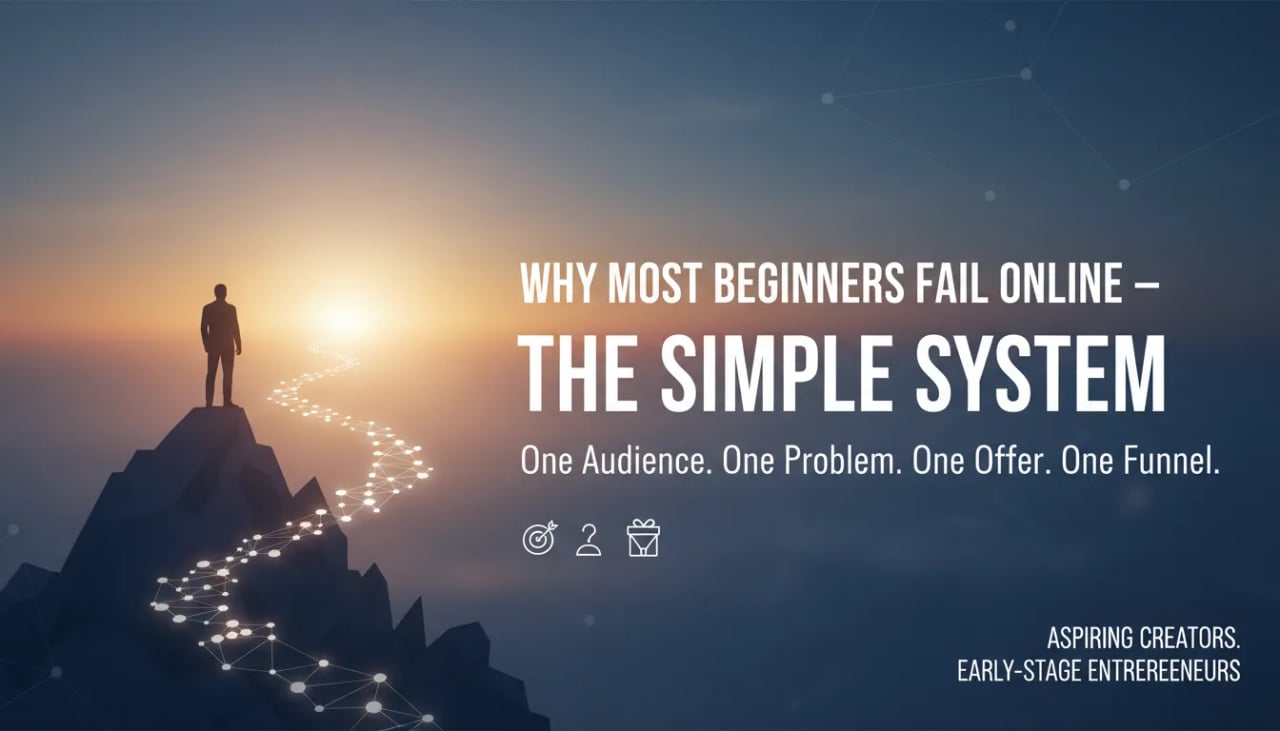
One audience → one problem → one transformation → one offer → one funnel
3) Build It Step‑by‑Step (A Practical Mini-Blueprint)
I used to think the answer was “post more.” But posting without a plan is just noise. When I finally built a simple system, everything got easier—and results started showing up.
Systems make chaos repeatable; start small and test fast. — Justin Welsh
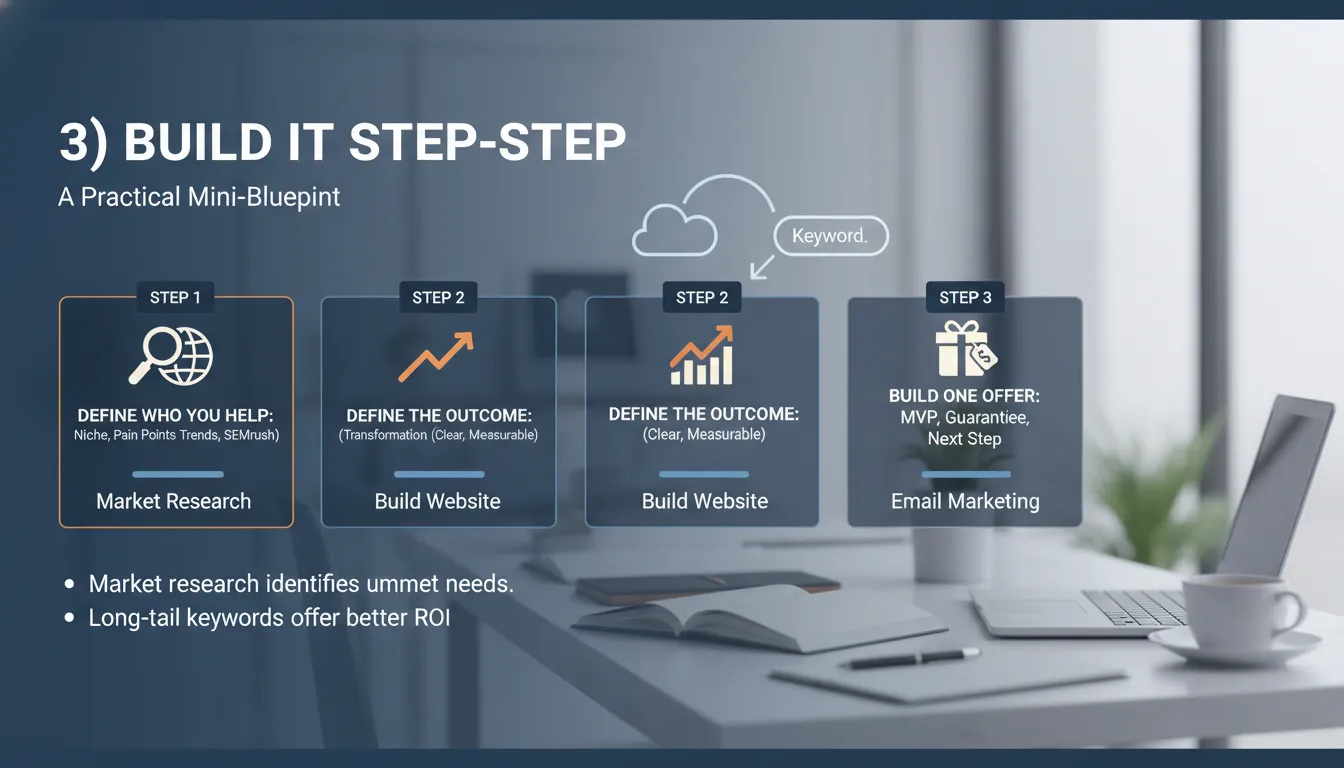
Step 1 — Define who you help (Market Research first)
If you skip Market Research, you end up guessing—and guessing is expensive. I start by picking a narrow niche, then I look for real pain, real urgency, and real context.
Niche: Who is this for (job, stage, situation)?
Pain points: What keeps them stuck?
Context: What tools, budget, and time do they have?
Tools I use to validate demand fast:
Google Trends to see if interest is growing or fading
SEMrush to find what people already search and pay attention to
Research insight: Market research identifies unmet needs and guides offer creation. That’s how you stop creating “nice content” and start building something people actually want.
Step 2 — Define the outcome (the transformation)
People don’t pay for information. They pay for a clear change. I write my outcome like a simple promise that can be measured.
Bad: “Help you grow online.”
Better: “Get your first 100 email subscribers in 30 days.”
When the outcome is clear, your content becomes focused, your offer becomes easier to explain, and your audience knows if it’s for them.
Step 3 — Build one offer (MVP + simple site)
One offer beats five half-finished ideas. I build an MVP (minimum viable product) and test it before I “perfect” it. A simple price test in the $100–$200 range can reduce failure risk by ~60% because you learn faster with real buyers.
What’s included: one clear deliverable (call, template pack, mini-course, audit)
Simple guarantee: “If you do X and don’t get Y, I’ll refund you.”
Next step: book a call or buy now
To Build Website fast, I keep it simple:
Carrd.co for a one-page launch
WordPress for content + SEO
Shopify if you’re selling products
And I track tasks in Asana so I don’t rely on motivation.
Step 4 — Connect content to conversion (Email Marketing + Long-Tail Keywords)
This is where beginners break the system: they post, but they don’t lead anywhere. I map every piece of content to one funnel step: lead → nurture → convert.
Funnel step | Content goal | What I link to |
|---|---|---|
Lead | Get the right click | Free checklist / lead magnet |
Nurture | Build trust | Email sequence (3–7 emails) |
Convert | Make the offer clear | Sales page / checkout / call |
I lean on Long-Tail Keywords early because they convert better and cost less effort than broad terms. Insight: targeting long-tail keywords with 100–1,000 monthly searches often gives better early ROI than chasing huge keywords. Then I use Email Marketing to turn attention into action.
Micro-case: when I reorganized my posts so each one pointed to a single lead magnet, my email signups doubled in a few weeks. I also added short videos to key posts—content marketing + video can boost engagement by ~30%—and that extra attention pushed more people into the funnel.
4) Reality Checks, Wild Cards, and Small Experiments
The 100-Follower Wild Card (Clarity Creates Revenue Streams)
Here’s a reality check I use when I feel stuck: pretend I only have 100 followers. Not 10,000. Not “one day I’ll go viral.” Just 100 real people watching me right now. What would I sell that would actually convert?
This question forces clarity. It pushes me to stop chasing attention and start building Revenue Streams that make sense: a small digital product, a simple subscription, or affiliate marketing tied to one clear outcome. And it keeps the customer path singular—one offer, one funnel—even if I validate demand in multiple places.
Here’s the simple math that changes everything: If my 100 followers paid $150, I’d earn $15,000 — reverse engineer the funnel. I don’t need “more content.” I need a clearer promise, a cleaner page, and a direct next step.
Validate Fast with Paid Ads and Influencer Partnerships
Most beginners waste months building in public with zero proof anyone wants the offer. I’d rather test early with small audiences, because it reduces time wasted on unfounded ideas.
I diversify validation channels, but I keep the funnel the same. I might test with email, PPC, influencer promos, and affiliate marketing—yet every test points to one landing page and one checkout.
For quick proof, I run tiny Paid Ads tests (even $5–$20/day) to see if people click, opt in, and buy. I also use Influencer Partnerships to borrow trust fast: one creator, one promo, one link. If the offer is strong, you’ll feel it immediately in replies, sign-ups, and sales.
To keep my tests grounded, I check demand signals with Google Trends and keyword tools like SEMrush. Then I build the simplest possible page on Carrd.co or WordPress, and if it’s a product, I’ll validate checkout flow with Shopify.
Test small, learn fast, scale what converts. — Amy Porterfield
Keep It Simple: Automation Tools Support the System (They Don’t Create It)
When I’m new, complexity kills momentum. I don’t need a “perfect tech stack.” I need one clear message and one clear path. Automation Tools help me stay consistent—like using Asana to track tasks, scheduling emails, or tagging leads—but they don’t replace clarity.
My rule is simple: build an MVP, test it with a small audience, and only then add layers. If the offer doesn’t convert with 100 people, it won’t magically convert with 10,000. So I run small experiments, listen closely, and scale only what proves itself. That’s how I stop posting randomly and start building intentionally—one funnel, one offer, and results I can repeat.
