
No one tells you about the silence. When I took the uniform off for the last time, the noise disappeared and a strange gap opened where my role used to be. I remember sitting in my kitchen, rank folded in a drawer, feeling like a character whose script had been lost. This piece is for anyone who’s felt that gap — for the veterans who wake up and realize discipline didn’t vanish, it only changed shape. I’m writing from that messy, hopeful place: to map out identity after service, name the traps, and sketch systems that honor who we were and who we can become.
1) The Identity Gap Veterans Experience (Military Identity)
When the routine ends, the questions start
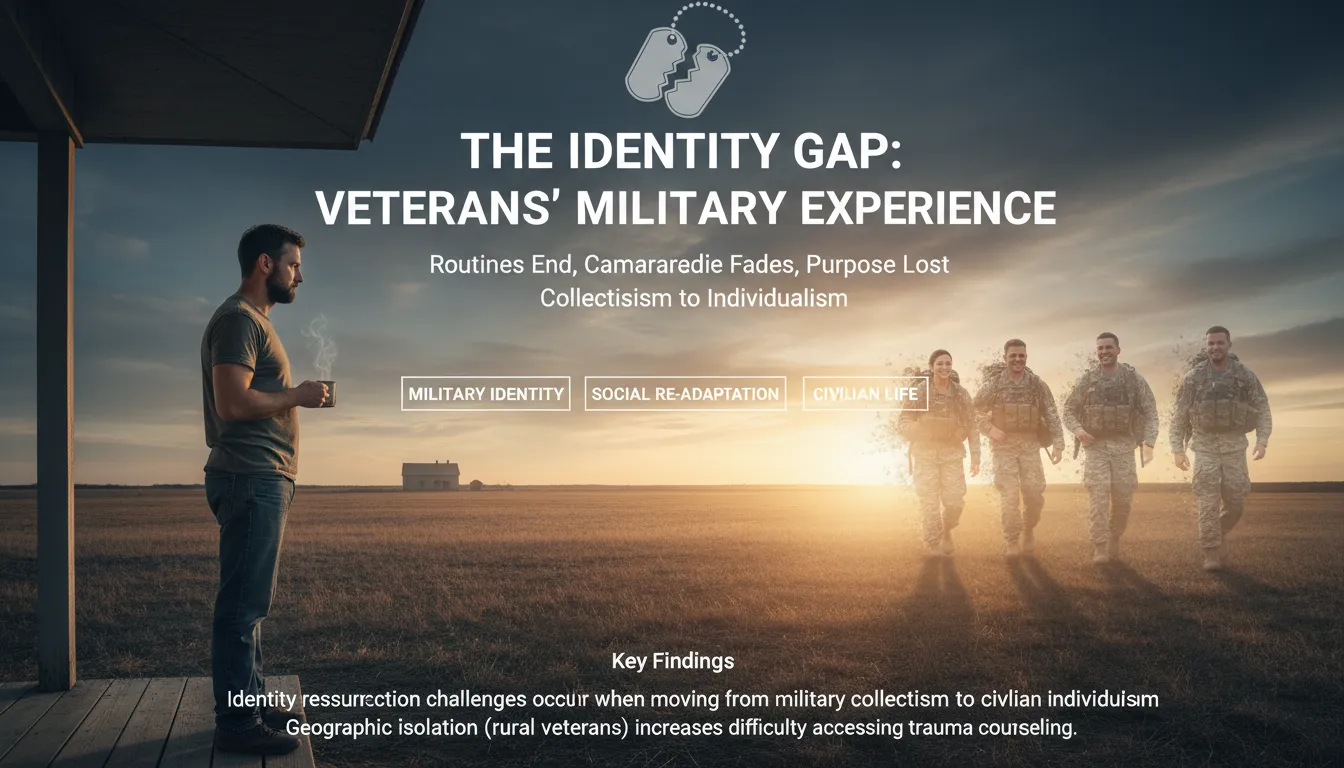
No one prepares you for the silence after service. The noise stops. The rules vanish. And suddenly, your identity feels… unfinished. That’s the identity gap—the space between who I was in uniform and who I’m supposed to be in Civilian Life.
I remember my first civilian weekend. No formation. No timeline. No one needed me at 0600. It should’ve felt like freedom, but it felt like an endless hallway with no doors. I didn’t call it grief then, but that’s what it was: a sharp, quiet grief for a life that used to tell me exactly where to stand.
Military Identity is collective—civilian identity is individual
Military Identity is built in a group. You move as a unit, speak a shared language, and carry a mission that’s bigger than your mood. That collective identity leaves a lasting imprint. Research on identity reconstruction shows the shift from military collectivism to civilian individualism can hit hard, because in Civilian Life you’re expected to define yourself alone—job title, hobbies, “personal brand.”
Dr. Emily Carter, Clinical Psychologist: "The loss of collective identity is a measurable risk factor for depression in transitioning veterans."
Common reactions during Social Re-adaptation
Pulling back from people because small talk feels pointless
Depression or numbness when purpose turns into a question mark
The urge to chase familiar structure—anything that feels like rank, rules, and clear standards
When help is far away, the gap gets wider
For many of us, Social Re-adaptation runs into real-world barriers. VA wait times can exceed 90 days, and rural veterans face extra strain when trauma counseling is hours away. Inside the system, the VHA has been criticized for inefficiency across its 18 VISNs, and restructuring is planned starting in 2026 with the goal of reducing bureaucracy.
So I try to name it clearly: my Military Identity wasn’t destroyed. It was unmoored. And unmoored things don’t need shame—they need new anchors.
2) Why Discipline Isn’t the Problem (Leadership Abilities & Structure)
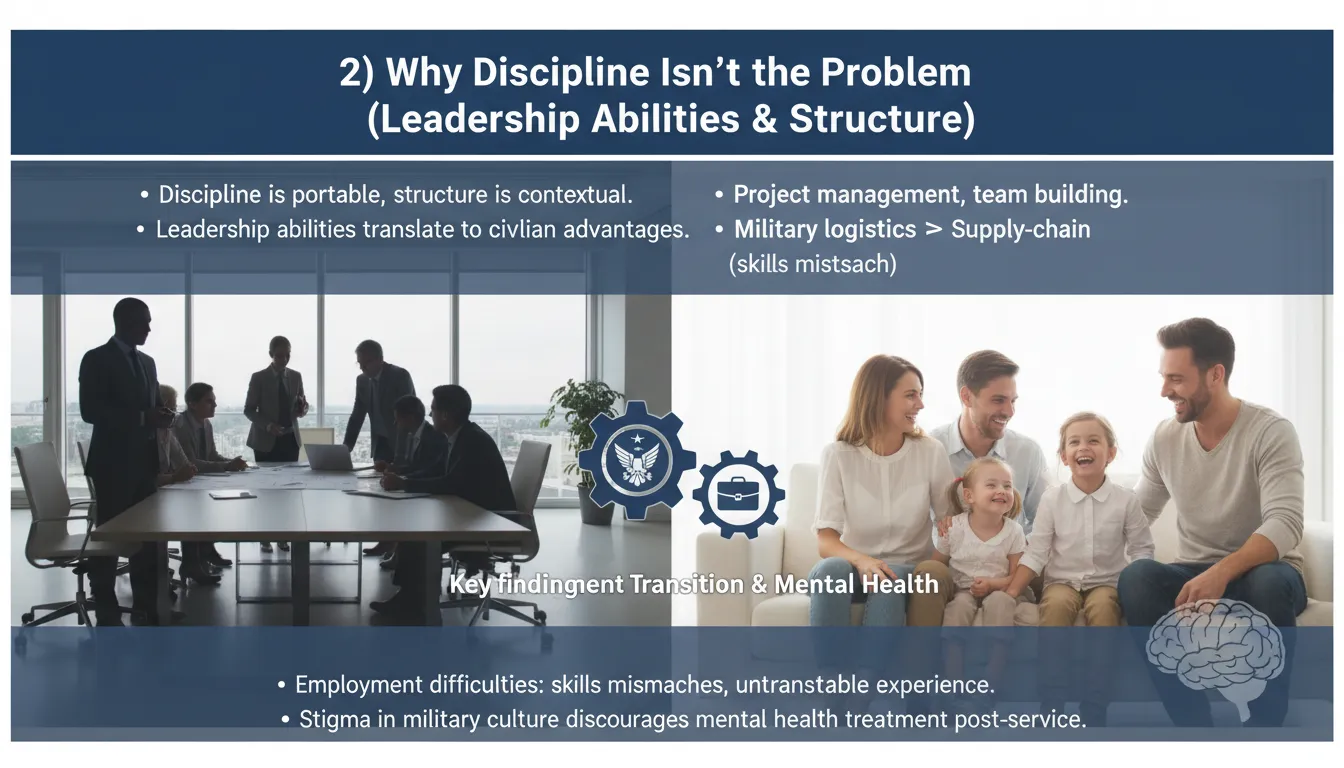
I’ll confess something: when my strict schedules disappeared, I thought my discipline disappeared too. But discipline is portable. Structure is contextual. The military gave me a ready-made system. Civilian life asked me to build my own.
Mark Johnson, DAV Policy Director: "Discipline survives the uniform — the challenge is channeling it into roles that recognize veteran skills."
Leadership Abilities During Employment Transition (Fixing Skills Mismatches)
In my Employment Transition, the real problem wasn’t work ethic—it was translation. Research keeps pointing to the same issue: employment difficulties often come from skills mismatches and not knowing how to explain what we did. My Leadership Abilities didn’t vanish; they just needed new labels: project management, team building, risk planning, and clear communication.
I watched a buddy with military logistics experience get passed over because his resume sounded “too tactical.” Once he reframed it as supply-chain coordination—inventory, vendors, timelines—doors opened. The mismatch was real, but it was fixable.
Mental Health Service: Asking for Help Isn’t Failure
Another trap is the stigma we carry. In military culture, needing help can feel like weakness, so after service we go quiet. That silence can stall reconnection—with work, with purpose, and with ourselves. Choosing Mental Health Service isn’t losing discipline; it’s using it to face what’s real and get support.
Family Dynamics: Expanding the System
Reintegration isn’t a solo mission. My Family Dynamics shifted fast—my spouse had routines, my kids had needs, and my old “just push through” mindset didn’t fit. Structure had to expand to include them.
One morning, I caught myself missing the brief. So I made a civilian version:
Today’s mission: 3 priorities
Support plan: who needs me and when
After-action: 5-minute review at night
That’s the reframe: discipline isn’t a relic to mourn. It’s a tool to design new systems that respect who you are now.
Support Systems & Structural Barriers)" />
3) How Systems Replace Rank (Support Systems & Structural Barriers)
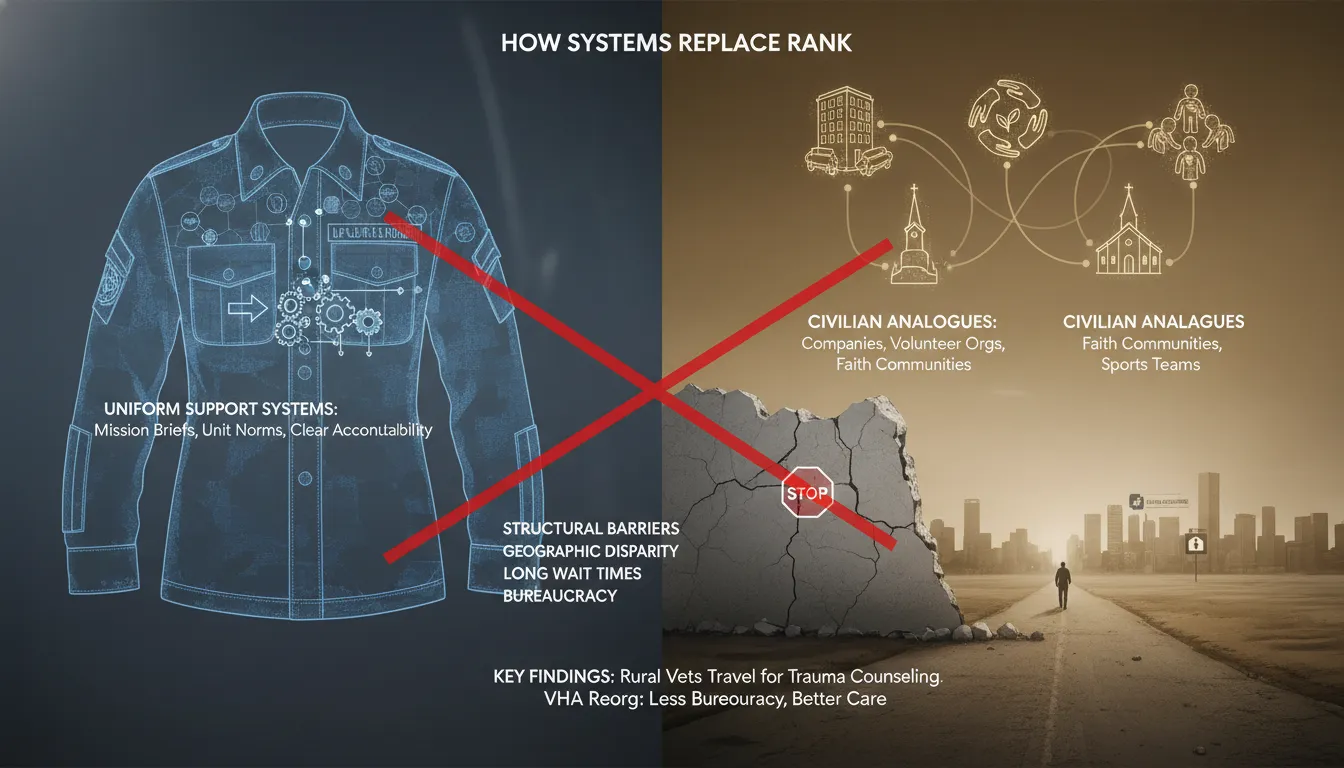
In uniform, I didn’t “find myself” every morning. I reported into a system that already knew what mattered: mission briefs, unit norms, clear accountability, and a chain that caught me when I slipped. There was odd comfort in checking a roster or showing up for PT—simple proof that I belonged somewhere.
When I got out, I learned a hard truth: rank disappears, but the need for Support Systems doesn’t. Civilian life has systems too—companies with clear roles, volunteer organizations with schedules, faith communities with weekly rhythm, competitive sports teams with standards and feedback. The goal isn’t to copy the military. It’s to rebuild predictability on purpose.
Structural Barriers (and the Access Barriers no one warns you about)
Here’s where it gets real: not everyone can reach the systems that help. Structural Barriers create Access Barriers that feel personal, even when they’re not. Rural veterans can be geographically isolated, forced to travel hours for specialized trauma counseling. And even when care exists, VA wait times can exceed 90 days. Add paperwork, referrals, and inconsistent processes across the VHA’s 18 VISNs, and momentum dies fast.
The VHA restructuring planned for 2026 is meant to reduce bureaucracy and improve consistency in care. That matters—because big systems should not require heroic effort just to use them.
Col. Sarah Jenkins, Veteran Reintegration Specialist: “Replacing rank with reliable systems is how many veterans reclaim stability in civilian life.”
What helped me was building layers of Support Systems so one failure didn’t take me out:
Join veteran cohorts and PTSD communities for shared language and accountability.
Use Transitional Housing programs when stability is the first mission.
Ask about VA programs and peer support, not just appointments.
Commit to Vocational Retraining with a schedule, mentors, and milestones.
Some systems will fail you. So I plan redundancy: two points of contact, two routines, two places where I’m expected. That’s how I replace rank with structure—and keep moving.
4) Designing a Civilian Mission (Create Purpose & Freedom Within Structure)
When I first stepped into Civilian Life, I thought freedom meant “no schedule.” It didn’t. It felt like floating. And when I tried to copy military structure without a reason, it felt hollow. That’s when I started designing a Civilian Mission—not a job title, but a direction.
My two-sentence mission statement (imperfect, but real)
I use my leadership and calm under pressure to serve my community and build stable work. I protect my mental health by choosing routines that support recovery, connection, and growth.
Three exercises that helped me build it
Audit transferable skills: leadership, planning, training others, safety, teamwork, logistics.
Pick a north star: service, stability, family, faith, learning, health—choose one that feels true.
Build micro-missions: daily/weekly rituals that prove the mission is alive.
One micro-mission that changed me: lead a community service project once a month. It’s leadership meets purpose, and it also builds a network that helps with employment transition.
Dr. Miguel Alvarez, Rehabilitation Psychologist: "Small, repeated civilian missions rebuild identity by attaching intention to routine."
Freedom Isn’t the Absence of Structure.
Freedom without structure made me drift. Structure without meaning made me numb. The win is structure aligned with values—and supported by real resources: Vocational Retraining programs, local veteran groups, and Transitional Housing if stability is the first battle. If you’re carrying trauma, build your mission with PTSD Treatment and peer communities in the plan, not as an afterthought. Policy matters too: DAV advocacy and the BRAVE Act 2026 push suicide prevention and mental health workforce expansion.
Draft a 30-day experiment (messy is allowed)
3 habits: 10-minute walk, 15-minute skill study (job training), lights out time
1 volunteer action: join/lead one service event
Check-in plan: weekly call with a buddy + one appointment (coach, therapist, or group)
Keep your mission malleable. Mine has changed—after a few failures—and that’s proof I’m still building.
5) Mental Health, Treatment Access, and the Practical Paperwork (Mental Health Service)
My first Mental Health Service appointment didn’t start with a breakthrough. It started with forms, phone trees, and me wondering if I even “deserved” help. I was skeptical. I also didn’t want anyone to think I was weak. That mix—stigma plus friction—is how people quietly disappear from care.
Wait Times, Rural Veterans, and Access Barriers
Some VA Wait Times still run over 90 days, and for Rural Veterans the drive can be the real wall. These Access Barriers don’t just delay help—they raise the risk of Treatment Abandonment. The VHA says restructuring in 2026 is meant to reduce bureaucracy and improve access, and I’m rooting for that. But I still plan like delays are real.
Dr. Emily Carter, Clinical Psychologist: "Faster access to mental health services can mean the difference between staying in treatment and dropping out."
PTSD Treatment Options (and Staying Connected)
PTSD Treatment can include trauma-focused therapy, group support, and medication when needed. What mattered most for me was continuity: not restarting my story every time I changed providers during transition.
Where I Looked for Help (Local + National)
VHA clinics and Vet Centers
Community mental health clinics (often faster)
Veteran peer groups (VFW/DAV posts, local meetups)
Telehealth options when travel is the barrier
How I Advocate for Faster Access (BRAVE Act + People Who Can Push)
I ask for a case manager, call DAV/VFW service officers, and I support pressure points like the BRAVE Act (2026) to expand the mental health workforce.
My Intake Checklist + Conversation Starters
Gather: DD-214, insurance card, prior records, meds list, crisis contacts.
Write 5 symptoms + 3 goals (one sentence each).
Ask:
“What’s the soonest appointment, and can I be waitlisted for cancellations?”Say:
“I’m worried about dropping out—what’s the follow-up plan if I miss a week?”
6) Employment Transition & Skills Translation (Employment Barriers)
My first civilian interview was awkward. I spoke in ranks, readiness, and “mission essential.” The hiring manager nodded politely, then asked, “So… what did you deliver?” I even brought a certificate with a medal listed on it. He squinted and said, “Is this like an employee-of-the-month thing?” I laughed, but inside I felt small. That moment showed me how Employment Barriers can be less about effort and more about translation.
Why Skills Mismatches Happen
Research keeps pointing to the same friction: Skills Mismatches and the inability to translate military experience into civilian terms. Employers may respect service, but they hire for outcomes, tools, and proof. Perception becomes a barrier when my story sounds like a title instead of a result.
Lisa Chen, Director of Veteran Workforce Solutions: “Employers respond to clear outcomes—teach veterans to sell what they did, not what they were called.”
A Simple Translation Framework (Title → Outcome)
I started rewriting my experience as measurable civilian outcomes:
Military wording | Civilian wording |
|---|---|
Squad Leader | Led 10-person team; improved on-time task completion by 20% |
Readiness NCO | Managed compliance tracking; reduced errors through weekly audits |
Awarded commendation | Recognized for process improvement and risk reduction |
Quick template:
Did [action] using [tools] to achieve [result] for [who], measured by [metric].
Tools That Reduce Employment Barriers
Vocational Retraining programs that convert experience into credentials (IT, trades, healthcare).
Veteran hiring initiatives and targeted pipelines that improve placement rates.
Local workforce boards for coaching, apprenticeships, and employer connections.
VSO connections and even VHA restructuring-era community partnerships that can indirectly open doors through referrals and support.
Small Experiments That Build a Civilian Track Record
I stopped waiting for the “perfect” job and ran small tests: a weekend freelance gig, a temp role, a volunteer project with clear deliverables. Meaningful work rebuilt my identity faster than a generic résumé ever could.
7) Family, Community, and the Spiritual Homecoming (Social Re-adaptation)
My relationships took the hardest hit when the uniform came off. My wife learned my new rhythms before I did. I was home, but not really present. That’s the quiet truth of Social Re-adaptation: cultural disconnection and social withdrawal can sneak in fast, and isolation can turn into depression if we don’t name it.
Family Dynamics: renegotiating roles without keeping score
In service, roles are clear. At home, they’re negotiated—sometimes daily. Parenting changed for me too. I wanted order, my kids wanted connection. What helped wasn’t “trying harder,” but building a shared system: a weekly check-in, a simple chore plan, and shared therapy when we needed a neutral room to translate each other.
Spiritual Fulfillment: finding a place that remembers you
“Spiritual homecoming doesn't have to be religious—it can be a community that remembers you.” — Rev. Daniel Ortiz, Chaplain and Veteran Liaison
For me, that “home” showed up in unexpected places: faith groups, veteran peer networks, PTSD communities, and local service clubs. Transitional housing programs can be anchors too—not just a roof, but a bridge back to people.
Substance Use and Suicide Prevention: supportive monitoring, not shame
I’ve seen Substance Use become a coping tool for trauma, anxiety, and depression—because it works for a minute. If you’re worried, build support early: one trusted friend, one family member, and one professional option. That’s not weakness; it’s Suicide Prevention through connection.
Rebuilding camaraderie (I started with a messy BBQ)
I once hosted a backyard BBQ and overcooked everything. I almost bailed. Then a neighbor brought chips, another stayed to talk, and suddenly I wasn’t “the veteran”—I was just a person on the block again.
Start a 3-person accountability team
Set a repeating meetup (same day, same time)
Do one shared project (yard, garage, volunteering)
A short, imperfect gratitude ritual
At dinner, try this: each person says one thing they noticed today and one thing they appreciate about someone at the table. Keep it awkward. Keep it real.
8) Practical Checklist & Resources (Actionable Next Steps)
When I feel that identity gap hit, I don’t “think” my way out—I run a simple system. Try this 30-day experiment for Transitioning Veterans who need real Support Systems, not hype.
30-Day Experiment (Veteran Support Micro-Missions)
Three micro-missions (pick 1 per week): I will train (20 minutes), I will serve (one small volunteer act), I will build (one resume/skill task).
One help-seeking step: I will schedule a VA/VHA mental health intake or telehealth consult—today. If VA wait times push past 90 days, I will ask for community care options and peer support in the meantime.
Weekly accountability: I will do a 10-minute check-in every Sunday with a buddy, peer group, or VFW/DAV contact.
VA/VHA Mental Health Intake: Paperwork & Steps
Bring: DD214, VA.gov login info, insurance card (if any), list of meds, prior mental health/medical records, emergency contacts, and any benefit forms you’ve started.
Steps: Call your VA clinic/VHA line → request mental health intake → ask about local vs. VISN options (VISNs vary, especially for rural veterans) → confirm appointment + telehealth backup.
Resource Map (National + Local)
National: VA/VHA, DAV, VFW, VA telehealth, peer groups.
Local: county/state veteran service organizations (VSOs), community clinics, faith/community groups.
Advocacy Touchpoints (BRAVE Act + VHA Restructuring)
I will contact my Representative and Senators: ask them to support the BRAVE Act (DAV-backed, 2026) to expand the mental health workforce and suicide prevention, and to protect access during planned VHA restructuring across VISNs.
Mark Johnson, DAV Policy Director: "Practical systems and advocacy go hand-in-hand—policy changes matter, but so do the tools veterans use weekly."
Quick Self-Check: Treatment Abandonment
Signs: missed appointments, “I’ll handle it alone,” stopping meds, isolating, or quitting groups. Do this: I will text/call my accountability person, reschedule within 24 hours, and switch to telehealth or a local VSO bridge.
You don’t need motivation—you need a system that respects who you are. If you’re ready, try the system for 30 days.
9) Wild Cards: Quotes, Hypotheticals, and a Slight Tangent
When my Military Identity felt shaky, I stopped trying to “figure it out” in one big moment. I started collecting wild cards—small ideas that didn’t fit the plan, but still moved me forward.
Dr. Emily Carter, Clinical Psychologist: "The loss of collective identity is a measurable risk factor for depression in transitioning veterans."
That line hit me because it explains so many Reintegration Challenges. In the military, we’re trained for “we.” In civilian life, it’s suddenly “me,” and that shift can feel like standing in a quiet room with no instructions.
Mark Johnson, DAV Policy Director: "Practical systems and advocacy go hand-in-hand—policy changes matter, but so do the tools veterans use weekly."
So here’s my hypothetical for Transitioning Veterans: what if I treated civilian life like a 12-week deployment? Not forever. Just twelve weeks. I’d pick a mission (one sentence), set a weekly rhythm, choose my “team” (two people I check in with), and define what “success” looks like on Fridays. I’d plan meals, workouts, job search blocks, and recovery time like it actually counts—because it does.
And about rank: I don’t think we lose it. I think we climb down from it. Like scaffolding on a building—solid, useful, temporary. You don’t mourn the scaffolding. You thank it, step onto the ground, and keep building.
Slight tangent: sometimes a song, diesel exhaust, or even cheap coffee snaps me back to my unit in half a second. Those sensory anchors aren’t weakness. They’re proof my identity has roots. I can carry the roots without living in the old soil.
Now, imagine your civilian mission on a postcard. Front: a simple image of the life you’re building. Back: one line you’d actually share.
My micro-challenge: I will try the 12-week experiment and report back.
