

I left the service convinced hustle would carry me—until it didn't. I watched buddies chase the next bright idea, burn out, then fall back on VA disability checks and part-time gigs. That taught me a blunt lesson: we already know how to follow a system. We were trained for it. What we lack is a simple, repeatable system that executes without constant motivation. In this post I walk through why motivation fails, how execution differs from effort, the role of VA disability and COLA 2026 in civilian income planning, and how AI can reduce friction while you stay in control.
1) The Motivation Myth: Why Drive Fades
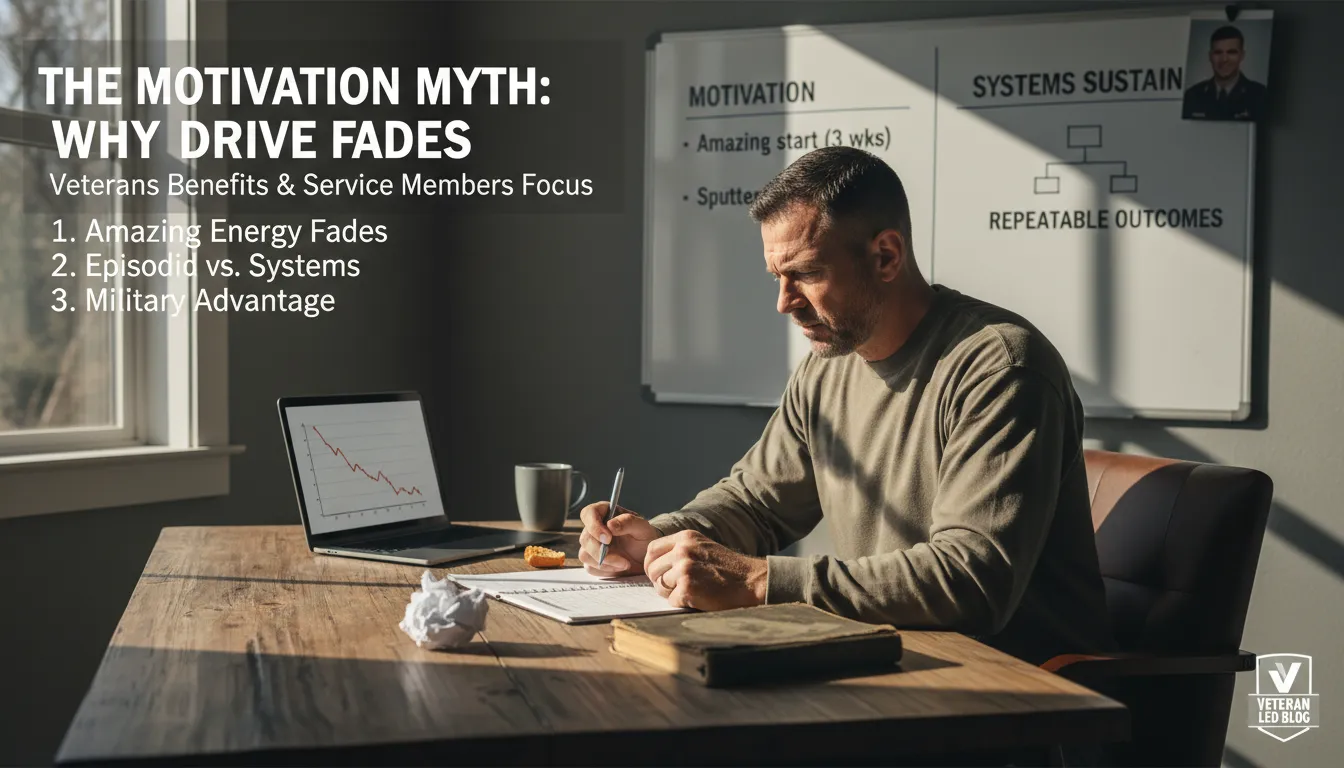
My first civilian side gig started like a weekend mission. I built a simple offer on Saturday, posted it on Sunday, and by Monday I was fired up. For three weeks, I was unstoppable—late nights, big plans, “this is it” energy. Then week three hit. No adrenaline. No clear orders. Just me, a laptop, and a growing list of half-finished tasks. I didn’t quit on purpose. I just… sputtered.
That’s the motivation myth: we think drive is a steady fuel source. It isn’t. Motivation is episodic—great for starting, terrible for maintaining repeatable revenue. Post-service, it can feel even worse because we’re used to structure, urgency, and a team rhythm. In business, nobody blows a whistle.
Col. James Hart (Ret.): “Motivation gets you started; a system keeps you in the fight.”
Why service members stall after the uniform
In the military, I didn’t rely on random inspiration. I relied on systems: checklists, routines, standards. That training is a hidden advantage, but many of us expect the same adrenaline we had on duty to show up in civilian work. It doesn’t. Psychology backs this up: motivation often rides on dopamine spikes—new idea, new goal, new rush. Systems run on habits—small actions that don’t need hype.
Where veterans benefits help—and where they don’t
VA disability, monthly payments, and COLA increases can be a real safety net when motivation dips. I’m grateful those stabilizers exist. But they’re not a business system. They reduce pressure; they don’t create execution.
Practical tip: replace “motivation checks” with micro-tasks
- One daily output: publish, pitch, or follow up—no exceptions.
- One daily input: learn one skill for 15 minutes.
- One system action: update a template, automate a step, or log leads.
If I can do those three, the system carries me on the days motivation disappears.
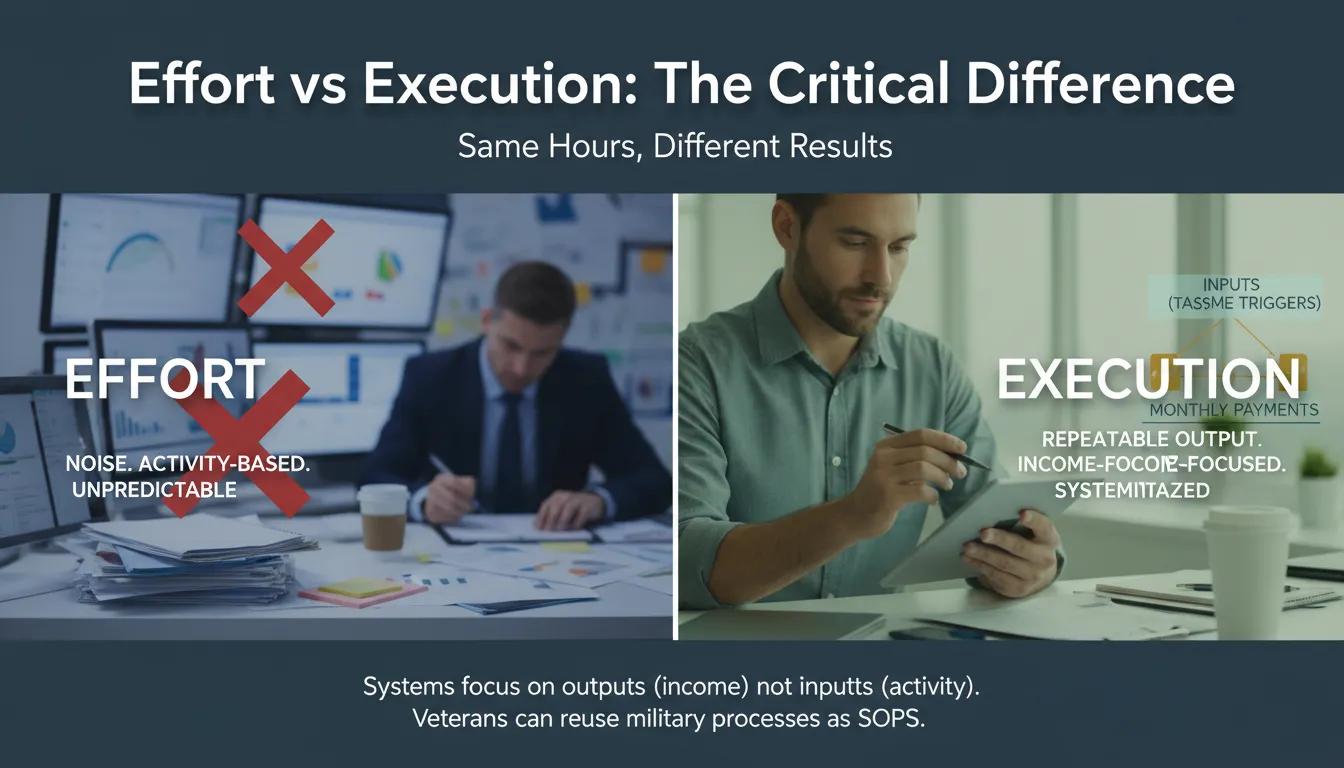
2) Effort vs Execution: The Critical Difference
I used to think effort was the whole game. If I stayed “busy,” I felt like I was winning. But effort is often just noise. Execution is a repeatable output that produces income. That’s the difference between grinding and building an employment system that pays you.
Dr. Laura M. Bennett: "Execution outperforms raw effort when processes are designed for repeatability."
Two Days, Same Hours, Different Results
Busy day: I answered messages, watched videos, tweaked a logo, and “researched funnels.” Eight hours later, I had nothing measurable—no leads, no sales, no next step.
Executed day: I followed a checklist. I wrote one offer page, loaded it into a simple funnel, and connected an email sequence. Same eight hours. Now I had a working path that could create leads while I slept.
Checklist Method: Inputs vs Outputs
In the military, we didn’t “try hard.” We ran SOPs, checked boxes, and reviewed results. I learned to bring that same mindset into business: track outputs, not activity.
| Inputs (Tasks) | Outputs (Income Triggers) |
|---|---|
| Build funnel page + checkout | Conversions |
| Write 5-email sequence | Follow-ups + booked calls |
| Publish 3 posts, scheduled | Leads captured |
| Set recurring offer | Monthly payments |
Practical Mechanics That Turn Effort Into Results
- Batch content for one hour, then schedule it.
- Send traffic to a simple funnel with one clear CTA.
- Let an email sequence follow up automatically.
- Sell a recurring offer so wins stack into monthly payments.
Effort without tracking looks heroic, but it often wastes time. Execution gives you proof: leads, conversions, and payments you can count.
3) Civilians Burn Out, Veterans Stall: Different Failure Modes
Burnout vs. Stalling (and why both kill income)
I’ve noticed something after service: civilians often burn out, while veterans often stall. Same goal—stable income. Different failure modes.
Civilians usually sprint. They stack freelance gigs, side hustles, late nights, and “just one more client.” There’s no structure, so they try to replace it with effort. That works… until it doesn’t. Burnout looks like exhaustion, missed deadlines, and quitting right when momentum finally shows up.
Veterans, on the other hand, are trained to follow systems. So when civilian life feels chaotic, we wait for the system to appear. We wait for permission. We wait for the “right” plan. Stalling looks like anxiety, overthinking, and watching good windows pass by.
A quick story from my circle
One friend of mine (civilian) went all-in on freelance work. He was making money, but he was also always “on.” After a few months, he crashed and started turning down work because he couldn’t breathe.
Another friend (a veteran) had skills and a solid idea, but he kept saying, “I just need the right program,” like someone was going to hand him a mission brief. He wasn’t lazy—he was stuck waiting for structure.
Benefits, COLA, and the illusion of a “pay increase”
When both paths break, people lean harder on safety nets: VA disability, part-time shifts, or whatever keeps the lights on. And yes, the cost-of-living adjustment helps. The 2026 COLA is 2.8% (higher than 2025’s 2.5%, lower than 2022’s 8.7%). That’s a real pay increase on paper—but it’s not a system. It changes timing and planning, not the outcome.
Amanda Reyes, Veteran Transition Coach: "Many vets think structure solves everything; it helps, but only if the system is designed to produce income."
The middle path
- Structure so you don’t rely on motivation
- Flexibility so life doesn’t break the plan
- Automation so execution happens even on low-energy days
4) The System Bridge: From Chaos to Consistency
I call it the System Bridge: a deliberately designed process that turns small actions into predictable income. Not hype. Not hustle. Just an employment system you can run like a mission plan—especially when motivation is low and life is loud.
Col. Sarah Nguyen (Ret.), Systems Designer: "The System Bridge is just disciplined habit design—something veterans already practice."
Three Pillars (SOP + ROE + AAR)
- Repeatable process: your SOP—same steps, same outcome.
- Automation: your force multiplier—tools do the follow-up without you babysitting it.
- Feedback loop: your AAR—what worked, what didn’t, what changes next.
The 5-Step Bridge I Use
- Audit: list every step from “lead” to “paid.” Include VA disability pay dates, VALife, and any benefits income. Don’t gamble with that baseline—build around it.
- Simplify: cut steps until it fits on one page. Clear ROEs: what you do, what you don’t.
- Automate: connect email, scheduling, and simple billing. Example:
Calendly → intake form → welcome email → invoice. - Monitor: weekly AAR—numbers only: leads, booked calls, closes, cash collected.
- Scale: once it’s stable, add one channel (referrals, content, or service networks)—not five.
Mini-Case: Predictable Payments
A vet I worked with automated client onboarding: one link, one form, one invoice. No chasing. No “Did you get my email?” Within two months, his predictable monthly payments doubled—same effort, better execution.
15-Minute Daily “System Maintenance”
- Check pipeline and unpaid invoices
- Send 2 follow-ups (templated)
- Review tomorrow’s schedule
- Log one AAR note
And yeah—systems still need occasional creative spurts. But creativity works best when the bridge is already built.
5) What a Simple Automated Income System Actually Looks Like
When I say “automated,” I don’t mean a complicated machine. I mean a simple system that executes even when my energy is low. For many of us, VA disability and disability compensation already create a baseline of stability through monthly payments. In 2026, those numbers rise a bit (about $4.91/month at 10% and $107.28/month at 100% without dependents). That’s not a full plan—but it’s a partial safety net while a system scales.
VA Disability + Monthly Payments + Recurring Income = Predictable Cash Flow
Ellen Park, Small Business Advisor: "Pairing predictable benefits like VA compensation with a simple recurring offer reduces financial risk."
Here’s the clean version of an automated income system:
- Lead capture: a one-page site with a short form.
- Email nurture: 5–7 emails that teach and build trust.
- Low-friction offer: a small “yes” (like $9–$29).
- Recurring billing: a subscription that creates steady monthly payments.
Concrete Example: Veteran Coach “3-Call Funnel” + $49/Month Membership
My simple model: someone books a call, I run a 15-minute fit check, then a paid strategy call, then invite them into a $49/month membership. The automation is basic: calendar booking, payment link, and a lightweight CRM. No expensive consultants required.
My Weekly Cadence (So the System Doesn’t Drift)
- Monday: outreach (10 messages, 2 follow-ups)
- Wednesday: batch one piece of content + one email
- Friday: review numbers, fix one bottleneck
Imperfect aside: I once over-automated everything and it felt cold. Now I automate the steps, not the relationship.
Scale Slowly: One Automation Step Per Quarter
Add one improvement, measure impact, iterate. If you want, I can share a downloadable checklist/template for this exact funnel.
6) How AI Removes Friction Without Removing Control
I don’t use AI to “run my business.” I use it to remove the drag that keeps execution from happening. For AI for veterans, that’s the win: less busywork, more follow-through, and you still call the shots.
AI handles the tedious work; I keep the decisions
AI can draft emails, summarize calls, suggest headlines, and turn rough notes into clean outlines. But nothing goes out without my approval. That’s the difference between automation and autopilot. In an employment system (or any income system), speed matters—but control matters more.
Dr. Marcus Hall, AI Ethics Researcher: "Good AI amplifies human systems; bad AI replaces essential human oversight."
My two-hour setup: templates, automations, guardrails
In about two hours, I can set up a simple AI assistant that supports my system instead of steering it:
- Templates: email replies, follow-up scripts, post formats, proposal outlines
- Automations: scheduling posts, logging leads, reminders for follow-ups
- Guardrails: “Ask before sending,” approved phrases, banned claims, tone rules
Control checklist (so it still sounds like me)
- I vet outputs for accuracy and promises I can’t keep
- I preserve my voice by editing intros and personal details
- I avoid outsourcing relationships; AI supports, it doesn’t “connect” for me
Example: I’ll have AI draft a week of social posts, then I tweak them so they feel real—my story, my tone, my standards.
Simple tools that help without getting expensive
- Copy: ChatGPT / Claude for drafts and summaries
- Scheduling: Buffer / Later for posting
- CRM + automation: HubSpot free + Zapier/Make for basic follow-ups
Hypothetically, that setup can free up one full day a week—time I’d rather spend on client work. And when AI connects to invoicing reminders, it can help keep monthly payments consistent without me chasing people.
7) Real-World Financial Context: VA Changes & Why They Matter
2026 cost-of-living adjustment (COLA): small %, real impact
The 2026 cost-of-living adjustment is 2.8% (up from 2.5% in 2025, and far below the 2022 peak of 8.7%). That 2.8% matters because it flows through multiple Veterans benefits—not just one check. Per DAV and Military.com reporting, COLA affects:
- VA disability disability compensation
- Clothing allowances
- DIC (Dependency and Indemnity Compensation)
What the VA disability increase can look like
Even “small” raises add up when you’re budgeting tight. For 2026, examples of monthly disability compensation increases include:
- 10% rating: +$4.91/month
- 100% (no dependents): +$107.28/month
And for Military retirees, a simple rule of thumb I’ve seen used is about $28 more per $1,000 of pension in 2026.
VA budget shifts change the planning window
The VA’s 2026 budget request is $187.2B, including $52.7B for the Toxic Exposures Fund (VA budget brief). That tells me the system is still evolving—benefits can expand, rules can tighten, timelines can move.
VALife program + health system restructuring
The VALife program offers up to $40,000 in coverage for eligible veterans with service-connected disabilities (VA). Also, VISNs are slated to shift from 18 to 5 integrated networks starting in 2026—another reminder that “stable” doesn’t mean “unchanging.”
Karen Holt, Veterans Policy Analyst: “COLA and VA budget shifts change planning windows—veterans should treat benefits as predictable baseline income when possible.”
My take: benefits are a safety net, not the whole plan. VA paperwork is messy, but manageable. If you want, I can point you to resources to calculate your expected monthly payment based on rating and dependents.
8) Action Plan: Build Your First System in 30 Days
I treat this like a briefed mission. Veteran readiness isn’t hype—it’s showing up daily with a clear checklist. The goal in 30 days is a minimal viable employment system that creates repeatable income while your benefits help stabilize finances.
Michael O'Leary, Veteran Small Business Mentor: "A 30-day system is less about speed and more about reliable repetition."
Safety Step (Day 1): Lock Your Cash Flow Baseline
Before I sell anything, I map expected VA disability compensation, any other VA monthly payments, and likely COLA into my budget. Note: track VA monthly payments weekly and adjust the plan if timing or amounts change.
| Item | Monthly | Notes |
|---|---|---|
| VA disability | $___ | Expected deposit date |
| Expenses | $___ | Non-negotiables first |
| Runway | ___ months | How long I can test |
Week 1: Audit Skills + Simple Offers
- List 3 skills I can deliver in 7 days (resume edits, outreach, basic websites, bookkeeping).
- Write 1 clear offer:
“I help X get Y in Z days.”
Week 2: One Funnel + One Recurring Offer (SOP Everything)
- Pick one funnel: DM outreach or a one-page site with a booking link.
- Create one recurring offer (monthly check-ins, reporting, maintenance).
- Write SOPs for each step: lead list → message → call → invoice → delivery.
Week 3: Automate the Tedious Parts (Under $50/month)
I keep tools simple: Google Workspace, Calendly, Stripe/PayPal, and a $10–$20/month email tool. I use an AI assistant for drafts (messages, proposals, follow-ups) so I stay in control but remove friction.
Week 4: Track Metrics + Run an AAR
- Monitor: leads, calls booked, conversions, and monthly payments.
- Expect breaks. That’s fine. I run an AAR and update the SOP.
If you want clarity, start here—no pressure, just a system template I recommend. I can also share my SOP templates and a short email sequence to launch your first funnel.

9) Wild Cards & Tangents (Quotes, Scenarios, Analogies)
“I trusted my checklist more than a motivational post.”
That line isn’t famous, but it’s real in spirit. In uniform, I didn’t “feel ready.” I ran the steps. After service, I tried to build income the civilian way—big ideas, big energy, zero structure—and I stalled. The fix wasn’t more hustle. It was a system that executes, even on low-motivation days, even while I’m dealing with Veterans benefits paperwork or tracking Disability compensation changes.
When COLA Drops: My Plan B (Because It Can)
Here’s the scenario I rehearse: COLA comes in lower than expected, and my monthly buffer shrinks. I don’t panic—I switch lanes. Step one: freeze non-essentials for 30 days. Step two: redirect any “extra” to a simple reserve account. Step three: review recurring bills like it’s a pre-mission check. Step four: run my income system’s minimum version—just the actions that keep it alive. The point isn’t fear. It’s contingency.
My Favorite Analogy: A Money System Is an MRE
An MRE isn’t gourmet. It’s reliable, portable, and it keeps you moving. That’s what I want from my money system: simple inputs, predictable outputs, and enough fuel to get through rough weeks without breaking discipline.
Amy Castillo, Transition Specialist, said it best:
“A simple ritual keeps people honest—it’s not fancy, but it works.”
Mine is small: coffee, notebook, and a 10-minute plan. I write one line: Today’s one move that keeps the system running is ____.
If you want the numbers and official updates, start here: DAV, Military.com, and the Department of Veterans Affairs Budget in Brief.
Now imagine a system that buys you one worry-free day per month. What would you do with it? Tell me in the comments, or email me—seriously. I read them.
