




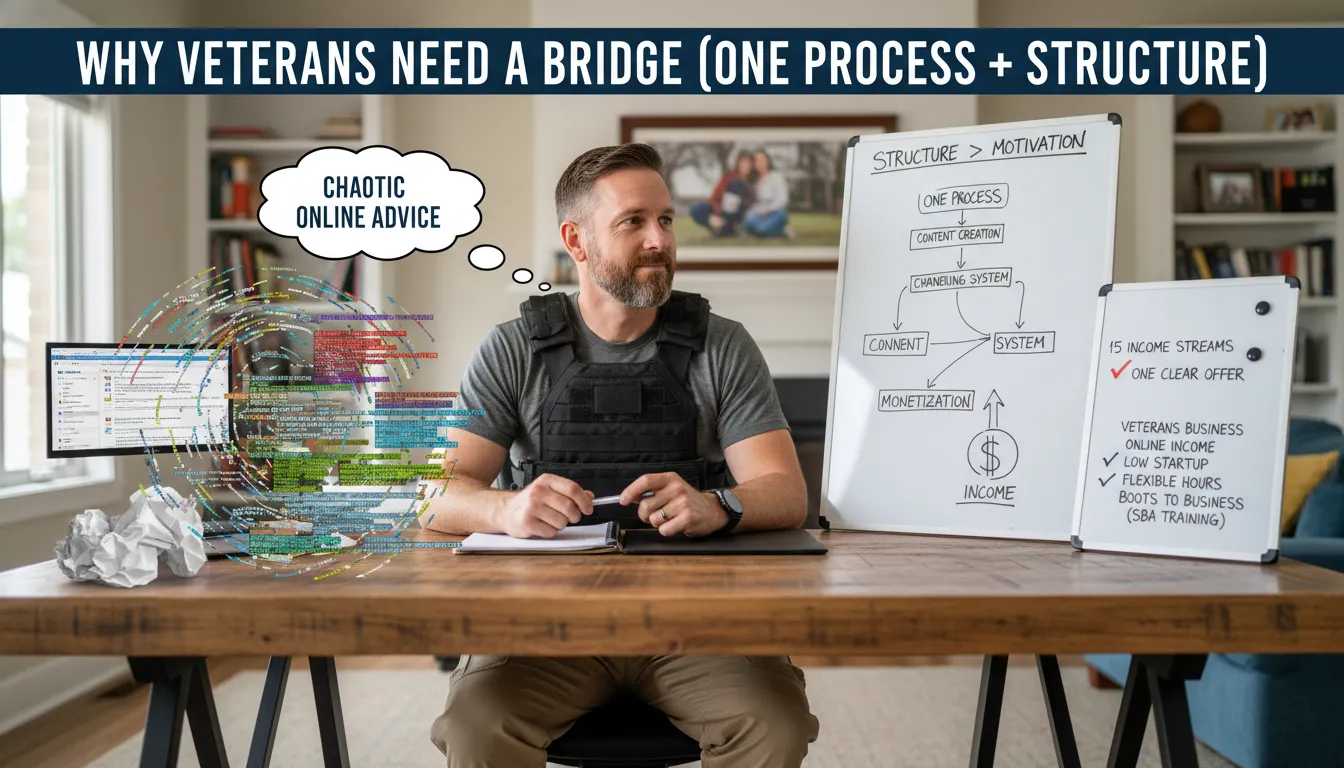
When I left the military I realized I hadn’t lost my discipline—I’d lost the structure that made discipline useful. Online business felt like a sandbox full of shiny tactics: reels, affiliate hacks, AI automations. I remember sitting at my kitchen table on 2026-02-12, notebook in front of me, scribbling one line: 'Build a bridge.' This post is that bridge—my attempt to hand you a repeatable, veteran-friendly process to turn random content into predictable income.
Why Veterans Need a Bridge (One Process + Structure)
On 2026-02-12, I wrote down the real shift I felt after service: I didn’t lose discipline. I lost structure. I traded morning formation for chaotic online advice—reels strategies, affiliate hacks, AI automations, and “15 income streams” all shouting at once. And I’ll be honest: after the military, I craved a playbook.
One Process Turns Effort Into Online Income
One Process is the bridge I wish I had: a single repeatable system that takes content and turns it into predictable Online Income. Not a dozen disconnected tactics. One lane, one direction, one outcome. That’s how a Veterans Business stops feeling like guesswork and starts feeling like a mission.
Jonathan Montoya: "Structure is the missing gear between effort and results for veteran founders."
Fewer Choices Win: One Clear Offer Beats 15 Streams
Most veterans I meet are building a Service-Based Business from home because it’s low cost to start and flexible with family life. But the internet pushes complexity. My first launch failed because I didn’t pick one core action. I had a call link, a freebie, two offers, and three “funnels.” People didn’t know what to do—so they did nothing.
Military Cadence Maps to Business Cadence
In the military, we didn’t “wing it.” We ran cadence: daily standards and weekly objectives. Business works the same way—daily sprints and weekly missions—so your content isn’t random, it’s assigned.
Message: what I want to be known for
Core Action: the one next step I want people to take
Story: a clear path from problem to payoff
Discipline: daily execution that compounds
12-Week Missions: weekly targets that create momentum
If you want extra structure, the SBA’s Boots to Business training is a solid starting point—because veterans don’t need more hype. We need a system we can run.
Step 1 — Define What You Want to Be Known For (Marketing Message)
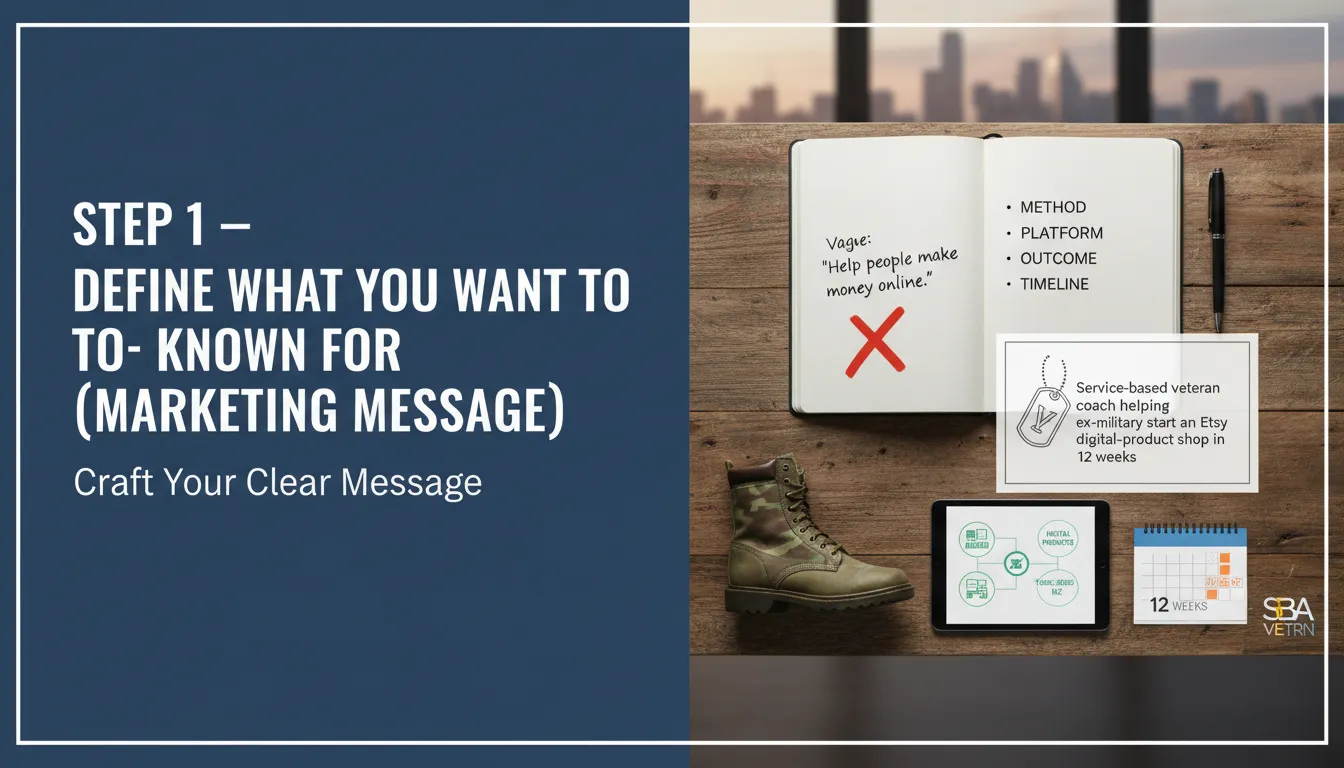
I can’t count the vague pitches I deleted: “I help people make money online.” That’s not a Marketing Message—it’s white noise. When I learned Your Marketing Message, it clicked: clarity isn’t branding fluff. It’s structure. And veterans respond to structure.
Training Coaching for a Service-Based Business: Use This 4-Part Template
If you’re building a Service-Based Business, your message needs four parts. Don’t over-polish it—ship a crisp version fast and improve it as you get feedback.
Part | Prompt |
|---|---|
Method | What system do you teach or do? |
Platform | Where does it happen (Etsy, LinkedIn, YouTube)? |
Outcome | What result do they get (sales, leads, first product)? |
Timeline | By when (7 days, 30 days, 12-Week Course)? |
Example persona: Service-based veteran coach helping ex-military start an Etsy Digital Products shop in 12 weeks. That’s specific. I can build content, offers, and calls-to-action around it.
Mini Exercise: One Sentence, Under 25 Words
Write yours now. Keep it under 25 words:
I help [who] use [method] on [platform] to achieve [outcome] in [timeline].
When I tightened my promise for a launch, opt-ins doubled—because people knew exactly what they were saying yes to.
Lisa Hernandez: “Clear promises make decision-making easy for your audience—veterans respond to clarity.”
Make It Discoverable (SEO + Bios)
Use your keywords in plain sight: put Marketing Message and Service-Based Business in headers, your bio, and your pinned post. Programs like Boots to Business and SBA training push business plans for a reason—clear positioning wins. If you’re using GI Bill or VR&E Program for retraining, anchor that training to one message and one outcome.
Step 2 — Build Around One Core Action (Content Creation + Conversion)
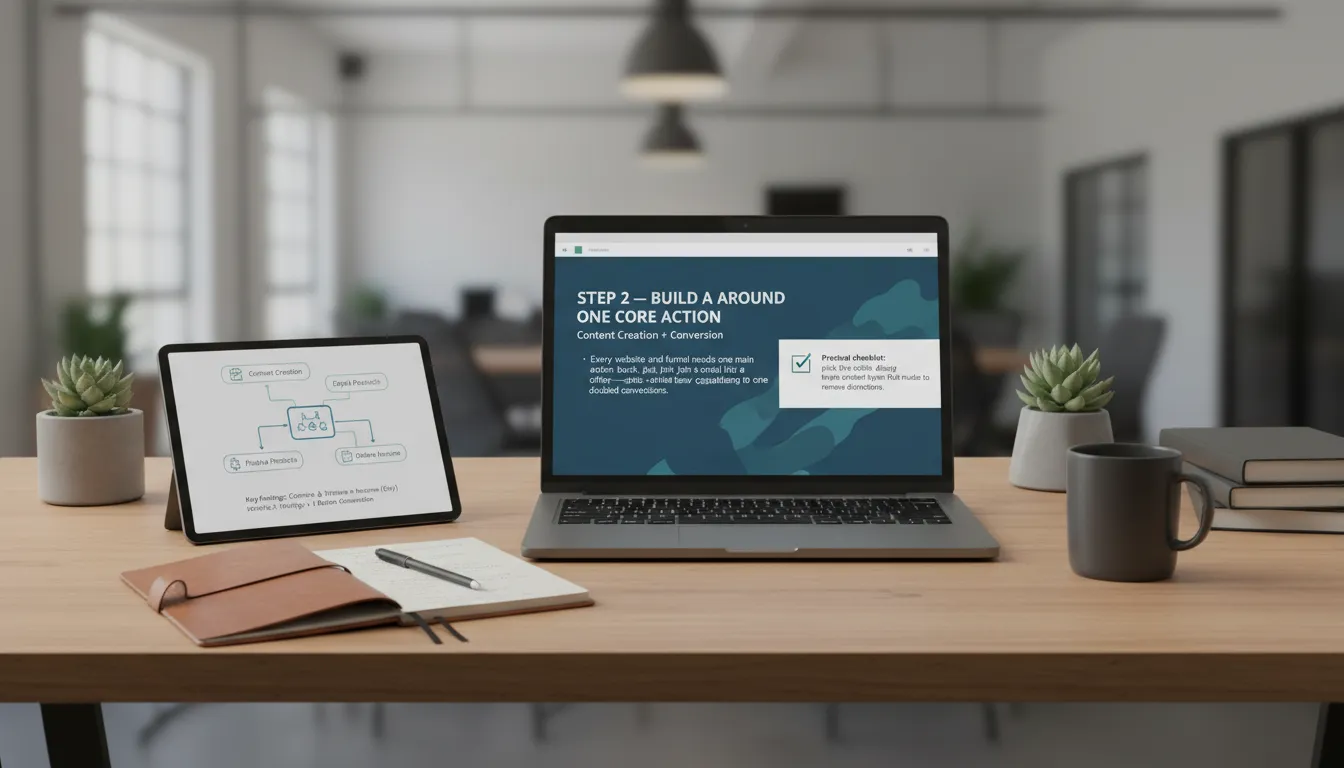
In the SEO Workbook, one line hit me like a drill sergeant: Every website needs ONE main action. Book a call. Join an email list. Buy one core product. Not five. One. When my funnel had three offers, three buttons, and three “next steps,” my audience froze. I thought I was giving options. I was creating friction.
I learned this the hard way. I was pushing coaching calls, an Etsy template pack, and an affiliate tool—all at once. My Content Creation was consistent, but my conversion was weak. The week I cut it down to one core action (email list for a digital-product prelaunch), my conversions nearly doubled. Same traffic. Clearer path.
Daniel Park: "Simplify your funnel: fewer options = higher conversion. It's basic human behavior."
Pick One Core Action (Then Let Everything Orbit It)
Email list for Digital Products prelaunch (best for future Passive Income)
Buy one paid course as the core product (simple Online Income engine)
Book a call if you sell coaching or services
Practical Checklist
Choose the action and remove extra buttons/links.
Create 3 content types that nudge to it:
SEO post targeting “Content Creation” + “Online Income”
Short story post with one lesson + one CTA
Proof post (results, screenshots, testimonials)
Run User Testing: ask 3 people, “What should I do next?” If they hesitate, simplify.
CTA Script (One Action Only)
If you want [outcome], click [single link] to [one action]. That’s the next step.
Affiliate Marketing can support the system, but it can’t be the system. I track one metric weekly: conversion rate to the single action, then adjust.
Step 3 — Use Storytelling That Sells (StepBack Framework)
In Content Creation, I used to tell “open-ended” stories. I’d share the struggle, the lesson, the emotion… then stop. People would nod, scroll, and never take action. No clicks. No calls. No Online Income. That’s when I started using The StepBack Storytelling Frame: Hook, Problem, Pivot, Process, Payoff.
Amanda Cole: "A story without payoff is like a mission with no objective—people tune out."
Hooks that work for veterans (and sell)
Battle-within metaphor: “The hardest fight after service wasn’t outside—it was building structure at home.”
Clear payoff promise: “Give me 60 seconds and I’ll show you the story that sold my first product.”
StepBack template for Training Coaching + Passive Income
Use this on reels, posts, emails, and sales pages—always pointing to your core action.
Hook (2 lines)
Problem (3 lines)
Pivot (1 sentence)
Process (4 steps)
Payoff (1 sentence)
Sample story: first $1k month
Hook: I was posting every day and still felt broke.
Problem: My message was scattered. My offer was unclear. My audience didn’t know what to do next.
Pivot: I stopped chasing “more content” and built one mission-focused story.
Process: 1) Picked one result I help with in Training Coaching. 2) Wrote one StepBack story. 3) Added one CTA to my email list. 4) Repurposed it into 5 short hooks across platforms.
Payoff: That story led to my first $1k month and a path toward Passive Income.
Practical tip: record yourself telling the story. If it doesn’t end with a clear payoff, rewrite it until the objective is obvious.
Step 4 — Install Daily Discipline (Daily Sprint Checklist)
Systems are built daily. That’s where my military training finally started paying off in business. Not in big “grind” weeks, but in small, repeatable actions that stack. Sporadic hustle feels heroic, but it doesn’t create predictable income. A Daily Sprint does.
My Daily Sprint Checklist (Not Randomly. Intentionally.)
I don’t post “when I feel like it.” I run a cadence—just like a unit runs a schedule. Every task points back to the one core action (book a call, join the list, or buy the core offer).
Reels: 1 short video tied to the core action
Conversations: 5–10 DMs/comments that lead to a next step
Value posts: 1 helpful post that teaches or clarifies
Threads: 1 simple thread that expands the same idea
Stories: 3–5 quick updates (proof, process, invite)
Rebecca Owens: "Ship something every day. Imperfection has momentum; perfection has paralysis."
Micro-Habits That Keep Me Moving
30-minute Content Creation sprint (one asset, one message)
15-minute engagement window (reply, invite, follow up)
Evening review: what shipped, what converted, what’s next
Digital Tools That Support Discipline
I use simple Digital Tools: a calendar block, a one-page tracker, and a habit buddy. The VETRN Program style of cadence—daily check-in, weekly review—keeps the mission tight. Think of it like Automating Savings: you don’t wait to “feel responsible,” you set the system so stability happens automatically. Same with content cadence.
Failure story: I skipped sprints for one week. My reach dipped, DMs slowed, and I felt like I was “starting over.” Nothing was broken—my structure was missing.
Step 5 — Think in 12-Week Missions (10K Fast Track Plan)
The 10K Fast Track plan taught me a hard truth: Revenue isn’t built in vibes. It’s built in structured weekly objectives—week by week, mission by mission. A 12-week mission beats a vague annual goal because it gives you a clear timeline, a clear target, and a clear scorecard. That’s why a 12-Week Course format works so well for veterans.
Why 12 weeks works for Online Income
I’ve seen the same cadence in veteran programs like VETRN (a 12-week online course with weekly structure) and support systems like the PenFed Foundation VEP, which helps veteran business growth with mentorship and funding. Structure creates momentum—and momentum creates Online Income.
Marcus Lee: "Treat content like a military op: clear objective, roles, timeline, and an after-action report."
Mission breakdown: objectives, milestones, review
Weekly objective: one outcome that supports your single core action (opt-in, call, or sale).
Measurable milestones: track simple KPIs: opt-ins, calls booked, sales per week.
End-of-mission review: run an after-action report and adjust the next mission.
My first 12-week mission (the shift to consistent revenue)
My first mission was simple: one offer, one landing page, one daily content rhythm. Each week I aimed for a small number of calls booked. By week 6, the numbers stopped being random. By week 12, I had repeatable results—and my first consistent revenue stream from a few focused Business Ideas instead of scattered posts.
Templates I use (copy and run)
Tool | What it tracks |
|---|---|
12-week mission planner | Objective, offer, weekly targets |
Weekly checklist | Posts, DMs, follow-ups, calls |
Mission retrospective | Wins, misses, next changes |
Weekly KPIs: opt-ins | calls booked | sales
Scale by running sequential missions—each one adds a predictable income layer, as long as every mission stays aligned to your single core action.
Funding and Programs for Veterans (SBA, SDVOSB, VR&E)
Funding Options that bring structure back
When I started building predictable income, I stopped chasing random tactics and started stacking real Funding Options. For many of us, that begins with SBA Loans (often through SBA-backed lenders), plus veteran-specific support like the PenFed Foundation Veteran Entrepreneur Program (VEP), which pairs mentorship with funding pathways. If you’re eligible, the VR&E Program can also cover career counseling, training, and even self-employment support for disabled veterans. Don’t overlook GI Bill opportunities for business training, either.
SDVOSB Certification: credibility + set-aside contracts
SDVOSB Certification isn’t just paperwork—it’s a door into government set-aside contracts and a credibility boost when you pitch. As Sarah Patel says:
“Certifications like SDVOSB change the game—suddenly you're competing in a different league.”
Where to start (VBOC + Boots to Business)
VBOC: free business advising and plan reviews.
Boots to Business: training that helps you choose a model and map costs.
Next steps: Boots to Business and Veterans Business Outreach Centers (VBOC).
Alternative capital: Peer Lending
If banks move slow, Peer Lending and P2P platforms can be another lane. Your veteran background can help—some lenders weigh service, stability, and consistent income history. Be patient: funding can take weeks to months.
My tactical ask: a one-page funding plan (12-week mission)
Amount needed + use (equipment, ads, payroll)
Primary source (SBA/VR&E) + backup (peer lending)
Timeline + documents checklist
Quick case study
A veteran I coached used PenFed Foundation VEP mentorship to tighten his offer, then secured an SBA loan to hire help and standardize delivery. Same service—now predictable weekly capacity and cleaner cash flow.
Scaling with AI and Passive Income (Digital Products & Automation)
Once I install the structure—one message, one offer, one core action—AI stops being noise and starts becoming leverage. Install the structure. Let AI scale it. That’s the bridge from random posting to Passive Income that doesn’t depend on my mood.
Ethan Cole: "AI is a force multiplier—use it to repeat the right moves, not to invent new ones for you."
AI Automation That Keeps My System Running
I use AI to repeat the right moves: draft, sort, and schedule—then I do a human edit pass so my voice stays real and veteran-focused.
Automated email sequences: welcome, value, offer, follow-up.
Repurpose content: one story becomes a Reel script, a thread, and an email.
Automating Savings analogy: like setting an automatic transfer, automation removes decision fatigue and keeps momentum.
Digital Products + Affiliate Marketing (Aligned to One Core Action)
Digital Products work best when they point to the same main action—join the list or buy the core offer. I keep it simple:
$27 templates (checklists, SOPs, swipe files) that can sell on Etsy
$97 mini-courses (one outcome, one weekend build)
$1/month micro-memberships (weekly prompts, accountability, Q&A)
Affiliate Marketing for the exact tools I already use (email, LMS, payments)
Quick Income Bridges While Products Build
While passive income is loading, I use quick bridges like user testing gigs and simple side hustles to fund the runway. I also look at peer-to-peer lending platforms that may consider veteran background beyond credit scores.
My Simple Workflow + Tech Stack
Create
StorySell
Automate
Monitor weekly KPIs
Email provider
Simple LMS
Payment processor
Automation rules
Caveat: AI scales what I systematize. If my foundation is shaky, automation multiplies mistakes.
Wild Cards: Analogies, Hypotheticals, and Quick Wins
On 2026-02-12, I’m back at my kitchen table thinking about why online income feels like noise. Then the military part of my brain kicks in: it’s not noise—it’s missing structure.
Analogy: Your Funnel Is a Convoy (Core Action + Content)
Think of your funnel like a convoy. One lead vehicle is your core action (book a call, join the list, buy one offer). Everything else is support: posts, emails, reels, and proof. If every vehicle tries to lead, the convoy breaks. If one leads, the rest can move fast and safe.
Hypothetical: Three 12-Week Missions = Stacked Income
Run a quick thought experiment: if you ran three 12-week missions this year, what would “stacked” look like? Mission 1 builds the message and offer. Mission 2 builds traffic and trust. Mission 3 builds scale. Here’s a tiny worksheet you can copy:
Mission #1: Offer = ____ | Weekly target = ____ | Income goal = ____Mission #2: Channel = ____ | Leads goal = ____ | Conversion goal = ____Mission #3: System = ____ | Automations = ____ | Profit goal = ____
And if Mission 1 misses? That’s normal. We iterate, not quit.
Nathan Brooks: "Small, repeatable missions win more than sporadic grand gestures."
Quick Wins (Side Hustles, Peer Lending, Business Ideas)
Write your message in 25 words so people can repeat it.
Pick one core action and point everything to it.
Ship one story with a clear payoff this week.
Need fast cash flow while you build? Side Hustles like user testing, surveys, and resale sites work well for military families. For extra options, explore Peer Lending carefully as part of smart Financial Planning, not as a gamble.
Surprising Tangent: Automating Savings = Automating Content
When I automate savings, I protect long-term stability over short-term spending. Content is the same: automate your cadence so your future income doesn’t depend on today’s mood.
Micro-Case: PenFed Mentorship to Etsy Course
I watched a veteran use PenFed mentorship to map one 12-week mission: a simple Etsy course, one email list, one weekly story with payoff. It wasn’t flashy. It was predictable.
If you want, book a no-pressure 15-minute troubleshooting call. Veteran to veteran: you don’t need motivation—you need a bridge, and we’ll find your next step together.
