
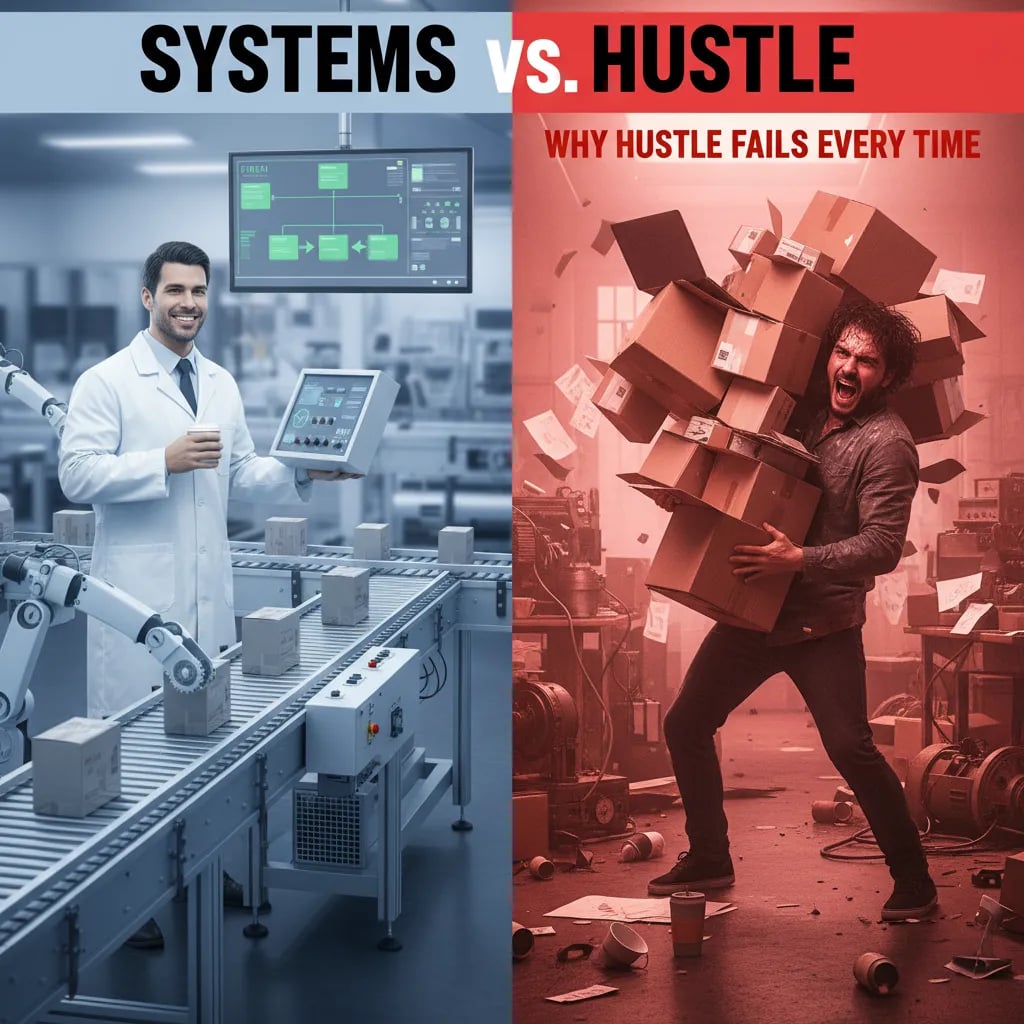


Last year I had this very glamorous moment: 6:12 a.m., laptop open, cold coffee next to me, and a sticky note that said “WORK HARDER.” I remember staring at it like it was a threat. I wasn’t lazy—I was fried. I’d been living on hustle culture fumes, thinking if I just pushed a little more, things would finally click. Instead, my output got noisier, my decisions got worse, and my “progress” looked suspiciously like running in place. That morning was the first time I asked the question that changed everything: what if the goal isn’t doing more… but needing to do less?
Hustle Mentality Kept Me in Survival Mode
For years, I wore my exhaustion like a badge of honor. Early mornings, late nights, and endless to-do lists—this was my version of “discipline.” Hustle culture told me that if I just worked harder, I’d eventually break through. But the truth? I was stuck in survival mode, not because I was lazy, but because I was exhausted. As the blog post from 2026-01-07 says, “Most people aren’t lazy. They’re exhausted.”
Hustle mentality disguises burnout as ambition. It’s a clever trick: you feel productive because you’re always busy, but you’re really just treading water. I remember a stretch where I’d wake up at 5am, crash after midnight, and still—month after month—my business results barely budged. No matter how much coffee I drank, I couldn’t out-hustle the fact that my business depended entirely on my energy. If I slowed down, everything slowed down. If I stopped, everything stopped.
Here’s the hidden cost of hustle culture: when you’re the engine, your business can’t scale beyond your own bandwidth. You can’t escape burnout if you’re always the bottleneck. Hustle is temporary; systems are permanent. Hustle depends on energy; systems depend on structure. I learned the hard way that discipline isn’t about how many hours you grind—it’s about building something that works even when you’re not grinding.
Let’s do a quick gut-check: If you took three days off—no email, no phone, no “just checking in”—what would actually break?
- Inbox: Would client messages pile up, unanswered?
- Fulfillment: Would orders or projects stall out?
- Sales follow-up: Would leads go cold because you weren’t there to chase them?
When I finally asked myself this, the answer was clear: everything would break. That’s when I realized I wasn’t building a business—I was building a pressure cooker. As Erin Cantwell says,
“Rhythm isn’t about doing less work—it’s about doing work in a way your life can actually hold.”To escape burnout and work smarter, I had to trade hustle mentality for systems that could run without me. Because hustle culture keeps you in survival mode, but systems let you scale and breathe.
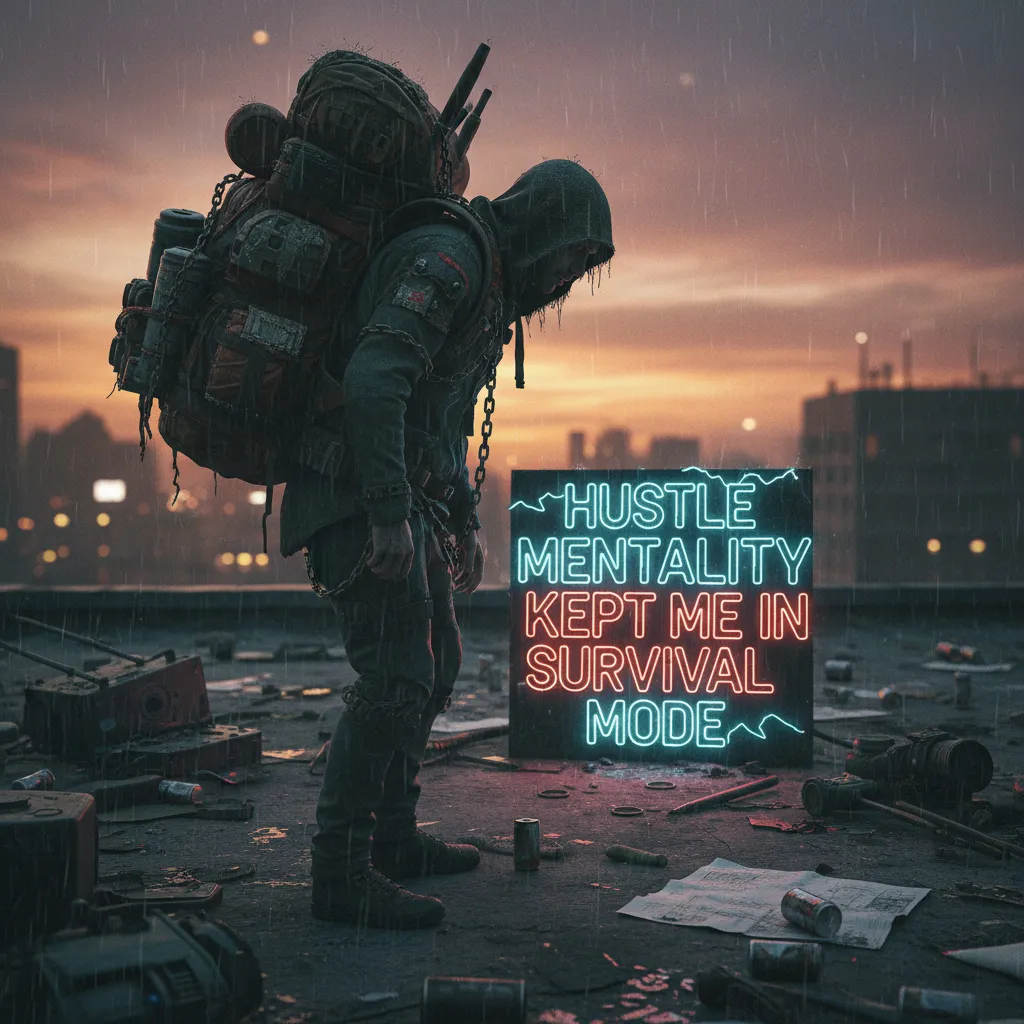
Systems vs Hustle: The Leverage Swap I Wish I’d Made Sooner
For years, I thought hustle was the secret sauce. Early mornings, late nights, endless to-do lists—I wore exhaustion like a badge. But here’s the trade nobody explains: when you hustle, you trade hours for progress. When you build systems, you trade strategy for leverage. It took me far too long to realize why hustle fails and business systems win every time.
Let’s break down Systems vs Hustle with a simple truth: hustle is loud, but leverage is quiet. Hustle depends on my energy, my mood, my motivation. But a system? It doesn’t care if I’m motivated. It doesn’t need coffee. It doesn’t take days off. That’s the leverage swap I wish I’d made sooner—because motivation is fickle, but structure is reliable.
James Clear said it best: “You do not rise to the level of your goals. You fall to the level of your systems.”
The Dishwasher Theory: Why Routines Beat Raw Effort
Here’s my wild card analogy: my ‘dishwasher theory.’ If a kitchen can run on routines—dishes in, soap in, button pressed, and out comes clean plates—why can’t a business? The dishwasher doesn’t care if you’re tired or inspired. It just runs. That’s what business systems do: they turn chaos into repeatable results, no matter how you feel.
Why Side Hustles Stall and Businesses Scale
- Hustle is energy-dependent. When you stop, progress stops.
- Business systems are structure-dependent. They keep working, even when you don’t.
- That’s why businesses scale and side hustles stall when they rely on constant effort.
A Small, Practical Reframe
I used to ask, “How can I work harder?” Now I ask, “How can this work without me?” That’s the shift from hustle to systems. Instead of pouring in more hours, I started building processes—automation, checklists, templates. I refined once, and let time do the rest.
In the Systems vs Hustle debate, the real win is leverage. Hustle is temporary. Systems are permanent. When you build business systems, you stop betting on your energy and start betting on your strategy. And that’s how you scale business without burning out.
Documented Processes: My Unsexy Shortcut to Repeatable Processes
I used to think that documenting processes was something only big, stiff corporations did. I pictured endless binders, boring meetings, and paperwork that killed creativity. But after years of hustling—answering the same client questions, re-explaining my onboarding steps, and scrambling to remember what came next—I realized something: documented processes aren’t about bureaucracy. They’re about freedom.
The turning point for me was client onboarding. I found myself typing out the same welcome email, outlining the same next steps, and chasing the same missing info. One day, it hit me: if I’ve done it twice, it deserves a checklist. That’s my golden rule now. Every time I repeat a task, I pause and document the process. It’s not glamorous, but it’s the bridge between chaos and scale.
I started small. I wrote down the exact steps for onboarding a new client: the intro email, the forms to send, the files to request, the timeline to share. Suddenly, I wasn’t just saving time—I was freeing up brain space. I could hand off the checklist to a VA or automate half the steps. And when a client asked, “What happens next?” I had a clear, repeatable answer.
Here’s what I learned about what to document first:
- Sales follow-up: Every lead gets the same sequence.
- Client management: Weekly check-ins, project updates, feedback loops.
- Content publishing: Draft, edit, schedule, promote—each step mapped out.
- Invoicing: How and when to bill, what info to include, reminders.
The magic of repeatable processes is that they don’t care if I’m tired, busy, or on vacation. They just work. As Atul Gawande put it,
“Checklists seem able to defend anyone, even the experienced, against failure in many more tasks than we realized.”
Documenting every business activity is the first step to building real systems. It’s how I stopped working in my business and started working on it. One process at a time—starting with the tasks I kept re-explaining—I built a foundation for growth. Turns out, freedom looks a lot like bullet points.
Automated Systems + Project Management: The “Work Without Me” Test
There’s a moment every business owner hits: the realization that hustle is a hamster wheel, not a highway. I remember staring at my to-do list, exhausted, and thinking, “How can this work without me?” That’s when I started building Automated Systems and rethinking my approach to Project Management.
Automated Workflows I’d Actually Recommend
Forget the flashy automations that promise the moon but add more noise. The real game-changers are simple, repeatable workflows that quietly remove friction:
- Reminders: Automatic nudges for deadlines or follow-ups so nothing slips through.
- Follow-ups: Scheduled emails or messages that check in with clients or teammates, so I don’t have to remember every detail.
- Invoice Nudges: Gentle, automated reminders for unpaid invoices—no more awkward “just checking in” emails.
These Automated Workflows don’t just save time—they reclaim mental space. They’re the backbone of my operational frameworks, letting me focus on strategy, not busywork.
Project Management That Doesn’t Become Another Job
I used to bounce between sticky notes, emails, and spreadsheets. It was chaos. Then I set up a single ClickUp board for all my tasks, due dates, and handoffs. Suddenly, my team and I had one home for everything. No more “where’s that file?” or “who’s got this?” moments. That one board cut my mental load in half—proof that the right Project Management tool isn’t another job, it’s a relief.
Decision Frameworks: My 2-Question Filter
Systems aren’t just about tech—they’re about choices. To avoid reinventing the wheel, I use a simple Decision Framework every day:
- Does this task need me, or can it be automated or delegated?
- Will doing this move the needle, or is it just noise?
Cal Newport said it best:
“Clarity about what matters provides clarity about what does not.”These questions keep me focused on what actually matters—and let the rest run on autopilot.
When you build Automated Systems—from reminders to invoice nudges—and anchor them in a solid Project Management tool like ClickUp, you stop trading hours for progress. You start building leverage, not just pressure. That’s the real “work without me” test. Funnels, automations, and decision frameworks aren’t just buzzwords—they’re the foundation of freedom from 24/7 hustle.
Rhythm Over Hustle: Business Rhythms, Defined Roles, and a Weekly Challenge
For years, I thought the answer to feeling stuck was to hustle harder. Early mornings, late nights, and endless to-do lists became my routine. But the truth hit me: hustle is a sprint, not a marathon. What I really needed was rhythm—steady, repeatable business rhythms that made my work sustainable and my business scalable.
Instead of daily punishment, I shifted to rhythms I could actually stick to: a weekly review every Friday to check progress and clear my mind, a monthly metrics check to see what’s working, and a quarterly reset to realign my goals. These business rhythms adapt as my operations grow, unlike the rigid routines I used to force on myself. They give me space to breathe, reflect, and improve, rather than just survive.
Another game-changer was defining roles—even when it was just me and a contractor. I used to let everything silently become “my problem.” Now, I’m clear about who owns what. Defined roles mean nothing falls through the cracks, and I’m not secretly resentful that I’m doing it all. Team leveraging started small: the first time I delegated a task, it felt oddly emotional, like letting someone else drive my car for the first time. But the relief was real. Suddenly, I had more time and energy for the work that truly mattered.
To make this shift practical, I started a simple Weekly Challenge: pick one recurring headache and systemize it in 30 minutes. It doesn’t have to be pretty—messy is fine. The point is to build once, refine once, and let time do the rest. Each small system I put in place frees me from the grind and moves my business closer to being truly sustainable.
David Allen said,
“You can do anything, but not everything.”That’s the heart of Rhythm Over Hustle. The goal isn’t doing more; it’s needing to do less. Every rhythm, every defined role, every small system is a step toward a business that works—without me having to hustle nonstop. If you’re ready for real freedom, start with one rhythm, one role, and one challenge this week. Let time—and your systems—do the rest.
