
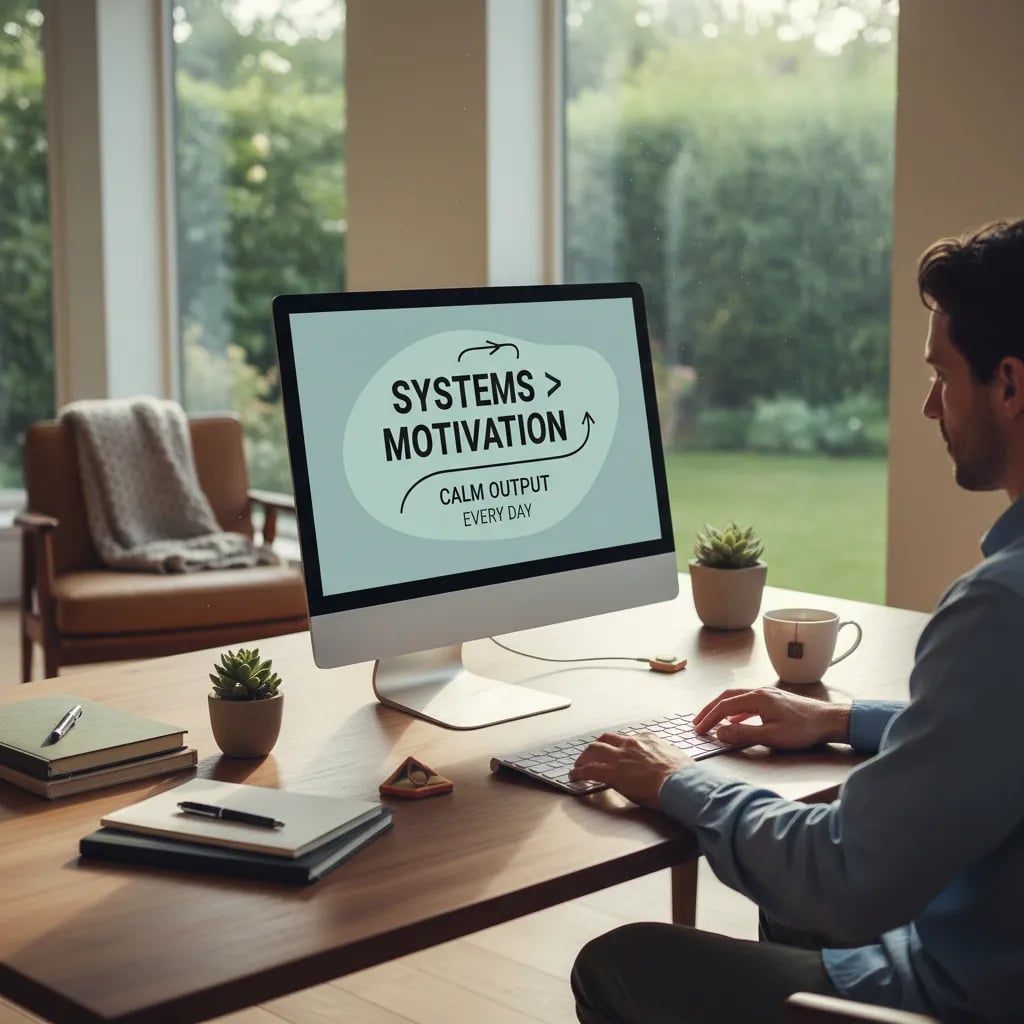



Last summer I tried to “get motivated” at 9:00 p.m. with a heroic cup of coffee and a playlist that made me feel like I could outrun my own procrastination. I wrote half a post, opened twelve tabs, then stared into the void of my inbox like it was a haunted house. The next morning, a boring little checklist I’d made weeks earlier saved the day: publish draft, schedule promo, send two follow-ups. No hype. No inspiration. Just…done. That’s when it clicked for me: motivation is a mood. A system is a lever.
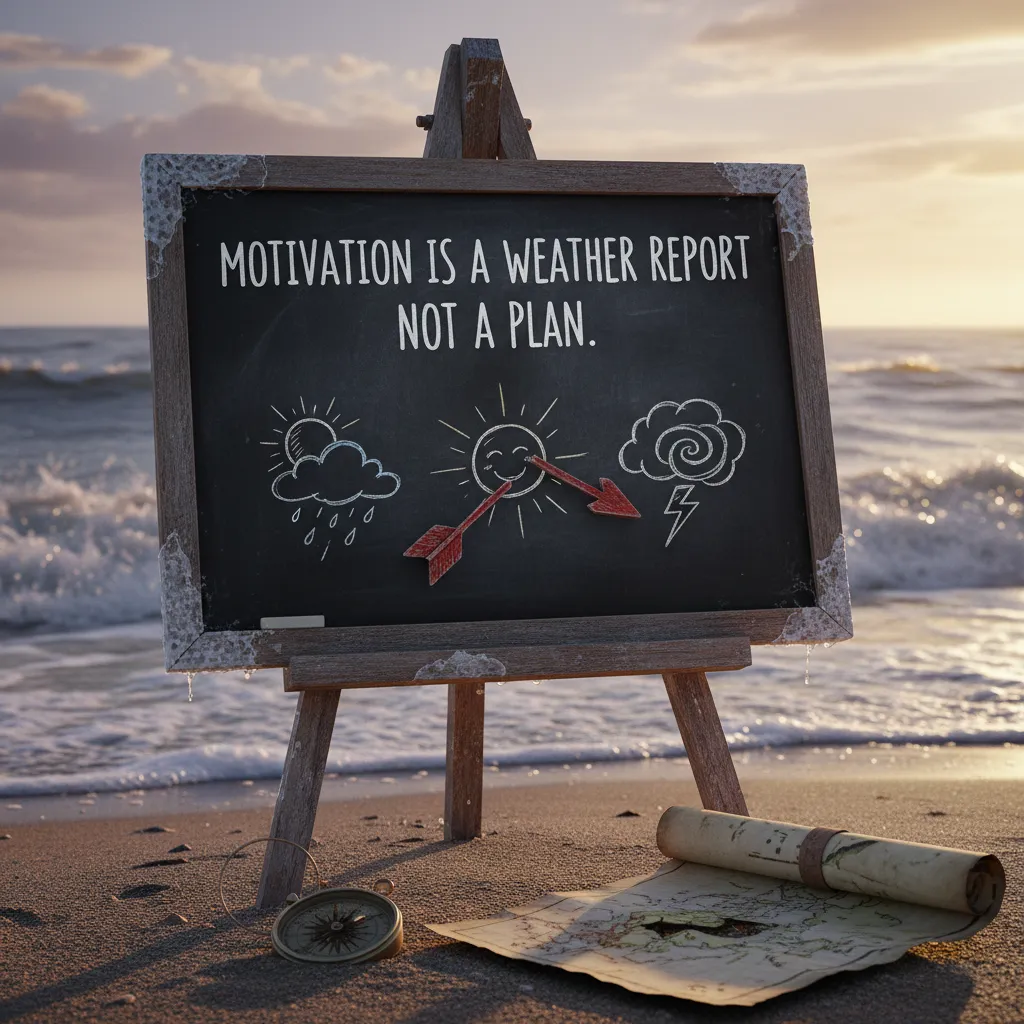
Motivation is a weather report, not a plan
My “high-motivation Monday” used to feel like a superpower. I’d wake up convinced I was about to change my life before lunch. I’d make big promises, open a fresh doc, and tell myself, this week is different.
Then came the pattern: late-night coffee, 27 tabs open, three half-started outlines, and one tiny finish line crossed—if any. Motivation felt powerful. It felt productive. It felt exciting. It was also unreliable.
Why my motivation swings (and why that’s not a moral failure)
I used to treat low motivation like a character flaw. Now I see it for what it is: a mix of sleep, stress, and circumstances. If I slept five hours, argued with someone, or got hit with a surprise bill, my “drive” didn’t disappear because I was lazy. It disappeared because I’m human.
That’s why I’m learning to choose systems over motivation. Motivation is a mood. A system is a path. One depends on how I feel. The other depends on what I do next.
A quick reset: use the forecast, don’t build your house out of it
Now I treat motivation like a weather report. If it’s sunny, great—I’ll batch work, write faster, and push a little extra. But I don’t build my house out of sunshine. When the weather turns, I still need walls.
Sunny days: I use the energy to set up templates, checklists, and schedules.
Rainy days: I follow the checklist and do the minimum that keeps momentum.
This is how you scale without burnout: you stop betting your output on hype. Over-optimization is what happens when you chase the perfect burst of effort instead of steady progress.
Text analyzers don’t guess—they measure word count and readability. That’s the mindset shift I want measure effort, don’t guess. And just like modern search moved from simple keyword density to semantic relevance with machine learning, work moves better with structure than brute-force willpower. That’s how you build better systems that keep compounding even when your mood dips.
“You do not rise to the level of your goals. You fall to the level of your systems.” — James Clear
The quiet power of a system (even when I’m tired)
Some days I wake up ready to work. Other days I feel like my brain is running on 12% battery. That’s when I remember the whole magic trick: a system runs whether I feel inspired or not. Motivation depends on sleep, stress, and circumstances. Systems don’t. My calendar is basically my babysitter.
Cal Newport: "Clarity about what matters provides clarity about what does not."
I used to treat my business like a keyword density checker treats a paragraph—stuff in more, push harder, add more goals. And just like over-optimized SEO, it backfired. Too many targets. Too much hustle. Now I simplify. I run a few “boring” systems that keep output calm and steady.
1) A content posting system that doesn’t care how I feel
I built a content posting system that makes publishing almost automatic. I don’t “decide” every day. I follow a checklist. A system posts content on schedule, even when I’m not in the mood.
One writing block
One editing pass
One upload step
That’s it. The goal is a consistent content schedule, not a perfect one.
2) Follow-up automation that protects my energy
When I relied on memory, leads slipped through the cracks. Now I use follow-up automation. A system follows up automatically. It sends the reminder, the check-in, the “still interested?” message—without me needing to feel confident or social that day.
That’s where effort compounds. One setup keeps working in the background.
3) Weekly review (my simple content analysis)
Once a week, I do a quick review. Not heavy SEO—just reflective content analysis: what got replies, what got ignored, what felt easy to repeat. I also map my workflow visually, like those frequency reports with visual maps. I’ll use a whiteboard or sticky notes to spot friction fast.
Wild card: could a stranger run this for 48 hours?
I test my systems with one question: If a stranger took over my business for 48 hours, could they follow my checklist and keep it alive? If the answer is no, my income is still tied to motivation—and burnout becomes predictable.

Veteran brain: why SOPs feel like oxygen
I like structure because it removes drama. When I was in uniform, we didn’t wake up and “feel motivated” into doing the basics. We had a way to do things, and we did them. That’s why SOPs feel like oxygen to my brain: they keep me steady when life gets loud.
An SOP is just a decision you don’t have to relive. It’s one less debate at 6:30 a.m. One less “what should I do first?” loop. For me, SOPs for creators aren’t rigid rules—they’re relief. They turn chaos into a simple next step.
Repeatable processes build trust (with yourself and clients)
When I follow repeatable processes, I stop negotiating with my mood. I show up the same way on a good day and a rough day. That consistency builds trust with me first: I become the kind of person who ships.
And clients feel it too. They don’t need my inspiration. They need my delivery. If your income depends on constant motivation, you burn out. If your income runs on systems, you scale calmly.
I’ve learned to “borrow proven routines” the same way competitor analysis shows what works for others: I look at what’s already proven, then tailor it to my life. Same with tools that support local SEO—location-specific long-tail keywords matter because context matters. My systems have to fit my time zone, my family schedule, my job demands. That’s how we build better systems that actually stick.
The weird comfort of checklists
Checklists feel like packing for a trip, but for your week. Socks? Charger? ID? Same energy: headline, draft, edit, schedule. It’s calming because it’s predictable.
Checklists establish a higher standard of baseline performance.
—Atul Gawande
A simple publish SOP (the “I ship on Fridays” key phrase)
Draft (one idea, one promise)
Edit (cut 20%, add one example)
Schedule (set it and walk away)
Repurpose (turn it into 3 short posts)
Follow-ups (reply, DM, or email from a template)
Non-veterans can borrow this mindset too. You don’t need a background in structure to benefit from it—you just need a few decisions you never have to make again.

Build once, improve slowly (my anti-burnout rule)
I learned this the hard way: if my income needs constant motivation, I’m renting my nervous system. Some days I’m sharp. Other days I’m tired, stressed, or distracted. Motivation changes with sleep and life. A systems-based income doesn’t. When the work is built into a repeatable process, I can scale without burnout because I’m not asking my mood to carry the business.
The rule I come back to is simple and almost boring: build once; improve slowly; let the system work. Veterans trust SOPs for a reason. A checklist doesn’t care how I feel. A calendar block doesn’t negotiate. An automation doesn’t forget.
David Allen: "You can do anything, but not everything."
The “one notch better” approach (not a whole new identity)
I used to overhaul everything at once: new tools, new routines, new goals. That always ended the same way—burnout and guilt. Now I do “one notch better.” I adjust one step per week. Not my whole identity.
It’s like how tools compute frequency and density automatically—you don’t rely on memory. I treat my work the same way: reminders and tracking are automated, so I don’t have to hold the plan in my head.
A tiny system starter kit (checklist + calendar + automation)
If I’m rebuilding from scratch, I start with three pieces:
One checklist: the exact steps I repeat (publish, reply, follow up).
One calendar block: a protected time slot that makes consistency normal.
One automation: follow-up automation can be as simple as a template email.
Concrete example: I keep a follow-up email template and schedule it the moment I send a proposal. No “I’ll remember later.”
Subject: Quick follow-up
Hey [Name] — circling back on [topic].
Do you want to move forward, or should I close the loop for now?
— [Me]
For content, I batch on Sundays. I draft two posts, outline three more, and schedule them. Search engines look at word frequency; audiences do something similar with their trust. Consistency signal's reliability. I track simple outputs—word count, response rate, and a consistency streak—just enough to see what’s working without turning my life into a dashboard.
Conclusion: I’ll take ‘boring’ over ‘burned out’
Motivation is a spark. It’s loud, bright, and fun to chase. But sparks don’t cook dinner. Systems are the stove. My job isn’t to feel inspired every day—it’s to keep the kitchen usable so I can make progress even when I’m tired, stressed, or distracted. That’s why I choose systems over motivation, even when it feels a little boring.
When I look back at my best weeks, they weren’t the weeks I “felt it.” They were the weeks my consistent content schedule ran like a quiet machine. Content went out. Messages got answered. Nothing heroic happened—and that’s the point. I didn’t need a mood to cooperate. I needed a process to show up.
“Consistency is the hallmark of the unremarkable who become remarkable.” — Seth Godin
The three systems that keep me steady are simple. First, the schedule: I decide what gets published and when, ahead of time, so I’m not negotiating with myself at the last minute. Second, follow-up: I set reminders and templates so leads and conversations don’t slip through the cracks. Third, review and SOP: I take a short look at what worked, write it down, and tighten the process so next week is easier than this one.
I also try not to over-optimize. Keyword stuffing is a good warning sign in writing, and it’s the same in life. If I overstuff my week with tasks, the system can’t breathe. I leave slack on purpose—space for real life, space for rest, space for the unexpected—so I can scale without burnout instead of sprinting into a wall.
Tonight is a good example. The work got done earlier, not because I pushed harder, but because the system carried the day. I closed my laptop, ate dinner, and took an evening off without that nagging feeling that I’m falling behind. Small steps stacked quietly while I lived my life.
Build once. Improve slowly. Let the system work. If you want more of this kind of thinking, subscribe for daily systems-focused strategies—and if you’re curious, follow the journey. I’ll be here, choosing boring on purpose.
