


I used to treat my first post like a checklist item: pick a niche, post content, rinse and repeat. Then I realized something obvious and uncomfortable — I was thinking like a civilian matrix had reprogrammed me to trade mission for side hustle. In 2019 I helped a platoon mate monetize a skill and watched him swap purpose for tactics. That flipped a switch: don’t build a gig, build an identity, a cause, a movement. This post is my map.
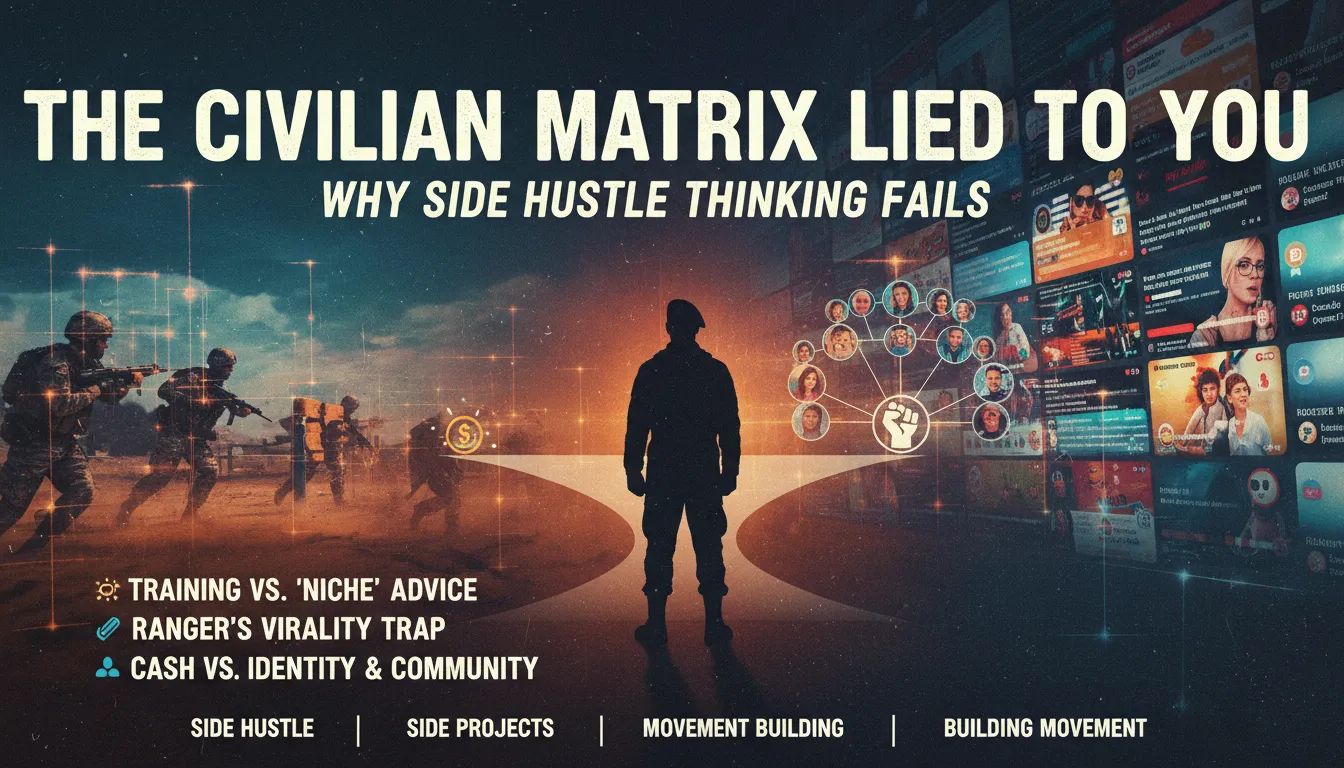
The Civilian Matrix Lied to You (Why Side Hustle Thinking Fails)
The Civilian Matrix Lied to You. I’m saying it like that on purpose, because the mainstream advice hits veterans like a bad joke. I was trained to execute missions—clear objective, clear team, clear standard. Then I got out and people told me to “pick a niche” and “start posting content.”
That’s like telling a Ranger to open a lemonade stand.
It’s not that a Side Hustle is evil. It’s that Side Hustle thinking is small thinking: small vision, small identity, small results. Most Side Projects are built for quick cash, not for who you’re becoming. And when you build for quick cash, you end up copying civilian content tactics that don’t fit your strengths—random trends, random hooks, random offers.
My Ranger-to-Creator Trap: Chasing Virality Instead of a Cause
Back in the original draft on 2026-02-23, I wrote this because I lived it. I watched a Ranger-turned-creator (and yeah, I’ve been that guy) get addicted to the algorithm. One week it was “3 AI tools you NEED.” Next week it was “day in the life.” The views spiked, then died. The comments were empty. The followers weren’t a team—they were tourists.
That’s the trap: you can go viral and still have nobody who believes what you believe.
Side Hustle vs. Movement Building: What You’re Really Creating
Here’s the consequence of Side Hustle thinking: you get short-term wins, but you don’t build long-term identity or community. You make money sometimes, but you don’t create trust always. And trust is what compounds.
Russell Brunson: “Every movement has three things: a leader, a new opportunity, and a future-based cause.”
That’s Movement Building. Not just content. Not just offers. Shared beliefs. A named cause. A future people want to step into together.
And for context, about 50% of Gen Z say they want to turn passions into businesses. Cool. But passion without a cause turns into scattered Side Projects. A movement turns passion into direction.
Nick Loper: “Side Hustle Nation shows how a blog and podcast can become full-time through affiliates and consistent value.”
Consistent value works—but it works best when it’s tied to a mission, not a trend.
Actionable Takeaway: Stop Chasing Trends, Start Naming the Fight
- Name who you serve (not “everyone,” not “people who like fitness”).
- Name the false belief keeping them stuck.
- Name the cause you’re building around—your version of Building Movement.
If you do that, you stop asking, “How do I make $1,000 this month?” and start asking, “What do we believe, and what are we building?” That’s when money stops being chased—and starts being attracted.
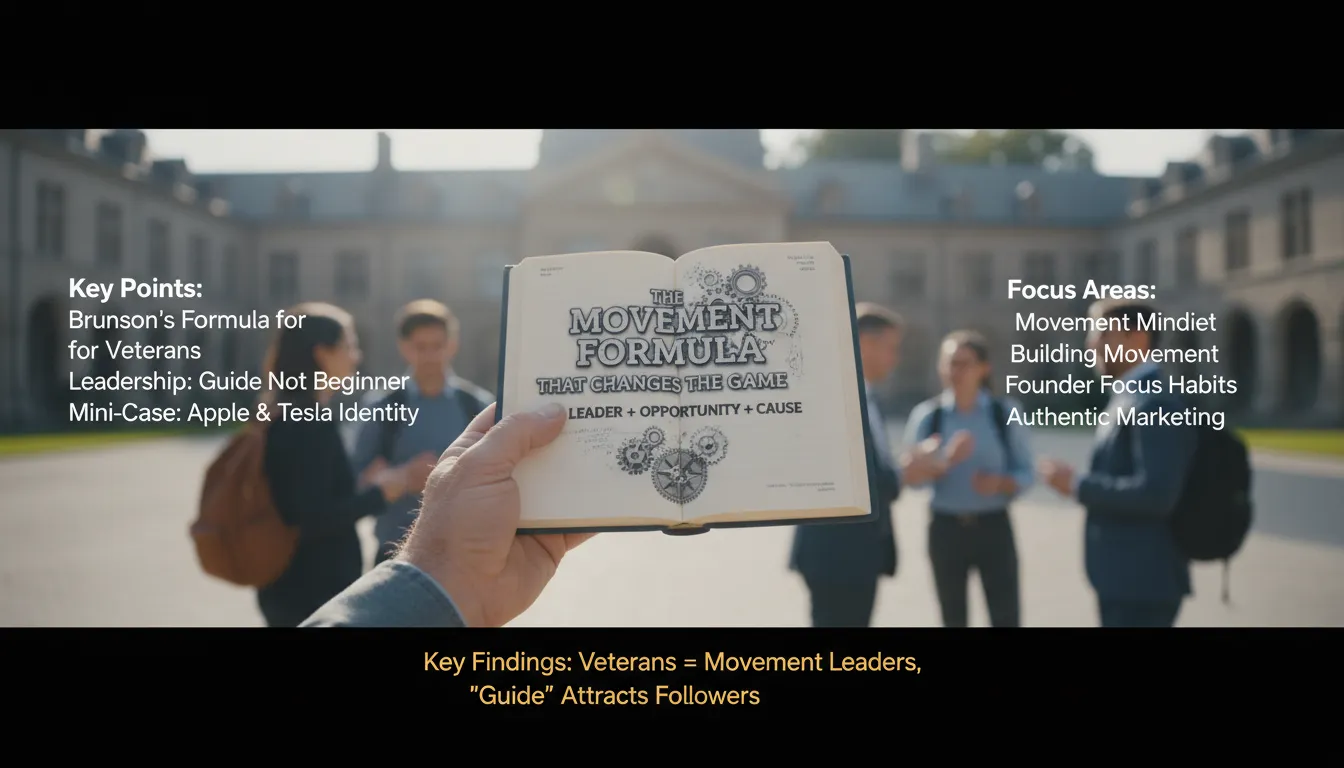
The Movement Formula That Changes the Game (Leader + Opportunity + Cause)
When I stopped thinking like a hustler and started thinking like a leader, everything got clearer. In Expert Secrets, Russell Brunson lays out the framework that separates random content from real Movement Building:
Russell Brunson: "Every movement has three things: a leader, a new opportunity, and a future-based cause."
1) The Leader: I Already Had It—I Just Didn’t Own It
As veterans, we don’t have to “learn leadership” from scratch. We’ve lived discipline, structure, pressure, and responsibility. Those traits map directly to movement leadership. The problem is how we position ourselves.
I used to show up online like a beginner asking for permission. Then I realized the shift is simple: I’m not a “new guy trying business.” I’m a guide with a proven operating system. That’s one of the most important Founder Focus Habits I’ve built—showing up with calm certainty, not noise.
2) The New Opportunity: The Door I’m Pointing People Through
A movement needs a clear “this is the way now” message. Not hype. Not trends. A new path that feels real and doable. This is where Authentic Marketing wins—because people can smell fake confidence, but they trust lived experience.
For veterans, the new opportunity often sounds like: “You don’t have to rely on a system that doesn’t care about you. You can build skills, systems, and income with structure—your structure.” That’s Movement Mindset: we’re not chasing quick cash; we’re building a new standard.
3) The Future-Based Cause: The Identity and Mission
This is the “why” that pulls people in and keeps them there. Identity-driven marketing outperforms product-led pitches because people don’t just buy tools—they buy who they become.
| Brand | What They Sell | What People Feel |
|---|---|---|
| Apple | Phones and laptops | Identity: creative, clean, modern |
| Tesla | Cars | Future: innovation, independence, progress |
That’s the lesson: if I’m teaching automation or online business, I’m not selling software or a course. I’m selling sovereignty. Control. Freedom. A future where veterans lead again.
Action Step: Write Your “New Opportunity” in One Sentence
Draft yours right now. Keep it simple. One line:
- Who you help
- What old belief you reject
- What new path you offer
I help [who] stop believing [old way] and start using [new opportunity] so they can [future-based result].
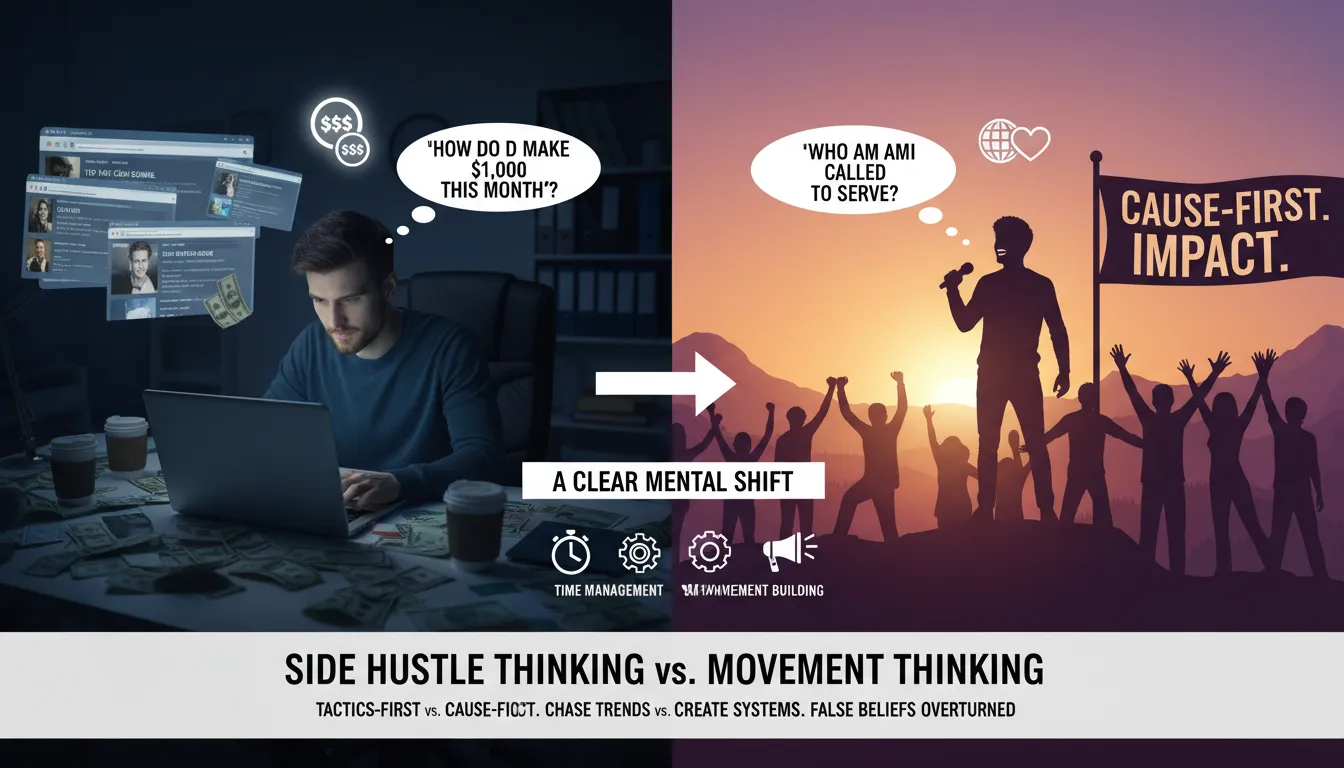
Side Hustle Thinking vs Movement Thinking (A Clear Mental Shift)
I used to think like Side Hustle Nation taught me: pick a niche, start a few Side Projects, post every day, and hope something hits. That mindset isn’t evil—it’s just small. It’s tactics-first. It asks the algorithm for permission. And it turns Time Management into a daily fight because you’re always chasing the next “viral” idea.
Side Hustle questions chase tactics. Movement Building questions create infrastructure.
Here’s the shift that changed everything for me: the questions you ask decide the offers you build, the content you post, and the people you attract.
- Side Hustle thinking sounds like: “How do I make $1,000 this month?”
- Side Hustle thinking sounds like: “What’s the fastest trend?”
- Side Hustle thinking sounds like: “How do I go viral?”
- Movement Building sounds like: “Who am I called to serve?”
- Movement Building sounds like: “What false belief is keeping them stuck?”
- Movement Building sounds like: “What system can I build that outlives me?”
Side hustle creators chase trends; movement builders create systems. One reacts. The other leads. One collects views. The other creates change.
Rewire your content: stop posting trends, start overturning false beliefs
If I’m stuck in Side Hustle mode, my content becomes random tips and recycled hacks. That’s not Authentic Marketing. It’s noise. But when I switch to movement mode, I start naming the lies my people believe—and I replace those lies with a clear path.
Instead of “3 AI tools you need,” I’ll say: “You don’t need more tools. You need a repeatable system.” That’s infrastructure. That’s leadership.
Measure what matters: transformation over vanity
Side hustles obsess over quick revenue and vanity metrics like likes and reach. Movements track long-term metrics: community retention, transformation rate, and milestones people actually hit. Cash flow matters—but it should be the result of impact, not the goal that drives every post.
Nick Loper: "Side projects often lead to full-time paths if you focus on consistent value rather than quick hacks."
Workshop prompt (10 minutes): 3 beliefs + 1 system
- List three limiting beliefs your audience holds.
- For each belief, write the truth you want them to adopt.
- Build one system that proves that truth: a weekly habit, a simple funnel, a cash-flow routine, or a marketing cadence.
Belief → Truth → System
That’s how I turn scattered Side Projects into real Movement Building—without losing my life to “content grind” and broken Time Management.
You Don’t Sell Tools — You Sell Transformation (Identity > Product)
When I first started writing offers, I sounded like a catalog: features, dashboards, templates, “AI does this in 3 clicks.” That’s product-focused copy. It’s also forgettable. Authentic Marketing starts when I stop selling the thing and start selling what the thing makes you become.
Apple doesn’t sell phones. They sell identity. Tesla doesn’t sell cars. They sell a future. That’s why people defend those brands like a tribe. Identity-driven offers create loyal communities because the buyer isn’t just purchasing—he’s joining.
Paraphrasing Tim Cook: “People don’t buy products; they buy into what the product says about them.”
Product Copy vs. Transformation Storytelling (The Shift)
Here’s the contrast I use when I write:
- Product-focused: “Get access to my AI prompts and automations.”
- Transformation-focused: “Build a system that gives you control over your income again.”
If I teach AI Automation for Veterans, I’m not selling software. I’m selling sovereignty—financial control, independence, and the ability to stop relying on a system that doesn’t care. That framing aligns with veteran values: freedom, responsibility, and mission.
Copy Swipe: Turn Features Into a Future-Based Cause
When I’m tempted to list features, I run them through this simple “cause filter.” Three lines you can steal:
It’s not [feature]. It’s [freedom].

It’s not [tool]. It’s [identity].

It’s not [automation]. It’s [a future you can defend].
Example:
- It’s not “Zapier workflows.” It’s “time back with your family.”
- It’s not “AI content.” It’s “a voice that leads.”
- It’s not “CRM setup.” It’s “a pipeline you can trust.”
The Transformation Transaction (Why People Pay More)
A Transformation Transaction happens when the buyer believes, “This changes who I am and what I can do.” Qualitatively, transformation sells better than features because it increases willingness to pay and willingness to refer. People don’t brag about buying tools. They brag about becoming the kind of person who wins.
Offer Design: A System That Proves the Change
I don’t want my offer to feel like “software access.” I want it to feel like a path. So I package it as a system that can outlive me:
- 1 Lead Magnet: a “Freedom Workflow” checklist that produces a small win in 30 minutes (not just a freebie).
- 1 low-ticket offer: a plug-and-play automation kit with a clear outcome: “book 3 calls in 14 days.”
- 1 coaching pathway: implementation + accountability so the identity shift sticks.
That’s how I sell transformation: I make the first step easy, the outcome obvious, and the mission bigger than the tool.
The Veteran Advantage & Founder Habits (Discipline, Structure, Belief)
In Veteran Entrepreneurship, I’ve noticed something civilians don’t see: we already have the raw materials to lead a movement. We were trained to execute when it’s boring, when it’s loud, and when nobody is clapping. That maps perfectly to movement leadership.
Three strengths that turn veterans into movement leaders
- Discipline: Civilians wait for motivation. I don’t. I run the reps even when the numbers are quiet.
- Structure: We lived checklists, timelines, and standards. That becomes systems, funnels, and follow-up.
- Leadership under pressure: When things break, we don’t spiral—we adapt, communicate, and move.
Most people online are trying to “look like experts.” Veterans can simply be consistent. And consistency is what builds trust—trust is what builds an army of supporters.
The real gap: belief and positioning
The main blocker isn’t skill. It’s belief that you’re qualified to lead. I had to flip this in myself. I stopped asking, “Who am I to teach?” and started asking, “Who gets hurt if I stay quiet?” When I watched other vets do the same, their content got clearer, their offers got stronger, and their confidence stopped depending on likes.
Russell Brunson: "Leadership in movements is about guiding people to a new opportunity, not showing off your tools."
Founder Focus Habits that keep the mission moving
Movements don’t run on hype. They run on Founder Focus Habits—simple rituals that protect your attention and your energy.
- Daily founder briefing (10 minutes): One objective, one offer, one message. I literally write:
Today’s mission: ____ - Cash Flow Baseline check (weekly): I track the minimum numbers that keep me stable—leads, calls, sales, and runway. That Cash Flow Baseline keeps me from making desperate decisions.
- Community touchpoints (3x/week): I post a win, a lesson, and a challenge. Movements are built in conversation, not broadcasts.
| System Component | Simple Tool | Purpose |
|---|---|---|
| Lead magnet | AI-assisted doc + PDF | Capture attention with a shared belief |
| Email funnel | 5-day welcome sequence | Turn interest into trust |
| Community platform | Circle/Skool/Discord | Turn trust into belonging |
Distributed Leadership: how movements actually scale
Here’s the insight most founders miss: Leadership in movements emerges from within and is distributed, not hierarchical. That’s Distributed Leadership. I’m not trying to be the hero—I’m building leaders inside the community.
30-day cohort experiment: build a shared-belief lead magnet
About 50% of Gen Z wants to turn passions into businesses. Veterans can guide them—and each other—by running a 30-day cohort where we build one “shared-belief” lead magnet together. Same mission, different stories. One message, many voices. That’s how you stop building a solo hustle and start building an army.
My Monday Assignment & How to Start (Practical, Imperfect Steps)
I call it my Monday Assignment because it forces me to stop “side hustle” thinking and step into Movement Building. Not someday. Not when the logo is perfect. Today. This is how I keep it Purpose Driven and grounded in real Community Building instead of chasing likes.
The Three Questions That Reframe Everything
These are the exact three questions I asked myself, and they’re still my compass:
Who am I called to serve? Not “everyone.” A real person with a real problem.
What do they believe that’s keeping them stuck? The false belief is the cage. Name it.
What system can I build to guide them? A simple path they can follow, even on hard weeks.
Answering these three questions flips the work from “How do I make money fast?” to “How do I create Social Change that lasts?” And here’s the truth: simple experiments validate demand and sharpen messaging faster than any course ever will.
Mini-Workshop: 20 Minutes, Then One Real Test
Set a timer for 20 minutes and draft rough answers. Keep it ugly. Keep it honest. I once rewrote my core offer three times in one week; that’s okay. Clarity shows up after you move.
Then do one pilot conversation with a veteran friend. Not a sales pitch. A real check-in. Tell them what you think your movement is, ask what hits, what feels off, and what they’d actually want help with. That one qualitative conversation will tighten your language fast.
Nick Loper: “Consistent small tests—like chats with peers—turned Side Hustle Nation into something bigger.”
Wild Card: Time-Travel to 2030
Close your eyes and imagine it’s 2030. Your movement is real. What changed for the people you serve? Are veterans using AI Automation for Veterans to control their income? Do they have structure again, a mission again, a tribe again? Write the outcome like it already happened. That future-based cause is what creates retention—because tools don’t hold people together. Identity does.
Optional Accelerant: AI-Powered Systems
AI can scale outreach and onboarding—simple follow-ups, intake forms, training sequences—but it’s not the heart. The heart is culture. The system supports the mission, not the other way around.
If you’re ready, join the journey. We’re building systems that attract veterans, not leads—and we’re doing it with purpose, discipline, and a movement that outlives us.
