
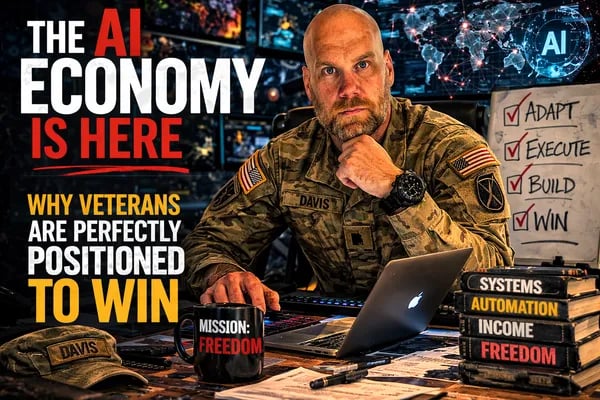

The AI economy is not just about chatbots or clever prompts; it’s an entirely new economic system arriving. Those who will lead this shift are the people who know how to design and run automated systems. Veterans stand out as uniquely positioned to dominate this new era—not because they are the best coders, but due to their discipline, system-building skills, and execution excellence.
We are witnessing the biggest economic shift since the Internet's rise in the 1990s. Back then, a new class of entrepreneurs emerged, building entire industries online. Today, AI enables individuals to automate tasks and run businesses that previously required whole teams—including marketing, customer support, content creation, and data analysis. This revolution is already underway, and those who master these systems now will lead the next wave of digital business.
The core insight is simple: success goes to those who can design systems. Veterans’ battlefield mindset—planning, executing, reviewing, and improving—translates powerfully to AI-powered business building.
The AI Economy: A Game Changer
We are witnessing the biggest economic shift since the Internet revolution of the early 1990s. Back then, the rise of the Internet spawned an entirely new class of entrepreneurs who built websites, online stores, and digital media companies, birthing industries that didn’t exist before. Today, artificial intelligence is driving a change that promises to be even more profound. Where the Internet connected people and information, AI empowers individuals to create tools that automate tasks and run businesses that once required entire teams.
This transformation is already tangible. Imagine a single entrepreneur operating what used to be a full marketing department, customer support team, content creation team, data analysis unit, and software development crew—all powered by AI tools. This is not theoretical hype; it’s already happening in real industries. Those who master running automated AI systems today position themselves at the forefront of the next digital economic wave.
The essence of this economic shift is that the winners won’t necessarily be the best coders or the most advanced technologists. Rather, success belongs to those who understand how to design, build, and systematically run automated systems. This is where veterans have a natural advantage. The military ingrains a mindset of planning, execution, after-action review, and iteration—skills directly transferable to designing AI-powered businesses.
In an AI-driven economy, battlefield objectives become market challenges, logistics translate to automated workflows, and continuous improvement cycles mirror after-action reviews. Veterans already think in terms of integrated systems and operational efficiency, giving them a strategic edge in adapting to this new environment.
This leads to a revolutionary concept: the rise of the one-person AI business model. AI tools allow entrepreneurs to launch and run businesses at scales previously impossible for individuals. For example, AI can generate targeted marketing content, handle customer queries through chatbots, automate email campaigns, analyze performance metrics, and even assist in coding simple applications—all without needing a traditional team.
This shift fundamentally changes the economics of entrepreneurship. Instead of hiring multiple specialists, one entrepreneur can leverage AI to create a scalable operation with reduced overhead. This not only lowers barriers to entry but also multiplies productivity, making it possible to operate more efficiently and creatively than ever before.
To illustrate the scope of this transformation, consider the scale of new businesses emerging from the AI economy compared to the Internet era. In the 1990s, approximately 500,000 new Internet-based businesses were launched. Today, the AI economy is enabling over 1.5 million new businesses—three times as many—reflecting its powerful influence across diverse sectors.
For practical context, here is a simple example of how AI can automate key business operations like marketing workflows. The following JavaScript snippet demonstrates an AI-powered system that retrieves potential leads, generates customized emails, and automatically sends campaigns. This kind of automation speeds up execution and improves reach without requiring large teams or extensive coding expertise.
Understanding this shift, it becomes clear that the AI economy is more than just a technological advancement—it is an entirely new economic system. Its potential to empower individuals, especially those with the discipline and operational mindset like veterans, positions it as a transformative force in the digital era.
I’ve read the material carefully, and I see a clear thesis: the AI economy is not just about chatbots or clever prompts; it’s the arrival of an entirely new economic system. I understand that the people who will lead this shift are those who know how to design and run automated systems, and the piece argues that veterans are uniquely positioned to dominate this new era. It isn’t about being the best coder or the most tech expert; it’s about discipline, system-building, and execution—qualities veterans tend to bring to the table.
I start with the premise that we’re witnessing the biggest economic shift since the Internet. In the early 1990s, the Internet gave rise to a class of entrepreneurs who built websites, online stores, and digital media companies, creating entire new industries as they went online. Today, AI is driving a shift that could be even larger: it enables individuals to create tools, automate tasks, and launch businesses that historically required entire teams. I note the practical implication: a single person can now run what would have previously required a marketing department, a customer support team, a content team, a data analyst, and sometimes even a software developer. This isn’t hype; it’s already happening, and those who learn to operate these systems now are positioning themselves at the front of the next wave of digital business.
The Role of Veterans in the New Economy
Veterans bring a distinct advantage to the AI-driven economy through their ingrained discipline and unmatched execution skills. Their military background fosters a mindset built on precision, planning, and relentless follow-through—traits essential for designing and managing complex automated systems. In the fast-moving AI landscape, where creating and running systems can define success, this disciplined approach becomes a powerful catalyst for innovation and business growth.
Beyond discipline, veterans possess profound system-building expertise. The military trains personnel to think in terms of interconnected components working seamlessly together under often chaotic circumstances. This systemic perspective aligns perfectly with the challenges of AI system design, where automation tools and processes must be integrated cohesively to deliver real value. Veterans are accustomed to iterative cycles of action, analysis, and adaptation, mirroring the process of building AI-powered ventures that continuously evolve based on market feedback.
The unique military mindset also emphasizes clarity of mission and priority setting, which translates into laser-focused efforts on solving market problems with AI. Instead of being overwhelmed by vast technological possibilities, veterans can apply battlefield-derived strategic thinking to simplify complexities, prioritize decisive actions, and execute solutions with speed and efficacy. This approach ensures that AI technologies are not used abstractly but are harnessed pragmatically to drive measurable business outcomes.
In practice, veterans excel at turning strategic insights into operational success. Their experience in managing logistics and coordinating people and assets equips them to oversee AI systems that require the orchestration of multiple automated functions. This capability places veterans ahead in the AI economy, where creating comprehensive, end-to-end solutions is critical.
For example, an automated task management script can be inspired by military logistics principles, where each task is precisely executed and reviewed to ensure completion and continuous improvement.
This snippet demonstrates disciplined task execution and review cycles mirrored from veteran training, showcasing how AI-driven systems can be managed efficiently. Veterans’ ability to translate their battlefield skills into AI system design makes them natural leaders in this emerging economy, commanding operations with precision and adaptability. Their mindset is a foundational asset, enabling them to lead the charge in creating the next generation of automated businesses that define the new economic era.

The One-Person AI Business Model
The AI economy today is reshaping entrepreneurship by empowering solo operators to launch and manage businesses that once demanded entire teams. This groundbreaking shift is centered on automating complex workflows using AI-driven tools. The emergence of the one-person AI business model means individuals can now orchestrate marketing, customer service, data analysis, and product development independently. This dramatic reduction in overhead and complexity opens the door for veterans and disciplined operators who excel at system design and execution to flourish in the new economy.
Veterans, in particular, are uniquely qualified to capitalize on this trend. Their experience in mission planning, execution, and iterative improvement mirrors the systematic approach necessary for running an AI-powered business. Instead of managing personnel, they focus on managing automated systems, continuously optimizing workflows and technology stacks. The mindset of translating mission objectives into clear operational plans translates directly into designing automated solutions that solve real market problems efficiently.
Automation Tools Driving Solo AI Businesses
Several leading platforms fuel this one-person revolution by enabling accessible automation and integration of AI. Zapier offers a user-friendly drag-and-drop system connecting over 5,000 apps, making it ideal for non-technical users. Make (formerly Integromat) caters to those requiring more complex automations with advanced scenario building and custom API integrations. For technically inclined entrepreneurs, n8n provides an open-source and highly customizable workflow environment, perfect for building unique, automated solutions.
These platforms allow solo operators to automate repetitive tasks such as lead generation, email campaigns, customer follow-ups, and data analysis with ease. They circumvent the need for a large team by combining AI tools with integration workflows, making it possible to run an entire marketing funnel or sales operation with minimal manual intervention.
Case studies of successful one-person AI businesses illustrate rapid scaling and increased efficiency through automation. For example, a veteran-founded company used AI to execute targeted marketing strategies, leveraging automated lead generation and personalized email sequences without hiring additional staff. This enabled them to grow prospects by thousands while maintaining tight operational control. Another solo entrepreneur implemented AI chatbots integrated with customer relationship management platforms, delivering instant responses and data tracking with zero human labor.
The key to this business model’s success is viewing AI as a toolset for system design rather than just coding or product development. Solo operators who excel at mapping workflows, designing feedback loops, and adapting AI capabilities can optimize their resources and scale up gracefully. By using platforms such as Zapier, Make, or n8n alongside natural language AI and data analytics tools, they turn complicated business functions into efficient, repeatable processes.
This approach has profound implications for veterans reentering the workforce or seeking entrepreneurship paths. Their ingrained discipline and experience with structured problem-solving equip them to implement and refine AI-driven systems that deliver real business outcomes. As the AI economy continues to expand, the one-person AI business model showcases a new frontier where agile system builders maintain competitive advantages against traditional multi-employee operations.

A Step-by-Step Pathway for Veterans
Veterans stepping into the AI economy have a distinct advantage: a mindset honed by discipline, structured problem-solving, and system thinking. To harness these strengths effectively, veterans can follow a clear pathway that moves from identifying authentic market problems through to deploying AI-powered automated systems. This methodical approach mirrors the military's operational planning cycle and delivers tangible business outcomes.
1. Identify Real-World Problems With Impact
Before diving into AI tools or automation, veterans should start by pinpointing real challenges that demand solutions. Unlike abstract technology experiments, these problems should be grounded in everyday inefficiencies or unmet needs that customers or organizations face. For example, slow customer service responses and repetitive inquiries are common pain points ripe for automation. Veterans can leverage their situational awareness to analyze workflows and identify bottlenecks, much like surveying a mission environment for threats and opportunities.
2. Map Out System Objectives and Requirements
Once the problem is defined, it’s critical to articulate clear objectives for the AI system to address. What outcomes will measure success? What constraints exist? Designing AI-driven systems demands careful planning of inputs, outputs, and user interactions—akin to mission planning. Veterans’ experience with after-action reviews and iterative improvement will prove invaluable here, helping them to refine problem scopes and align solutions with desired business goals.
3. Select the Right AI Tools and Platforms
The AI economy offers an expanding ecosystem of tools tailored to various tasks. Veterans should assess platforms like OpenAI for natural language processing, automation frameworks such as Zapier or Make, and cloud services offering AI APIs. The choice depends on project size, complexity, and technical expertise. Veterans don’t need to be expert coders; many tools provide low-code or no-code solutions that enable rapid prototyping and deployment of AI-powered automations.
4. Build Automated Systems with Precision
Implementing the system involves assembling AI components into workflows that consistently solve the problem. This phase draws direct parallels to orchestrating military operations—creating repeatable processes that integrate technology, data inputs, and human oversight. Whether building chatbots that handle FAQs, automating document processing, or monitoring data for anomalies, veterans’ system-driven mindset will drive disciplined execution.
5. Test, Monitor, and Iterate Relentlessly
Continuous improvement is native to military culture and essential for AI systems. After launch, vets should rigorously test system performance, collect user feedback, and analyze data to identify gaps. Iteration cycles boost efficiency and user satisfaction while adapting to changing conditions. This feedback loop is a battlefield-tested strategy repurposed for business agility in the AI era.
Example Workflow: Automating Customer Support Queries
To illustrate this pathway in action, consider a veteran building an AI-powered customer support chatbot. Starting with the problem statement—customers need fast answers without delays—the veteran selects OpenAI’s GPT API to handle natural language queries. Then, by designing a chatbot system, they automate responses to common questions like password resets or refund policies. Testing multiple queries ensures the solution meets real-world demands and provides a foundation for ongoing improvements.
This approach is not just theoretical. It’s a practical, executable blueprint veterans can follow to harness their unique skills and lead the charge in AI economy ventures. By thinking like commanders planning missions and acting as system architects, veterans can build sustainable AI-driven enterprises that scale rapidly and serve real market needs.
Sample Code: Building an AI-Powered Automated Customer Support System
Veterans' Strategic Advantages in AI
Veterans possess distinct strategic advantages that align perfectly with the demands of AI system design and leadership. Their military background instills discipline and a mission-focused mindset, essential traits for navigating the complexities of AI-driven economies. Unlike purely technical roles, AI system leadership requires holistic thinking—veterans excel at understanding integrated systems and their real-world applications.
At the core of military training is operational thinking, which translates directly to AI system architecture. Veterans approach AI projects with goals resembling mission objectives—they break down challenges into manageable components, build systems with clear roles, and continuously iterate based on outcomes. This approach ensures robust, adaptable AI systems that meet evolving business needs.
The discipline ingrained during service means veterans excel at rigorous planning and execution cycles. Military after-action reviews inspire an AI development process grounded in constant feedback and refinement. This iterative method improves AI models beyond initial deployment, optimizing performance in fluid environments—a crucial advantage in fast-changing markets.
Furthermore, veterans' mastery of integrated systems thinking enables them to see beyond isolated algorithms. They naturally assess how AI components interact within broader operational frameworks. This skill is vital for developing end-to-end AI solutions that combine natural language processing, automation, data analytics, and user experience into cohesive systems that function seamlessly in real-world applications.
For example, a veteran-led team can effectively coordinate AI-powered customer engagement platforms. By treating modules like NLP sentiment analysis and campaign automation as interlinked units designed to achieve strategic goals, they build smarter, more efficient solutions that drive measurable impact.
Veterans also bring resilience to AI leadership roles. Their ability to adapt under pressure and reorient strategies in response to real-time feedback is a competitive edge in the AI economy. This adaptability, combined with a proven systems mindset, uniquely positions veterans to lead the next generation of AI-powered enterprises.
Capitalizing on Current Opportunities
We stand at a rare inflection point where the AI economy offers an open opportunity window. This moment is reminiscent of the early Internet era but on a vastly larger scale. Many still underestimate AI’s transformative potential, mistakenly viewing it as just another tech trend or a resource for isolated tasks. The truth is, AI is reshaping entire business models, enabling individuals—especially those versed in systems thinking—to operate at a scale once reserved for large teams.
Veterans, in particular, possess a strategic advantage. Their experience in mission planning, execution, and iterative improvement aligns perfectly with designing and managing AI-powered systems. This mindset shifts the focus from merely coding to architecting systems that solve real-world problems efficiently.
Positions of influence and leadership in this new economy will reward those who understand automation workflows and integration of AI tools like OpenAI’s APIs, Hugging Face models, or RPA platforms such as UiPath. Mastering these technologies—or better yet, combining them with field-tested operational discipline—creates a powerful competitive edge.
The opportunity is now. By proactively integrating AI systems in areas like customer engagement, logistics, or data analysis, veterans can position themselves not just as users but as leaders driving the AI economy’s future. The early adopters who harness AI’s systemic capabilities will outpace competitors and redefine what’s possible with digital entrepreneurship.
Frequently Asked Questions
The AI economy is an emerging system built on artificial intelligence technologies, transforming how businesses operate and scale. This system leverages AI for automation, innovation, and efficiency to create new markets and opportunities beyond traditional models.
Veterans are uniquely suited to lead in this AI economy even without coding skills. Their military experience instills discipline, systemic planning, and execution abilities critical for designing and managing AI-driven businesses. By harnessing no-code tools like Zapier, OpenAI platforms, or Microsoft Power Automate, veterans can build automated solutions that run complex operations single-handedly.
Common AI business models veterans can pursue include services like automated content generation, AI-powered customer support, targeted marketing automation, and data analytics consulting. These models enable them to launch remote consulting businesses, develop software-as-a-service (SaaS) products, or offer virtual assistance solutions tailored to various industries.
What exactly is the AI economy? ▼
Can veterans start AI businesses without coding skills? ▼
What are common AI business models veterans can pursue? ▼
Conclusion
The AI economy marks the arrival of an entirely new economic system—one where system design and automation shape the future. Veterans possess unique advantages with their discipline, mission focus, and operational thinking, making them ideally suited to lead this transformation. It’s not about being the top coder but about building, executing, and iterating systems effectively.
One-person AI businesses today can replace entire departments, creating scalable opportunities for entrepreneurs who master these tools. As early adopters in this field, veterans have a window to harness these capabilities and establish leadership in the digital economy, much like Internet pioneers did in the 1990s.
This is a call to action: embrace AI as a mission to design automated systems that solve real problems, creating financial independence and impact. The AI economy is here, and veterans stand ready to define it.
🎯 Key Takeaways
- → The AI economy is more than tools; it’s a new economic system led by system designers.
- → Veterans’ discipline, operational thinking, and mission focus uniquely position them to succeed.
- → One-person AI businesses can now replace entire teams, creating huge opportunities.
- → The time to learn and build AI-powered systems is now—early adopters lead the next wave.
- → Veterans bring battlefield-level system-building skills to AI entrepreneurship for lasting impact.
